Get Full Government Meeting Transcripts, Videos, & Alerts Forever!
Get email alerts on the Evidence Admissibility topic
No spam. Unsubscribe anytime.
Utah Supreme Court weighs admissibility of prior sexual‑conduct evidence in State v. Blackwing
Summary
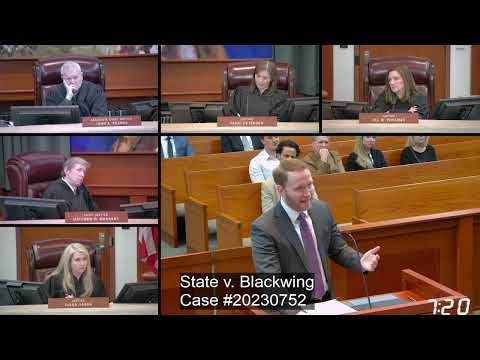
SALT LAKE CITY — The Utah Supreme Court heard oral argument in State v. Blackwing over whether a district court improperly excluded most evidence the state says is necessary to explain why three women would agree to plot the murder of a teenager and her family.
SALT LAKE CITY — The Utah Supreme Court heard oral argument in State v. Blackwing over whether a district court improperly excluded most evidence the state says is necessary to explain why three women would agree to plot the murder of a teenager and her family.
At issue is whether material from three categories of prior conduct — the prosecution and underlying facts involving a woman identified in the record as Tina, the facts surrounding the alleged sexual assault of a teenager identified as Catherine, and background showing the defendant’s control over other household members (Raven and Teresa) — are intrinsic to the charged offenses or instead are inadmissible "other‑acts" evidence requiring Rule 404(b)/403 scrutiny.
The state, represented by Christopher Bates, told the justices the excluded evidence is "integral, essential" to its narrative and necessary to explain motive and how the defendant "drew [the women] into his web" and exerted control. "The story of their relationship and the story of why Mr. Blackwing wanted the teenage girl and her family killed are integral essential aspects of the state's case," Bates said. He argued that the excluded material is highly probative of why the women would agree to commit a violent offense the state describes as "one of the most heinous offenses imaginable."
Defense counsel Trevor Lee countered that the notices the state filed were extraordinarily broad and that the district court appropriately limited the details the state may present. Lee said the district court permitted general evidence that the defendant was controlling while excluding more inflammatory specifics. "The notice was extraordinarily broad. We're introducing these entire cases," Lee told the court, saying the district court had to try to parse what, if anything, from those filings could be admitted.
Why it matters: The scope of admissible background evidence will shape how the state tells its case at trial, what jurors learn about alleged coercion or grooming, and how the defense can respond. The court’s decision will also clarify how Utah applies Rules 404(b) and 403 — and how far the "intrinsic" or "inextricably intertwined" exception extends in conspiracy and solicitation prosecutions.
Key factual and procedural points discussed at argument
- Charges: The state has charged Kane Blackwing with conspiracy, solicitation and attempted aggravated murder tied to an alleged plot to kill a teenage girl and her family to prevent testimony. (Discussed by Bates.)
- Three evidence "buckets": The parties and the court repeatedly referred to (1) evidence related to Tina (including alleged sexual assaults and a later conviction in that matter), (2) the facts surrounding Catherine’s alleged assault (the state described Catherine as a niece who attended a birthday at the defendant’s home and was later forced to sleep in his room), and (3) conduct by Raven and Teresa and other background showing the defendant’s household control dynamics.
- Form of the evidence: Bates said the state would use a cooperating witness (Tina) and recordings from the defendant’s jail calls — the parties referenced "11 weeks worth of jail recordings" — to show he instructed or directed others and that the women acted under his influence. Bates said the state could rely on the underlying facts even if the actual prior conviction were excluded as more prejudicial than probative.
- Timing/chronology: Counsel discussed the timeline: the plot against Catherine was hatched in July 2014; Tina’s alleged assaults occurred in March 2014; the record shows the defendant was charged in Tina’s matter in July 2015. Bates said the timeline is relevant to motive and to show why Catherine was a central witness. Bates also told the court that in the proceedings below the defendant later pleaded to forcible sexual abuse in Catherine’s matter.
- Evidentiary law debate: The justices and counsel discussed whether Utah’s Rule 404(b) should be read like the federal rule or whether the language permits a broader intrinsic‑evidence inquiry. Counsel cited Old Chief, Verde, Thornton and Green in discussing how courts draw lines between necessary narrative evidence and improperly prejudicial "other acts." The state argued that much of what the district court excluded is intrinsic to the charged offense, while the defense emphasized 403 balancing and the risk of unfair prejudice from detailed sexual‑conduct evidence or conviction evidence.
- Practical management at trial: Several justices suggested that if the court remands, the district court could rule at trial on particular proffers — for example, allowing narrative background while excluding the most inflammatory specifics unless the state shows a trial‑level need. Bates acknowledged courts could parse admissibility at trial and that the state could tell much of the narrative through underlying facts without necessarily introducing the fact of a prior conviction.
What the court did: At the end of argument the bench took the case under advisement and did not announce a dispositive ruling from the bench.
Context and next steps: The case centers on how far a prosecutor may go in presenting background conduct when trying to explain motive and control in a conspiracy or solicitation case. The justices’ questions show attention both to the parties’ preservation of issues below and to doctrinal line‑drawing that will affect trial practice in Utah. The court will issue an opinion setting the scope for admissibility or remand the matter for further proceedings at the district court level.
Quotes used in this article are taken from oral argument and attributed to counsel who made them.