Get Full Government Meeting Transcripts, Videos, & Alerts Forever!
Get email alerts on the Energy Policy topic
No spam. Unsubscribe anytime.
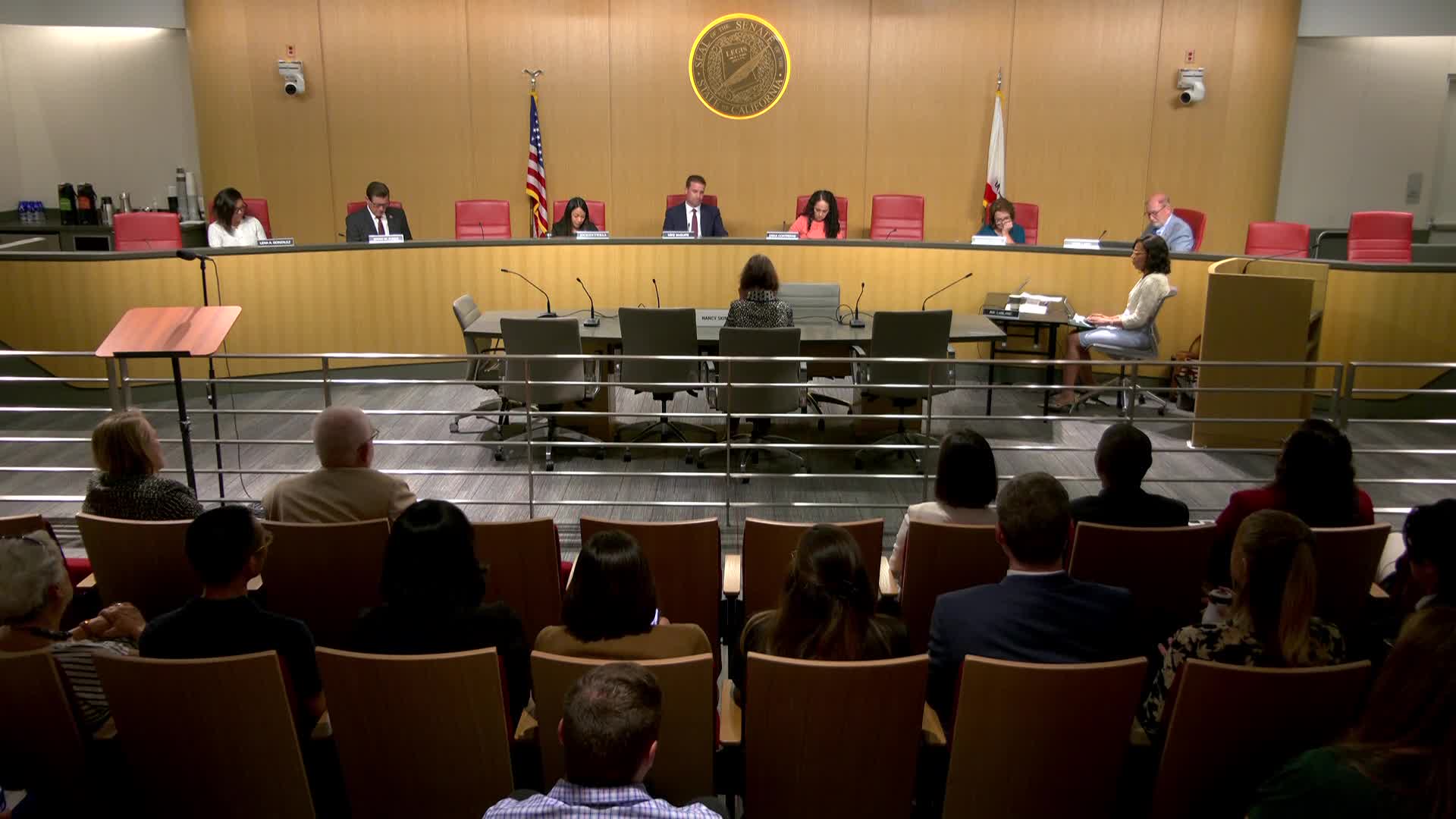
Senate Rules Committee approves Nancy Skinner for California Energy Commission on 3-1 vote
Summary
The Senate Rules Committee voted 3-1 on May 14 to confirm Nancy Skinner as a commissioner of the California Energy Commission, advancing the nominee to the full California State Senate.
The Senate Rules Committee voted 3-1 on May 14 to confirm Nancy Skinner as a commissioner of the California Energy Commission, advancing the nominee to the full California State Senate.
Skinner, a former state legislator, told the committee she views her role at the commission as “implementing your legislative and budget directions,” and outlined priorities including support for California’s transition to zero‑emission vehicles, building and industrial decarbonization, appliance and building efficiency, and the commission’s work with ports. She said the commission’s work should be accessible and that reports and grant solicitations should be written for non‑experts.
Why it matters: Skinner will be assigned a broad portfolio at the commission that touches affordability, grid planning and programs for electrification. Committee members pressed her on near‑term supply concerns for refined fuels, how the commission would use tools in the Petroleum Market Oversight framework, and safety and permitting for battery storage — areas that affect consumer costs, local jobs and public safety.
Discussion and committee questions
Senator Grove, who represents an oil‑producing Central Valley district, questioned Skinner about the impact of state policy on local oil jobs and refineries and disputed a prior Skinner comment that oil companies had been “price gouging.” Grove said California producers cannot set global crude prices and warned that reduced permitting has accelerated loss of local oil industry jobs. Grove asked whether the commission has authority to force local governments to allow more refinery storage; Skinner said a bill she co‑authored expanded some commission tools but that the commission has not used those tools and remains in a data‑collection and analysis phase to determine whether action is warranted.
Skinner told the committee the bill Grove cited (her original statute establishing petroleum market oversight and a later permissive follow‑up) created a data collection and analysis role for state agencies to identify whether consumer protections are needed. “So far, the Commission has not acted on any of those tools yet,” she said.
Committee members also pressed Skinner on refinery capacity and transition timelines. Skinner said California still needs refined product while the state transitions to electric vehicles and that the commission seeks the “least disruption” in that transition.
Grid reliability, storage and safety
Senator Laird and other members focused on grid reliability and battery storage safety. Skinner credited recent investments including the strategic reliability reserve and increased battery energy storage for helping the state meet high‑demand days; she noted that Sept. 2023 was the state’s highest‑demand day and the system held without outages. She said many recent projects combine new renewable generation with storage and cited the Darden solar‑plus‑battery project in Fresno County as an early example to come before the commission under the AB 205 opt‑in permitting law.
On battery safety, Skinner said the Moss Landing battery fire involved a facility that had been permitted only at the local level and predated statewide safety standards. She said the California Public Utilities Commission has adopted upgraded safety orders and that the CEC has incorporated strengthened standards into its review and funding. Skinner said the state funds research (through programs such as EPIC) into long‑duration storage technologies that are not lithium‑ion and could reduce fire risks.
Federal funding and EV infrastructure
Skinner said federal action has also affected California’s plans: she described the National Electric Vehicle Infrastructure (NEVI) program funds as paused by the federal administration and noted that California’s AG has joined other states in litigation over that freeze. She said the CEC still administers the Clean Transportation Program (CTP), which provides roughly $100 million a year in special‑fund dollars for transportation electrification and for medium‑ and heavy‑duty vehicles and infrastructure, including port electrification.
On local permitting for chargers, Skinner said local governments sometimes lack zoning rules for EV charging and that GO‑Biz has been directed to examine local permitting barriers; she also noted an AG bulletin encouraging jurisdictions to speed approvals.
Committee vote and next steps
The committee roll call recorded Senators McGuire (aye), Gonzales (aye) and Laird (aye) and Senator Jones (no), producing a 3‑1 vote to advance Skinner to the Senate floor for confirmation. The committee did not use any of the commission’s petroleum oversight tools and Skinner emphasized data collection as the basis for future action.
Quotes
“I really do view my role as implementing your legislative and budget directions,” Skinner said, describing how the commission carries out both legislative and executive directives.
“We still need refined product,” Senator Grove said while arguing for continued attention to refinery capacity and local jobs.
What the record shows (actions and authorities)
Action: Confirmation vote to advance Nancy Skinner’s nomination to the California Energy Commission — outcome: approved 3‑1 (Yes: McGuire, Gonzales, Laird. No: Jones). Motion made by the committee majority leader; second noted in the record.
Authorities referenced in the hearing included the statute creating the Department of Petroleum Market Oversight and follow‑up bills (referred to in testimony as the AB that established the Department and a permissive follow‑up sometimes cited as ABX2‑1), AB 205 (opt‑in permitting for certain energy projects), SB 38 (2023 safety plan filing requirement for new storage), and federal NEVI program guidance. The Clean Transportation Program (CTP) and the commission’s EPIC research program were discussed in committee.
Next: The nomination moves to the Senate floor. The committee scheduled no additional actions other than to forward the nomination.