Get Full Government Meeting Transcripts, Videos, & Alerts Forever!
Get email alerts on the Property Taxes topic
No spam. Unsubscribe anytime.
Panel: inflation, levy structure and state rules drove recent property tax spikes
Summary
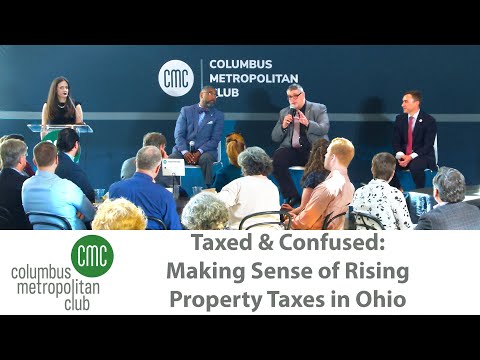
A Columbus Metropolitan Club forum on rising property taxes in Ohio brought county and school officials together with policy analysts to explain why some homeowners faced large increases this year and to outline state and local policy options.
A Columbus Metropolitan Club forum on rising property taxes in Ohio brought county and school officials together with policy analysts to explain why some homeowners faced large increases this year and to outline state and local policy options.
The panel traced recent spikes to a combination of rapidly rising property valuations after the COVID-era inflation surge, Ohio’s complex levy structure across thousands of local taxing districts, and statutory rules that change how voted levies interact with assessed value. "It's a perfect storm," Greg Lawson, research fellow with the Buckeye Institute, said, describing how inflation-driven value increases amplified long-standing structural issues.
Why it matters: property taxes fund local services such as schools, fire protection, senior services and public libraries, and sudden increases have spurred policy proposals at the statehouse. Panelists warned proposed short-term fixes could produce uneven results and said longer-term structural changes are needed.
Panelists explained basic mechanics for nonexperts. A "mill" is the tax rate applied to assessed value — $1 of tax for every $1,000 of assessed value — and most Ohio counties tax properties based on an auditor's assessed percentage of market value. Michael Stinziano, Franklin County auditor, said auditor valuations are not market values but statutory assessments used in the levy calculus and noted Franklin County’s assessment process includes both triennial updates and a six-year mass reappraisal cycle.
School finance and state rules were a central focus. Michael Cole, president of the Columbus City Schools Board of Education, described House Bill 920 (1976) and related rules that limit how increases in property values translate to school revenue. Cole said some legislative proposals in the current state budget that would limit how much districts can carry forward risk penalizing districts that maintain reserves. "The way I fundamentally see that concept is that you are penalizing fiscal responsibility," Cole said.
The panel reviewed three levy types homeowners commonly see: inside millage (authorized without a voter levy and capped by statute), outside/voted levies (operating or permanent-improvement levies approved by voters), and bonds for capital projects. Speakers distinguished "renewal" levies, which raise the same aggregate dollars as a prior levy, from "replacement" levies, which effectively can capture higher tax receipts when property values rise; some panelists said replacement levies can be confusing to voters.
Several policy proposals at the state level drew criticism and caution. Panelists discussed a one‑time property tax refund proposal in the House budget that backers say could return about $4.2 billion statewide by limiting how much districts may carry over year to year. Greg Lawson and others said the proposal’s effect would vary widely by district and could be a one-time relief that later complicates local budgets. "It's a one-time thing," Lawson said, noting that an immediate reduction could be followed by a rebound and confusion for homeowners the next year.
Speakers also warned that proposals to eliminate property taxes outright or move major revenue to state income taxes would produce large tradeoffs. "It is the treasurer, not the auditor, the treasurer who sends you your property tax bill," Stinziano said, adding that eliminating property taxes would force cuts to services or require other tax increases to replace the lost revenue.
Panelists singled out the accumulation of small, local decisions as a major driver of the current environment. Ohio has roughly 4,000 separate taxing districts, and many parcels carry multiple levies accumulated over decades. Greg Lawson said the layering effect — many small levies over time — made this year's inflation-driven valuation spike more painful for many homeowners.
Practical issues raised by residents included the timing of tax bills and valuation cycles. Stinziano said late mailings this year were caused by overlapping counties that had not completed election certifications required by the Ohio Department of Taxation; he encouraged taxpayers to use online tools the auditor and treasurer provide. He also explained the valuation schedule: triennial updates occur every three years and a mass reappraisal of all parcels takes place every six years, with the county able to adjust valuations sooner for renovations or damage.
The forum closed with a consensus that the immediate spike reflected a mix of inflation and long-standing local-tax structure, that short-term state fixes would produce uneven benefits, and that meaningful reform would require confronting local-government structure, tax abatements and other policy choices. Panelists urged clearer public explanations of levy types and valuation mechanics so voters better understand how local decisions affect bills.
Panelists and sponsors: the program was hosted by the Columbus Metropolitan Club and moderated by Anna Staver, state government and politics reporter for cleveland.com/The Plain Dealer. Sponsors noted at the event included Bricker & Eckler Public Sector Group, the Center for HumanKindness at The Columbus Foundation and the Columbus Dispatch.