Get Full Government Meeting Transcripts, Videos, & Alerts Forever!
Get email alerts on the Board Votes topic
No spam. Unsubscribe anytime.
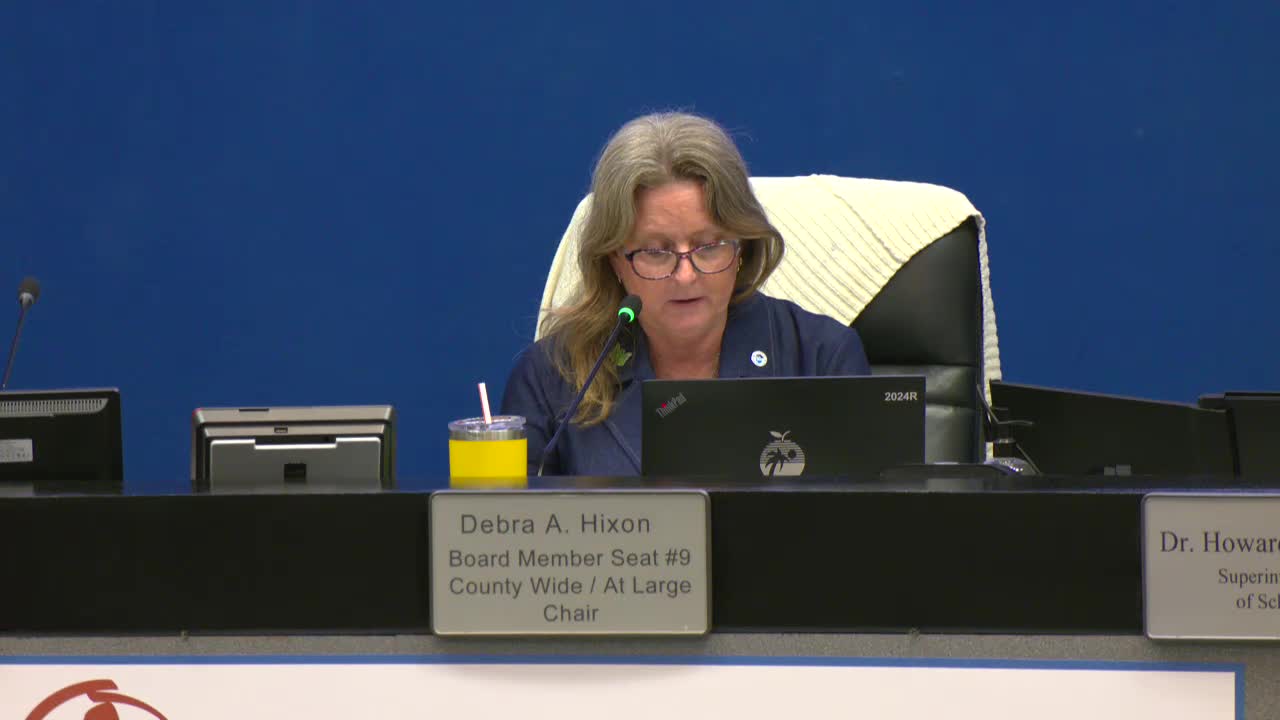
Broward school board rejects contract extension request, approves meal pricing and organizational changes
Summary
At the May 13 meeting the Broward County School Board declined to pursue an attorney-general opinion that would have supported a six‑month contract extension, approved a plan to end universal free student lunches and adjust meal prices, and advanced a revised district organizational chart and several personnel and facilities items.
The Broward County School Board met May 13 and took several consequential votes affecting contracts, student meals and district organization.
The board voted against asking the Florida Attorney General to weigh in on whether the board may grant a six‑month extension for a specific professional services contract. That proposal (agenda item B1) failed on a recorded vote after extended debate about legal risk, timeframes for an AG opinion and the district's procurement statute. Board members who spoke against the measure said their general counsel had already advised the board that the statute cited in earlier discussions did not apply to the school board and that seeking the AG opinion would unnecessarily delay important construction work. The motion to pursue the AG opinion failed on the floor.
The board approved changes to student meal pricing and the district's food service plan (agenda item O3). Staff described the action as a response to federal requirements on the allowable fund balance for the food and nutrition services fund. The district has been using one‑time federal and pandemic‑era funding to operate a universal free meals program; those funds have been used down over the last two years. With the fund balance approaching federal limits, the board approved returning to the normal eligibility‑based reimbursement system and a modest increase in paid meal prices for students not eligible for free/reduced meals. Food and Nutrition staff told the board they will: (a) keep breakfast universally free at school sites where it is served; (b) begin a communication campaign to help families complete free/reduced applications over the summer; and (c) provide school‑level short‑term coverage so no student misses a meal while applications are processed. Staff also said the Food & Nutrition fund balance had been reduced by roughly $9 million per year while a universal program ran and that continuing the universal program without new revenue would require coming to the general fund for support.
The board approved a district organizational update and a number of job descriptions (agenda items HH1 and CC1). Board discussion was robust: some members pressed for tighter minimum qualifications on select chief and director positions while others said keeping preferred qualifications flexible preserves the applicant pool for technically specialized roles. The superintendent and HR staff said positions were reviewed with attention to program needs and continuity of services. The board voted to adopt the revised org chart and accompanying job descriptions as presented with a small amendment (conforming job titles to the new chart).
The board also approved renaming two schools (agenda items SS1 and SS2) after a locally run naming process and adopted other consent and open agenda items including grant acceptances, charter school actions, facility projects, and personnel appointments. Several facility projects and capital items were discussed (including turf and field projects and spending authorizations) and will move forward under staff supervision.
Several items were postponed for further work, including a reciprocal‑use agreement with the City of Coral Springs (postponed to the June 17 meeting so city staff and district real estate staff can align language on priority use and scheduling).
Where the board acted by vote, staff recorded outcomes. The superintendent and general counsel committed to follow up with additional detail on food fund balances, the timeline for organizing student input and next steps for the health/sexual‑health curriculum review, and with clarifications about capital project schedules and contract scopes.