Get Full Government Meeting Transcripts, Videos, & Alerts Forever!
Get email alerts on the Neighborhood Advocacy topic
No spam. Unsubscribe anytime.
Near Northwest residents urge coordinated advocacy as TIF sunsets and development accelerates
Summary
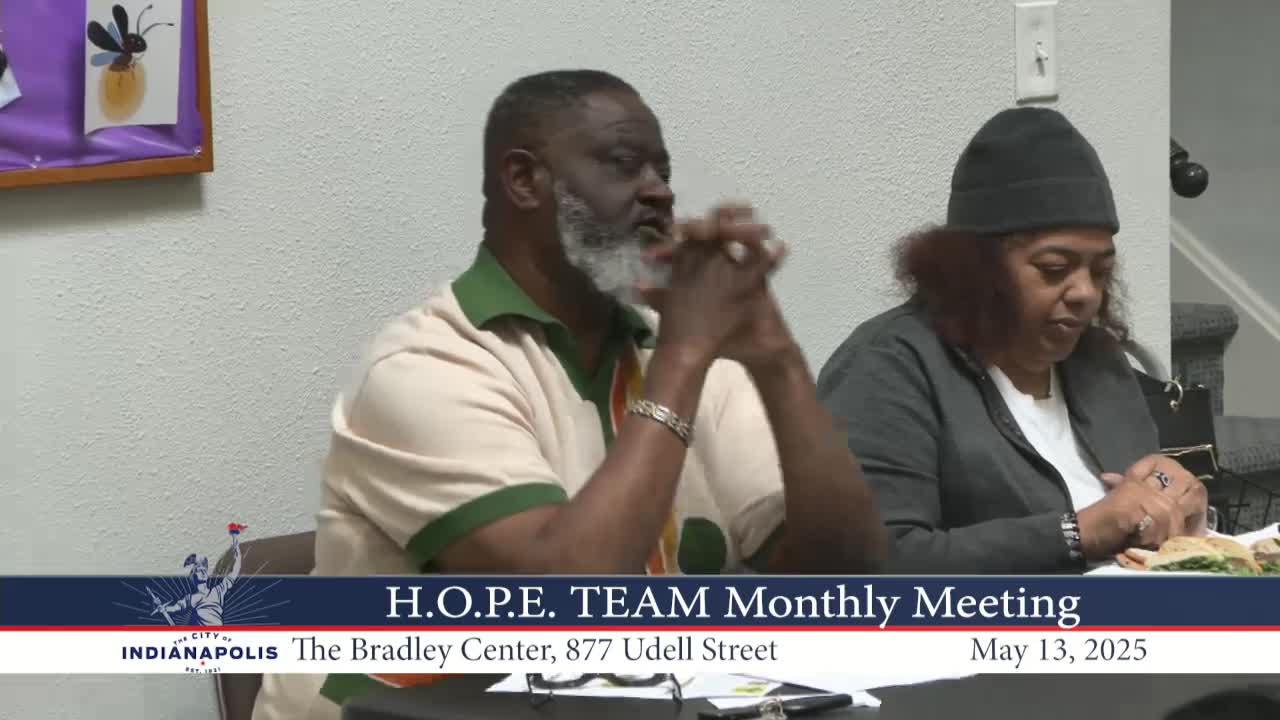
At a monthly HOPE Team meeting at the Bradley Center, resident Tyrone Chandler urged neighborhood leaders to unite around a quality-of-life plan and build coalitions to protect long-term residents as Tax Increment Financing (TIF) sunsets and major development projects arrive in the Near Northwest/Riverside area.
At a monthly HOPE Team meeting held at the Bradley Center, resident Tyrone Chandler urged neighborhood leaders to strengthen coordinated advocacy and use existing neighborhood structures as development accelerates in the Near Northwest (formerly called United Northwest). Chandler said the area—enefited from a local TIF fund years ago but that those development dollars are winding down.
Chandler said the neighborhood once had a TIF "that had like $6,000,000 into it when it first started," which funded projects such as structural fixes to Riverside High School and other local investments. He described long-term community organizing in the area and warned that rising property values and new projects can push longtime residents into higher property taxes.
"If you're not at the table, you're on the menu," Chandler said, urging residents to organize and engage with the city nd developers so neighborhood benefits are negotiated in advance.
Chandler described the neighborhood—ffort to link residents to job-training and technology opportunities at 16 Tech, which he said has maker-space equipment and certifiable training in areas such as CNC routing and 3-D printing. He said the neighborhood has sought arrangements so area residents could use some 16 Tech services without cost, and called for better documentation of the volunteer group's results to support future advocacy and funding requests.
Chandler also introduced two initiatives under development: "Connect Any Project," a database intended to map local organizations and services to reduce duplication, and CREDIT (Community Resource Evaluation and Development), a proposed system to evaluate service providers for quality and integrity and to connect vetted organizations with development and consulting supports.
Chandler repeatedly framed the proposals as grassroots efforts rather than formal nonprofits, stressing the power of coordinated neighborhood associations, quality-of-life plans and umbrella coalitions in negotiations with city and funders.
The discussion included appeals for clearer communication across neighborhoods, better record-keeping to document services delivered, and a push to make resident voices central in planning decisions.
Ending: Chandler asked attendees to consider coalition-building and to share organizational information so the proposed database and evaluation tools can be populated. He said time is likely to make coordinated advocacy more urgent as further budget and policy changes unfold at higher levels of government.