Get Full Government Meeting Transcripts, Videos, & Alerts Forever!
Get email alerts on the Gaza Humanitarian Crisis topic
No spam. Unsubscribe anytime.
UN says Gaza faces 'risk of famine,' documents hospital attacks; rejects proposed aid modality as inconsistent with humanitarian principles
Summary
The United Nations told reporters that humanitarian conditions in the Gaza Strip have worsened sharply, that hospitals have been hit and that the UN cannot support a proposed aid distribution modality because it would make assistance conditional on political objectives.
The United Nations told reporters that humanitarian conditions in the Gaza Strip have worsened sharply and that UN agencies and partners are ready to deliver aid at scale once crossings reopen.
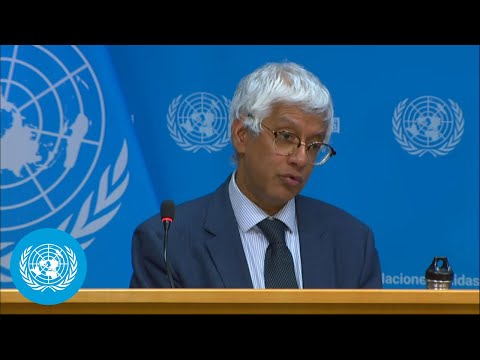
Farhan, the UN spokesperson, said that Tom Fletcher, the Under-Secretary-General for Humanitarian Affairs, told Security Council members that “Israel is deliberately unashamedly imposing inhumane conditions on civilians in the occupied Palestinian territory.” Farhan reported Fletcher’s warning that “every single 1 of the 2,100,000 Palestinians in the Gaza Strip face the risk of famine. 1 in 5 face starvation.”
The briefing said attacks have struck medical facilities. Farhan said a team from the World Health Organization was inside the European Gaza Hospital in Khan Younis when the facility was hit, and that the premises were struck again the next morning, reportedly causing additional casualties. The UN noted that WHO has documented at least 686 attacks impacting health care in the strip since October 2023.
The spokesperson said the blockade and denial of access to cargo have led to dwindling market stocks and dramatic price rises. He cited one example: during May in Gaza City, a single 25-kilogram bag of wheat flour was being sold for the equivalent of more than $415, an increase of more than 3,000% compared with last February.
Meal distribution has plummeted, the UN said. Farhan reported that only about 250,000 individual meals are being provided each day through roughly 65 community kitchens, down from nearly 1,100,000 meals daily produced by about 80 community kitchens on April 25.
The UN said humanitarian partners have prepositioned more than 71,000 metric tons of food in the region that are ready for delivery “as soon as the blockade on the entry of supplies is lifted.” The spokesperson urged member states with influence to ensure international law is respected and humanitarian operations are enabled without further delay.
On the proposed aid modality sometimes described in media reports as the Gaza Humanitarian Foundation or the Israeli humanitarian distribution plan, Farhan said the UN is not on board. Asked whether the UN supported the Gaza Humanitarian Foundation, he replied, “No. No. No. We're not. And he explained why we were not.” He summarized the UN view that the proposed mechanism would make aid conditional on political objectives and would not uphold the humanitarian principles of humanity, impartiality, independence and neutrality.
The briefing also reported an escalation affecting UN peacekeepers. The UN Interim Force in Lebanon (UNIFIL) said its personnel and assets near the Blue Line experienced an aggressive posture by the Israel Defense Forces, including an incident in which direct fire hit the perimeter of a UNIFIL position south of the village of Kfar Shuba. The UN said this marked the first time a UNIFIL position had been directly hit since the Nov. 27 cessation of hostilities understanding and that it has observed other incidents and aggressive behavior in recent days. The UN protested these actions and reminded all sides of their responsibility to ensure the safety and security of UN personnel and property.
Why it matters: the briefing lays out acute humanitarian shortfalls, direct impacts on health-care facilities and a UN refusal to endorse an externally proposed aid distribution mechanism, signaling continued diplomatic friction over how to deliver assistance.
Sourcing note: the quoted condemnations of conditions in Gaza and criticism of the aid modality were reported by the UN spokesperson from remarks by Tom Fletcher and other UN officials during Security Council briefings and the press briefing.