Get Full Government Meeting Transcripts, Videos, & Alerts Forever!
Get email alerts on the Agriculture Sugar Beets topic
No spam. Unsubscribe anytime.
Growers, county officials scramble after Spreckels Sugar closure; economist estimates $250 million annual local loss
Summary
Growers, trucking firms and county officials urged federal help after Spreckels Sugar Company announced closure plans. An economist told the Imperial County Board of Supervisors the combined farm and processing loss could total about $250 million a year and more than 700 jobs.
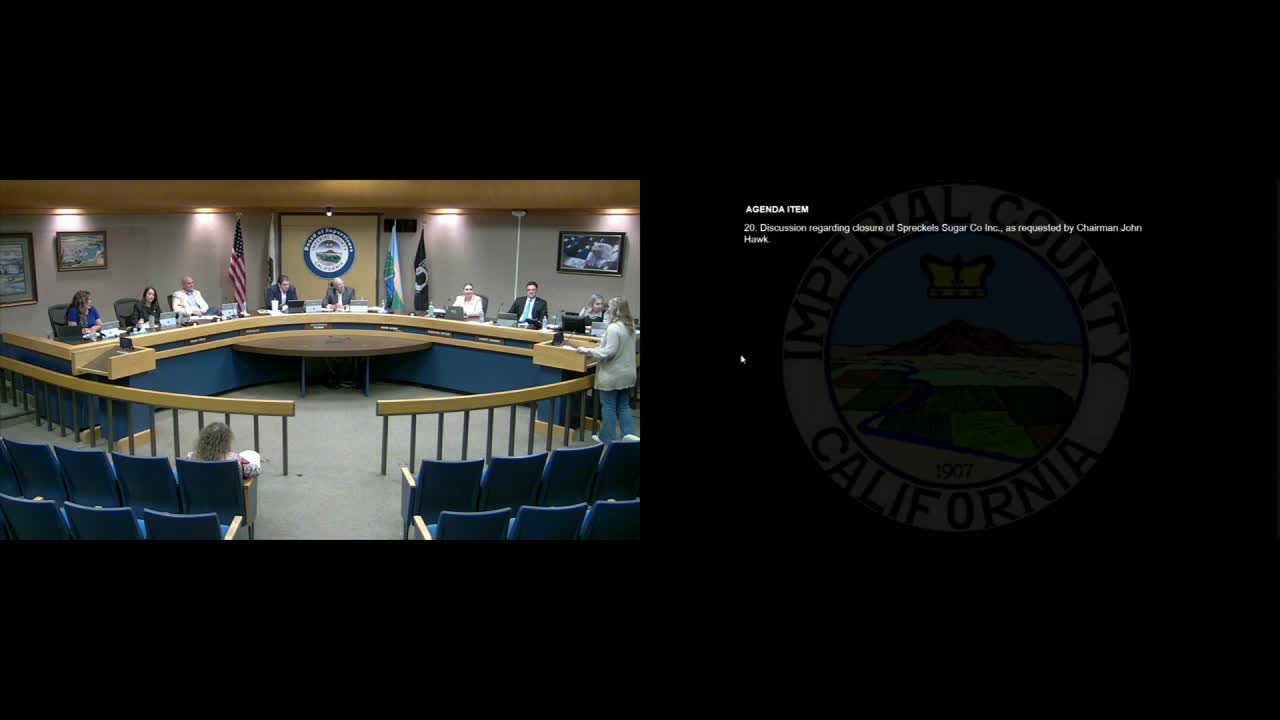
Shelby Trim, executive director of the California Beet Growers Association, told the Imperial County Board of Supervisors on May 13 that the surprise announcement that Spreckels Sugar Company will close its California operations threatens the county’s beet industry and related businesses.
“This is going to have a huge, you know, negative adverse impact on this community,” said a grower who spoke at the meeting, describing immediate steps he is taking—downsizing leases and staff—to stay afloat. Shelby Trim said growers are exploring options including selling the plant or finding a different use for the facility, and “we are exploring every avenue possible.”
Why it matters: Sugar beet growing in Imperial County supports farm labor, harvest contractors, truckers, equipment and input vendors, and the local processing plant that turns beets into refined sugar. Michael Bracken, an economist retained by county staff, told the board a five-year average crop value for beets was roughly $60 million and estimated total annual economic activity tied to growing and processing at about $250 million. Bracken’s analysis estimated roughly 434 direct jobs and 707 total jobs supported by the crop and its processing.
At the meeting growers and trucking contractors described the human impact: multi‑generation farming operations, harvest crews and truck drivers would all be affected if beet acres are taken out of production or left fallow. Armando Gonzales, who operates a trucking business that hauls beets, said he and many in the valley are “worried sick.”
What officials said and next steps: The county and the California Beet Growers Association discussed three parallel priorities: finish the current harvest campaign, pursue a reallocation of sugar under the federal sugar program, and explore buyers or alternative uses for the plant. Shelby Trim and others said the sugar allocation is controlled by Southern Minnesota Beet Sugar Cooperative and that a reallocation would require action from USDA and Congress.
Supervisor John Kelly urged immediate political action and recommended forming a subcommittee to press for an allocation and other federal support. County staff scheduled a follow-up meeting for 10 a.m. Friday to convene leaders, growers, labor representatives and congressional staff; county staff said they are lining up meetings with USDA and members of the county’s congressional delegation during the county’s Washington, D.C., advocacy trip in June.
Economic detail provided at the meeting: Bracken said recent data show about 23,000 acres averaged over five years (and roughly 28,000 acres currently reported) under beet production, and about $60 million in farm receipts on the crop side. He estimated farm-side direct wages around $20 million per year and processing-side wages about $16 million per year. Bracken also reported county-level impacts tied to property taxes and assessed values: the plant’s assessed value was cited around $47 million with annual property taxes near $550,000 and a county share (net of state reallocations) around $127,000 annually.
Stakeholders at the meeting urged a coordinated push in Washington to preserve allocation for Imperial County or win a reallocation; Trim and other growers said a cooperative purchase and plant restart would be possible only if allocation could be secured and if buyers could be found for the physical plant and operating assets. Trim said the company that currently owns the allocation has indicated it plans to shift production to Minnesota and is “not interested” in selling the facility.
Ending: Board members said they will use the county’s upcoming D.C. trip and the Friday subcommittee meeting to press USDA, members of Congress and federal agencies for options to preserve local production capacity or otherwise mitigate the economic shock.