Get Full Government Meeting Transcripts, Videos, & Alerts Forever!
Get email alerts on the Stormwater Finance topic
No spam. Unsubscribe anytime.
Wylie council asks staff to return with stormwater-fee plan after study; majority favor $5 flat rate and limited exemptions
Summary
Councilors directed city staff to continue work on a proposed stormwater utility after a presentation of a fee evaluation study. Council generally favored a flat residential fee, exempting houses of worship, the city and the county, while keeping school districts subject to the charge.
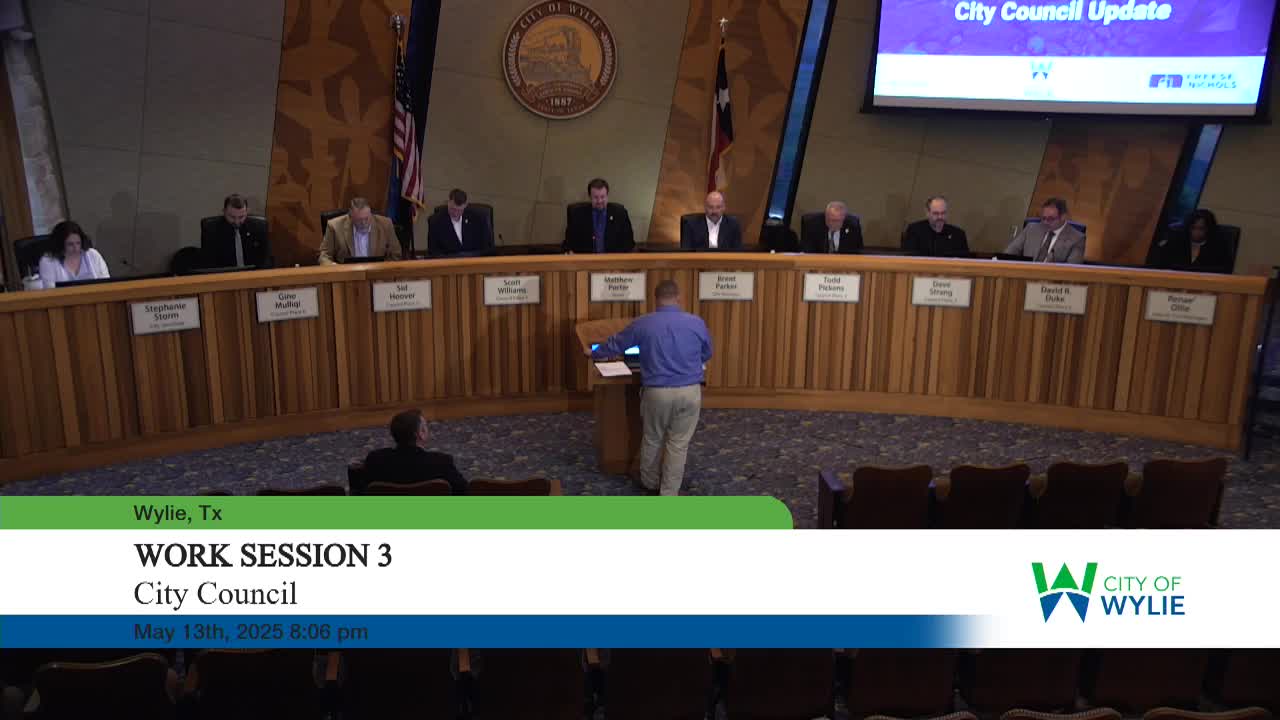
City staff presented a stormwater utility fee evaluation at the May 13 Wylie City Council meeting and received direction from council to refine a proposed program that would raise revenue for drainage maintenance and projects.
Tommy Weir, presenting the study produced with consultant Freese and Nichols, told the council the city’s storm system includes pipe, open ditches and about 65 miles of open-channel drainage. Staff counted just under 17,000 residential parcels and roughly 639 nonresidential parcels and estimated 62 million square feet of residential impervious area and 36 million square feet for nonresidential properties.
Weir summarized two basic rate approaches: a flat residential rate (one ERU per home) or a tiered residential model based on impervious area. His recommendation, supported by draft modeling, was a flat approach priced roughly at $5 per equivalent residential unit (ERU) per month (the presentation used a $5-per-ERU model as an example). At that rate the fee could generate roughly $1.3–$1.7 million annually, money intended primarily for stormwater projects and a moderate increase in O&M capacity.
Council discussion focused on fairness, administration, and implementation: Councilman Dave Strang and Mayor Pro Tem Gino Maleche said they favored a simple flat charge to minimize accounting and administrative overhead; Councilman David R. Duke and Councilman Scott Williams asked for more neighborhood-level impact data before finalizing a rate. Several council members asked staff to show a prioritized “burn-down” of the capital needs the fee would fund so the council could see the planned projects and timing tied to the revenue.
On exemptions, staff noted state law gives local governments policy discretion for certain public and nonprofit properties. The council gave direction that the staff should return with an ordinance drafted around a flat residential fee and drafts that treat the following as exempt by policy: city-owned property, county-owned property and property used as a primary place of worship. Council consensus was that independent school districts (ISDs) should not be exempt and would remain subject to the fee; the mayor and several council members asked staff to confirm legal detail and to prepare an implementation plan.
Why this matters: Wylie has identified dozens of stormwater projects costing tens of millions of dollars; a dedicated fee would create a predictable local revenue stream for maintenance and capital projects rather than relying solely on general-fund allocations or intermittent grants.
Next steps: Staff will return with a detailed rate ordinance and an expanded packet showing the $5-per-ERU derivation, a prioritized project list (with estimated costs and phasing), the likely administrative burden to implement a tiered vs. flat approach, and comparisons of total household bills with nearby cities for context.
Ending: Council provided policy direction to proceed with a flat-rate proposal and limited exemptions and asked staff for follow-up materials before a formal vote.