Get Full Government Meeting Transcripts, Videos, & Alerts Forever!
Get email alerts on the Land Use topic
No spam. Unsubscribe anytime.
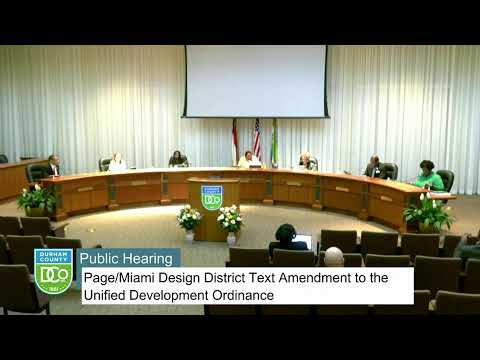
Durham commissioners approve UDO change allowing tree-coverage adjustments in development agreements after contentious public hearing
Summary
Durham County commissioners voted 3–2 on May 12 to adopt a UDO text amendment (TC24000003) permitting applicants to seek adjustments to tree coverage and protection standards as part of statutory development agreements.
Durham County commissioners voted 3–2 on May 12 to adopt a text amendment to the county—s Unified Development Ordinance (UDO) that would allow applicants to seek changes to tree coverage and tree protection standards as part of statutory development agreements (case TC24000003).
Supporters, including the applicant—s attorney, said the change adds a tool the governing body can use to negotiate development agreements that deliver community benefits, such as affordable housing, in constrained sites. Neil Ghosh, an attorney at Morningstar Law Group representing Lincoln Avenue Communities, told the board that the amendment does not automatically change tree requirements; it only allows applicants to include tree-standard adjustments in a development agreement that the governing body may approve or deny.
Opponents said the amendment would create a new path to reduce tree protections across Durham. Donna Steinback, a resident and speaker during the public hearing, cited local build-out numbers and said Southeast Durham already has thousands of approved units and thousands of acres cleared. Pamela Andrews, another resident, warned the amendment would create a precedent allowing developments to meet affordable-housing goals while sacrificing tree canopy. "Affordable housing should not be pitted against tree preservation," Andrews said, citing a comment attributed in her remarks to a riverkeeper.
City-County Planning Department staff explained the amendment—s scope. Robin Schultz told the board the change would amend UDO Section 3.26, which governs statutory development agreements, so those agreements could include alterations to UDO Article 8 (tree coverage and tree protection). Schultz said the amendment would apply across both city and county jurisdictions and that a development agreement would remain a legislative decision subject to a public hearing and governing-body discretion.
Commissioners questioned whether existing remedies (such as variances from the Board of Adjustment) were adequate and whether making tree coverage negotiable in development agreements would defeat the UDO—s environmental protections. Planning staff and the applicant answered that development agreements are a high-effort, case-by-case tool used rarely in Durham so far and have been used to support some affordable housing projects. Planning staff also noted that not every project would be a candidate for a development agreement because of the staff time required.
The motion to adopt the ordinance amending Article 3 (applications and permits) was moved by Commissioner Jacobs and seconded by Commissioner Burton. The motion passed 3–2. A separate motion adopting the statutorily required consistency statement under North Carolina General Statute 160D-605 also passed 3–2.
The discussion highlighted a recurring tension: some affordable housing design standards (including certain parking ratios and LIHTC requirements) can increase impervious surface and reduce the practical ability to meet strict on-site tree-preservation percentages on small or oddly shaped infill parcels. Opponents urged the board not to create a routine route for tree-coverage reductions; supporters urged flexibility when a development agreement would secure public benefits that would otherwise be infeasible.
The board did not adopt any binding new numeric thresholds as part of this text amendment; rather, the vote authorizes the governing body to consider tree-coverage adjustments as part of future negotiated development agreements.