Get Full Government Meeting Transcripts, Videos, & Alerts Forever!
Get email alerts on the Rates And Finance topic
No spam. Unsubscribe anytime.
Austin Energy presents forecast calling for 5% annual base‑rate increases and $1.6 billion five‑year CIP; commissioners press for details
Summary
Austin Energy presented a multi‑year financial forecast May 12 that proposes a 5% annual base‑rate increase for five years, recovery of some general‑fund transfers through pass‑through charges, and a five‑year capital plan estimated at roughly $1.6 billion.
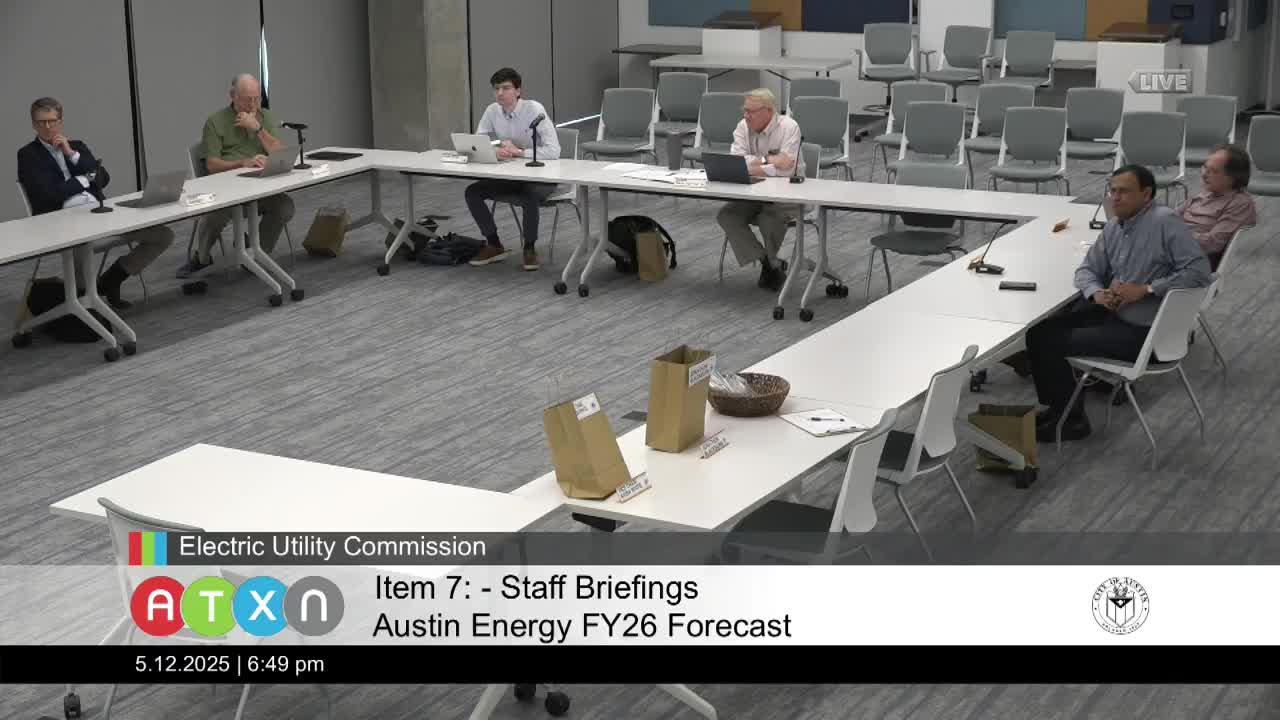
Austin Energy staff presented a multi‑year financial forecast and quarter‑end briefings to the Electric Utility Commission on May 12, outlining a plan that would include a 5% annual base‑rate increase for five years, a proposal to recover some general fund transfers through pass‑through charges, and a five‑year capital improvement plan (CIP) the utility estimated at about $1.6 billion.
Why it matters: Austin Energy said current rates and recent under‑recovery of costs have left the utility with lower cash reserves and a capital program that lags peer investment. Staff framed the proposal as a measured alternative to an immediate, full rate case and a larger one‑time increase.
Key points from staff presentations
- Forecast and proposed rate path: Rusty Manas, acting general manager (business services), said Austin Energy’s financial position has improved since 2023 but remains “not great.” Staff proposed a 5% annual base‑rate increase for the next five years as the preferred path to restore financial health while moderating bill impacts; Manas said an alternative—an accelerated rate case—could require a much larger, one‑time increase (he referenced an illustrative ~15% figure for a full rate case). Manas told commissioners the 5% scenario still leaves a shortfall of roughly $20 million in 2026 in the forecast model but tracks expected costs across the five‑year horizon.
- General fund transfer (GFT) and pass‑throughs: Staff proposed recovering the general fund transfer associated with regulatory, energy‑efficiency service and service‑area lighting charges through the pass‑through rates tied to those costs rather than through base rates. Manas explained that doing so aligns the revenue that triggers the GFT with the revenue used to recover it and would make those pass‑through charges self‑funding as they grow.
- Capital program and KPIs: The forecast included a five‑year CIP estimate of about $1.6 billion (staff said that number may be low compared with the final budget), funded roughly by a mix of cash and debt. Staff noted operating metrics: days cash on hand improved from a trough (below 100 days in 2023) and were projected to approach targets in outer years under the plan. Debt‑service coverage and other targets improve more slowly and do not hit policy targets until the later years of the forecast.
- Power supply adjustment (PSA) and reserve actions: Staff explained recent operational actions that reduced PSA volatility and moved an over‑recovery into a Power Supply Stabilization Reserve. Interim General Manager Stuart Riley said moving about $30 million into that reserve brought the reserve into compliance with a 90‑day policy and could be used to stabilize spikes in market cost rather than being returned immediately to customers.
- Q2 financials and ratings: Stephanie Koudelka, Austin Energy’s Director of Finance, reported the utility’s Standard & Poor’s rating was AA‑ (target AA). She reported days cash on hand near the 200‑day target when including over‑recovery cash but noted much of the cash is power‑supply over‑recovery that must be returned to customers or used for power supply risk management. She reported a $103 million PSA over‑recovery as of the end of the quarter.
- Operations and resource updates: Lisa (operations lead) reported Q2 carbon‑free generation of 77% of load (49% renewables, 28% nuclear for the quarter) and summarized generator availability and distribution reliability. She said Austin Energy had issued a battery storage RFP, shortlisted projects, completed initial modeling in April and that staff were negotiating terms with shortlisted proposers. Staff expect to bring recommendations to the EUC on July 14 and to City Council on July 24, while acknowledging tariff and regulatory risks could affect negotiations.
Commissioner questions and concerns
Commissioners pressed staff on the assumptions behind the 5% number, allocation across customer classes, the potential need for a rate case to set cost allocation, and the sensitivity of the forecast to power supply costs and inflation. Commissioners asked for more detailed numbers, asked whether pass‑through changes would materially affect customer bills, and requested follow‑up materials during the budget process.
Ending: Staff described the 5% annual plan as a balanced path to rebuild reserves and fund capital needs with more gradual bill impacts than a single large rate increase; staff acknowledged the forecast will be revisited in the budget process and that council will make final decisions.