Get Full Government Meeting Transcripts, Videos, & Alerts Forever!
Get email alerts on the Land Use Zoning topic
No spam. Unsubscribe anytime.
Berkeley County zoning votes: committee approves several rezoning items, denies one, and postpones another
Summary
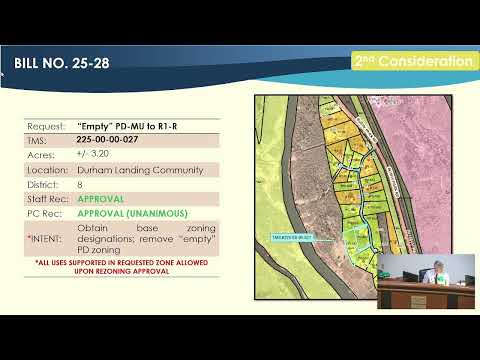
At the May 27 land use committee meeting Berkeley County approved multiple zoning map amendments (bills 23-37, 25-39, 25-40, 25-25, 25-26, 25-27, 25-28, 25-29, 25-18, 25-20, 25-21, 25-22), denied bill 25-38, and postponed bill 25-17 until June for clarification on right-of-way issues.
Berkeley County’s Land Use Committee handled a batch of zoning and land‑use matters during its May 27, 2025 meeting, advancing multiple rezoning requests, denying one application and postponing another pending additional information.
Key outcomes
- Approved (prior to first reading or as otherwise recorded): Bill 23‑37 (rezoning for William R. and Felicia R. Herbert, TMS 195‑14‑00‑062, Maclaurin Avenue — from R2RF to General Commercial), bill 25‑39 (rezoning PDMU to R1R), bill 25‑40 (conveyance of a 0.015‑acre right‑of‑way easement, TMS 247‑00‑0021), and additional bills listed below that were advanced as recorded.
- Denied: Bill 25‑38 (rezoning; applicant had not provided intended-use details and planning staff withdrew prior motion; council later voted to deny after discussion).
- Postponed to next committee meeting in June: Bill 25‑17 (rezoning related to Crazy 8 LLC; third reading postponed until right‑of‑way/donation clarifications are resolved).
Why it matters: The committee considered the fit of requested zones in the context of county comprehensive plan guidance, traffic impacts and conflicts with existing covenants. Staff and planning commission recommendations were discussed; in several cases staff requested verification of intended uses and mitigation for impacts. Committee members repeatedly noted that rezoning to broader commercial categories permits many future uses, and they urged careful consideration of how commercial zoning might extend into residential areas.
What the committee considered: Planning staff (Miss Simmons) summarized each application and noted where planning commission recommendations included conditions (for example requiring verification of intended use or mitigation measures). Committee members asked about traffic impacts, wetlands, and potential outdoor storage associated with general commercial zoning. On one case (bill 23‑37), staff noted the applicant intends to relocate a boutique home‑building business (Hebert Homes) to the site and that engineering determined no traffic impact analysis was required. For bill 25‑38 staff said the applicant had not provided intended‑use information and that the property is affected by the Geppert Corridor study; planning commission recommended resolving covenant conflicts before approval.
How votes were taken: Most motions were carried by voice vote; the record frequently shows “all in favor, say aye,” without roll‑call tallies. Where a formal motion to deny was moved (bill 25‑38) the committee recorded an affirmative voice vote for denial.
Full list of committee actions (as recorded at the meeting): see Actions array below for bill identifiers, motion text, movers/seconders as recorded, and outcomes. Each bill’s provenance in the transcript is listed in the record.