Get Full Government Meeting Transcripts, Videos, & Alerts Forever!
Get email alerts on the Electric Vehicle Registration Fee topic
No spam. Unsubscribe anytime.
Speakers from industry, health and consumer groups oppose large EV registration fee increase
Summary
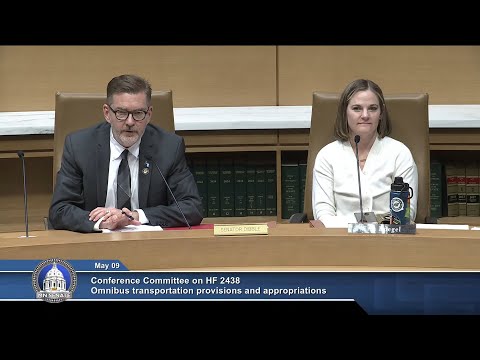
Multiple witnesses, including energy and health advocates, auto engineers and EV owners, told the Transportation Conference Committee that a proposed increase in Minnesota's electric vehicle registration fee would be punitive, unlikely to close the state's roadway funding gap, and could slow EV adoption.
Yuka Kokone, an EV market consultant and University of St. Thomas instructor, walked the committee through a miles-per-year and fuel-efficiency calculation and told members the current $75 annual electric vehicle fee exceeds the straight gasoline-tax equivalent for many EV drivers. "This basic math doesn't support increasing our current $75 annual fee at all," Kokone said.
Why it matters: Both House and Senate transportation omnibus proposals include higher EV surcharges; witnesses argued a large increase would discourage EV adoption, disproportionately affect lower- and moderate-income buyers, and not solve long-term roadway funding shortfalls.
Several groups and witnesses spoke in opposition. Nick Hague, Electric Vehicle Senior Associate at Fresh Energy, said the proposed $200 state fee — combined with a potential $250 federal fee under consideration in Congress — could raise an EV owner's annual burden to $450. "Nearly tripling the state EV registration fee will not plug the hole in our roadway funding, but it will make it harder for more Minnesotans to be able to buy an EV," Hague said.
Health and climate advocates also opposed the increase. Kathleen Schuler, state policy director for Health Professionals for Healthy Climate, said EVs yield health benefits through reduced air pollution and that a $200 fee places additional burden on lower- and middle-income buyers. Several EV owners and adopters echoed those concerns, noting that at current levels EV owners already contribute to road funding through sales taxes and higher tab fees.
Speakers suggested alternatives: indexing the current $75 fee, keeping EV fees proportional to road use, or delaying any increase until a comprehensive funding plan is in place. Some witnesses suggested mileage-based or electricity-use methods for tying contributions to actual road use rather than a flat annual surcharge.
Next steps: Committee members heard arguments from multiple perspectives and did not take an immediate vote; staff and the chairs indicated further deliberation as the conference committee negotiates the omnibus transportation bill.
Ending: The hearing produced repeated, cross-cutting objections to a large flat EV surcharge; several witnesses urged the conference committee to seek equitable, evidence-based approaches to roadway funding.