Get Full Government Meeting Transcripts, Videos, & Alerts Forever!
Get email alerts on the Disease Response topic
No spam. Unsubscribe anytime.
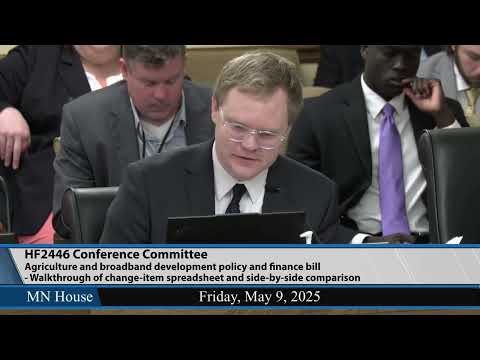
Committee discusses avian influenza funding, ag emergency account and depredation payments
Summary
Legislative staff and MDA testified about differing House and Senate approaches to the agriculture emergency account and appropriations for disease response and depredation compensation. Commissioner Tom Peterson emphasized biosecurity, the need for stable funds and delays in payments for elk and wolf damage.
Minnesota Department of Agriculture officials and conference committee staff told legislators that the House and Senate take different approaches to funding the state’s agriculture emergency response and to several damage compensation accounts.
Eric Olson, the Senate fiscal analyst, summarized transfer proposals: the Senate would transfer $1.5 million from the general fund to the agriculture emergency account in the current fiscal year (FY25) with immediate effect; the House would transfer $4 million in FY26 and allows up to $2 million of that transfer to be spent on specified purposes — including testing of milk and poultry products, biomonitoring at the Department of Health, or rapid testing work at the University of Minnesota — but requires the commissioner to notify chairs of the House and Senate agriculture finance committees prior to using that portion.
“Having those dollars available is very, helpful,” said Tom Peterson, commissioner of the Minnesota Department of Agriculture, describing the agency’s concern about sporadic detections of H5N1 in wastewater and occasional suspect flocks. Peterson noted recent detections have produced negative follow-up tests but said the virus is circulating regionally. He told the committee that since the department is behind on payments for elk and wolf depredation claims, some producers are being asked to wait for payment until July 1.
Why it matters: conference committee decisions will determine the timing and amount of emergency response funds available to the department, and the speed with which depredation claims and testing can be funded during outbreaks.
Peterson and committee members also discussed avian influenza trends elsewhere in the U.S., noting outbreaks in other states’ dairy and poultry herds this year and that Minnesota saw heavy poultry impacts in 2023. He said both bills include money for biosecurity and for meat and poultry inspection support. Legislators and staff said they want to ensure funds are sufficient to support testing and rapid response and that the committee will continue to reconcile timing and allowable uses as conferees negotiate the final bill.
No action was taken at the meeting; members said they will return to reconcile the transfer timing and allowable uses when fiscal targets are set.