Get Full Government Meeting Transcripts, Videos, & Alerts Forever!
Get email alerts on the Ag Finance Conference topic
No spam. Unsubscribe anytime.
Agriculture conference committee reviews House and Senate spending differences in House File 2446
Summary
Nonpartisan staff walked members through a line-by-line comparison of House and Senate positions in House File 2446, showing dozens of funding and policy differences for the Department of Agriculture, Board of Animal Health and related programs. Committee chairs said no votes were taken and no target figure had been set.
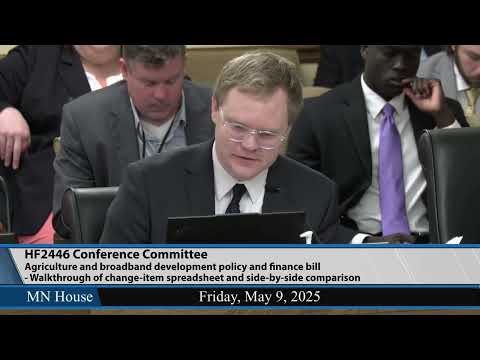
Representative Paul Anderson and Representative Rick Hansen, co-chairs of the Minnesota Legislature’s Agriculture Conference Committee, convened the committee on May 5 to review differences between the House and Senate versions of the ag finance and policy package, House File 2446.
Nonpartisan fiscal and policy staff gave a detailed side-by-side briefing. Ken Savory, nonpartisan fiscal analyst for the House Agriculture Committee, told members the spreadsheet in their packet is titled “2025 agricultural broadband and rural development — House file 2446 — conference committee comparison.” He walked through change items in the Department of Agriculture budget, calling out differences including reductions and increases for soil health assistance, wolf and elk compensation, meat inspection, county ag inspector grants, biofertilizer programs, and the farm-to-school appropriation.
Eric Olson, the Senate nonpartisan fiscal analyst, continued with totals and transfer items and flagged that the House and Senate take different approaches to transfers into the agriculture emergency account and certain ag fund balances. Megan Mullenback and Laura Painter, nonpartisan policy analysts, summarized substantive rider and policy differences between the two bodies, noting the Senate carried a number of policy changes not present in the House and the House included several house-only grant programs and studies.
Why it matters: the briefing lays out specific dollar differences that the conference committee must reconcile to produce a single bill for final consideration. Members said they had not yet received a conference target and that the committee will return for further negotiations once fiscal targets are set.
Committee members highlighted several line items during the discussion. Senator Torrey Westrom and others flagged an administrative allowance in the House language that would permit the department to use up to 10% of some grant appropriations for administration costs; staff and members noted that practice would represent an increase from historical norms (around 6–6.5%). Staff also pointed to non‑fiscal language differences — for example, the Senate renaming the Good Food Access Program and expanding definitions in several lending programs.
The committee received written testimony submitted before the meeting from organizations including the Minnesota Farm Bureau, Minnesota Farmers Union, Minnesota Corn Growers, The Nature Conservancy, Minnesota Center for Environmental Advocacy, Association of Minnesota Counties, Coalition of Greater Minnesota Cities, Minnesota Biofuels Association, Growth Energy, Friends of the Mississippi River, Second Harvest Heartland and other food banks, Minnesota Grain and Feed Association, and several smaller producers and businesses. Anderson said the committee would not take oral testimony at the meeting but that the submitted letters were available to members.
No formal actions or votes were taken. The co-chairs said the committee will resume meetings once a fiscal target is set; Senator Gary Putnam indicated the next meeting likely would be after noon on the following Monday. The Minnesota Department of Agriculture, Board of Animal Health staff and House and Senate fiscal and policy analysts stood ready to answer questions as the committee moved to later negotiations.