Get Full Government Meeting Transcripts, Videos, & Alerts Forever!
Get email alerts on the Auto Insurance Liability Limits topic
No spam. Unsubscribe anytime.
Michigan justices examine whether post‑July 1, 2020 liability limits apply to ‘straddle’ auto policies
Summary
In oral argument over Bonter v. Progressive Marathon Insurance Co., attorneys disputed whether higher post‑July 1, 2020 liability limits apply to auto policies issued before that date but extending beyond it, and whether a coverage summary or vehicle change triggers the higher limits.
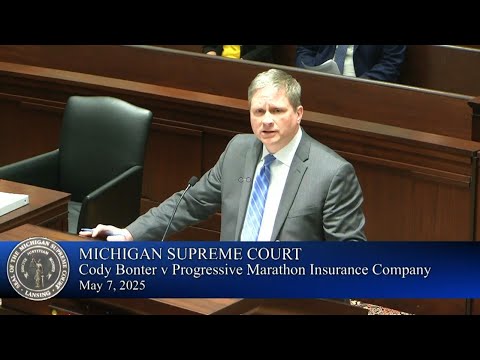
The Michigan Supreme Court heard arguments in Bonter v. Progressive Marathon Insurance Company over whether higher liability limits enacted in mid‑2020 apply to auto insurance policies issued just before July 1, 2020 that extend past that date.
Attorney Steve Hicks, representing plaintiffs Cody Bonter and Caitlin Jackman, told the court the statutory text in “500.3009” requires the higher limits and that the statute’s phrase “all of the following limits” means a policy must carry the post‑July 1, 2020 limits if it otherwise meets the statute’s conditions. “All means all,” Hicks said. He called policies issued before the change but that extend beyond it “straddle policies” and argued insurers should have used midterm endorsements or issued new policies after the Department of Insurance and Financial Services issued guidance.
The question grew from Michigan’s 2020 no‑fault reforms, which both sides accept changed the default available coverages and tort exposure beginning around July 1–2, 2020. Hicks said the Department of Insurance and Financial Services (DIFS) bulletin that followed the legislation supported insureds’ expectation of updated coverage and that, where an insurer instead left a policy at lower pre‑reform limits, the insured (and third‑party claimants) could face underinsurance issues.
Jeffrey Gerrish, counsel for Progressive, told the court the case raises the same legal issue the court addressed in Pena and that the dispute turns on how subsections 5–8 of the statute interact with subsection 1. Gerrish urged the court to read subsection 8 as limiting the new liability limits to policies “issued or renewed after 07/01/2020.” Quoting the DIFS bulletin language, Gerrish said, “These changes apply to policies issued or renewed after 07/01/2020,” and argued that reading resolves the ambiguity by applying the higher limits only to policies issued after that date.
Gerrish said subsections 5–8 (the opt‑out and notification provisions) clarify the legislature’s intent and that subsection 6, which directs insurers to notify applicants and named insureds about options and pricing for different coverage levels, shows the obligation applies on applications or renewals after July 1. He also stressed as a practical matter that insureds generally prefer lower limits and that only tort claimants would benefit from reading the statute to impose higher limits on pre‑existing policies.
Hicks and Gerrish disputed whether a midterm “coverage summary” reflecting a vehicle change could count as issuing a new policy. Hicks said DIFS’s July 8, 2020 bulletin required either a midterm endorsement or a new policy, and that insurers who continued to leave older 20/40 limits in place were failing to notify insureds of increased tort exposure. Gerrish replied that the statute’s structure and subsequent subsections show the legislature intended the changes to apply only on issuance or renewal after July 1, 2020, not automatically to “straddle” policies.
Both sides cited prior decisions and doctrines in argument. Hicks referenced Pena and the Koski line of cases about an insurer’s duty to inform an insured when coverage is reduced, and he invoked Auto Owners v. Martin to argue insurers can be held responsible for continuing to issue policies that conflict with legal changes. Gerrish relied on the court of appeals’ Pena decision and on the statutory text and DIFS guidance as interpreted in lower courts.
The court asked practical questions about timing and exposure: if the court adopted one reading, how immediately tort liability would increase and who would bear risk. Counsel agreed that the particular plaintiffs before the court had unlimited personal‑injury protection (PIP) in their own plans and therefore were not harmed in the narrow facts of this case; both emphasized the broader legal rule’s effect on other pending cases.
At the close of argument the court submitted the case for decision. No opinion or ruling was announced at the hearing.