Get Full Government Meeting Transcripts, Videos, & Alerts Forever!
Get email alerts on the Capital Projects And Funding topic
No spam. Unsubscribe anytime.
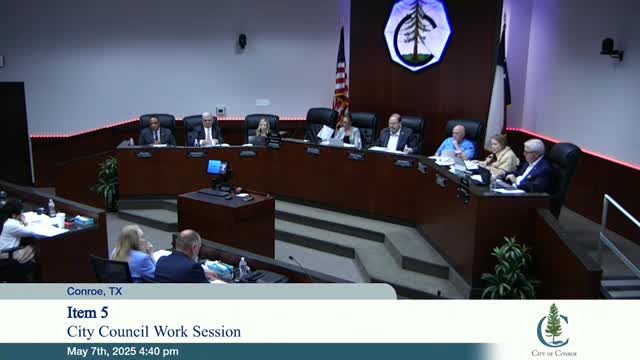
Council weighs redirecting Old Conroe Road bond/CIP funds to water projects amid push to prioritize wells
Summary
Councilmembers debated moving bond/CIP funds from the Old Conroe Road project to water infrastructure after staff said right‑of‑way acquisition costs are rising and county cost‑sharing commitments are uncertain; several councilmembers said water needs should take precedence.
Councilmembers debated whether to reallocate funds earmarked for the Old Conroe Road project to address Conroe’s water supply needs.
Background and finances: Public works staff said right‑of‑way acquisition for the 5.5‑mile Old Conroe Road project had large remaining costs. Staff reported an existing AFA (agreement for funding/engineering) and that the city currently faces the full share for additional right‑of‑way if partners do not participate. Numbers cited during discussion included roughly $1.2 million needed for the near‑term portion of right‑of‑way and a larger total right‑of‑way estimate near $20 million (city share roughly half). Councilman Hardman said only 1.25 miles of the route are inside Conroe city limits and questioned the fairness of asking Conroe taxpayers to shoulder wide costs when neighboring jurisdictions would benefit.
Council reaction and options: Several councilmembers — citing the water supply shortfall discussed elsewhere in the workshop — argued that available bond funds and CIP resources should be evaluated for reallocation to water wells and source‑water projects rather than proceeding with high‑cost road right‑of‑way purchases. Staff said covenant and bond restrictions vary by series and that moving money requires legal and financial review; staff also noted some projects already had local match commitments and that removing funds may trigger arbitrage or covenant questions. Council asked staff to return with legal analysis, the precise covenants affecting each bond series and an options memo showing impacts of redirecting each bond or CIP line to water infrastructure.
Why it matters: The debate pitted near‑term transportation priorities against urgent water infrastructure needs, and council members publicly asked county officials to honor previously discussed cost‑sharing commitments. If the city diverts existing bond funds to water projects, staff warned that other road projects and grant match eligibility could be affected.
Next steps: Staff will provide councils with bond covenant language, a list of projects funded by the series (including amounts spent to date), and a recommendation about whether and how to reallocate funds for water. Council members signaled strong interest in prioritizing water projects if legal and financial constraints permit.