Get Full Government Meeting Transcripts, Videos, & Alerts Forever!
Get email alerts on the Office Of Inspector General topic
No spam. Unsubscribe anytime.
Senate approves bill to create independent Office of Inspector General, adds optional law‑enforcement unit
Summary
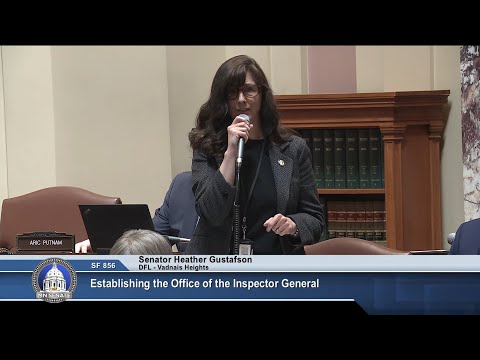
The Minnesota Senate passed Senate File 8 56 on Thursday, May 8, 2025, creating an independent Office of Inspector General with authority to investigate alleged fraud and misuse across state agencies. The bill passed the Senate as amended by a 60–7 roll call vote.
The Minnesota Senate passed Senate File 8 56 on Thursday, May 8, 2025, creating an independent Office of Inspector General with authority to investigate alleged fraud and misuse across state agencies. The bill passed the Senate as amended by a 60–7 roll call vote.
Supporters said the office will give the state a centralized, independent tool to prevent and investigate fraud. “This bill protects Minnesotans,” said Senator Gustafson, the bill’s sponsor. “Opposition to oversight is not a defense of good government.” Senator Croon, a coauthor, said: “This bill will help combat fraud in Minnesota.”
Why it matters: Lawmakers cited recent high‑profile cases and a multi‑hundred‑million‑dollar rise in fraud as reasons for legislative action. The bill aims to create an OIG that complements — but is independent from — existing agency oversight and to provide additional investigative capacity across the executive branch.
What the bill does: As approved on the floor, the underlying measure establishes an Office of Inspector General appointed through a bipartisan process and authorized to conduct independent investigations across state agencies. Key floor amendments adopted before final passage: - A91 (author’s/technical): Clarified appointment confirmation thresholds, allowed contracting with MNIT for IT services, and required an interagency agreement with the Department of Health (adopted). - A85 (law‑enforcement option): Authorized the inspector general to establish an Office of Inspector General Anti‑Fraud and Waste Bureau with statewide investigatory and arrest authority limited to offenses involving fraud, abuse, or related criminal conduct; included data‑practice and notification guardrails, and required the bureau to be led by a qualified chief law‑enforcement officer (adopted on the floor). - A86/A87 (implementation/federal coordination): A87 delayed specified provisions until Centers for Medicare & Medicaid Services (CMS) approval for certain Medicaid‑related authorities or until Jan. 1, 2026, whichever is later; the amendment was adopted to require federal sign‑off for provisions that could affect federal funding or Medicaid program administration. - A63 (whistleblower protections): Extended whistleblower protections to public employees who report fraud in good faith (adopted). - A89 (education carve‑outs): Restored certain statutory tools for the commissioner of education and clarified that the OIG would not have authority to cut off state or federal aid to school districts (adopted). - A90 (notice to unaffected recipients): Required notice to persons who receive public funds but are not implicated when those funds are stopped or frozen (adopted).
Floor debate and objections: Supporters described the bill as a bipartisan, bicameral effort to restore public trust. Opponents warned the floor additions expanded executive authority without sufficient committee vetting and raised questions about federal approval, due process, resource impacts, and overlapping jurisdiction with existing agency OIGs. Senator Wicklund said she had “a real strong concern” about adding a law‑enforcement division on the floor without committee review and pressed for clearer due‑process and coordination rules. Senator Hoffman raised concerns that CMS might not approve the Medicaid‑related provisions and moved to reconsider the third reading to allow additional amendments; that motion was called and voted on on the floor before debate continued.
Votes at a glance: The final passage vote for Senate File 8 56, as amended, was 60 ayes, 7 nays. Several floor amendments noted above were adopted; roll‑call tallies for each amendment were not all recorded in the transcript.
What the bill does not yet resolve in the transcript: The transcript records adoption of multiple amendments and the Senate’s final passage, but it does not show CMS’s response to the provisions that require federal approval or any final, post‑session implementation steps. Some senators said agencies requested additional appropriations or personnel to manage collaboration with the new OIG; those funding details and any federal approvals were not recorded in this session’s transcript.
Next steps: The Senate passed the bill and agreed to its title on the floor. The transcript does not record subsequent actions (enrollment, governor’s action, or CMS approvals).