Get Full Government Meeting Transcripts, Videos, & Alerts Forever!
Get email alerts on the Capital Improvement Program topic
No spam. Unsubscribe anytime.
Board approves submission of $6.5 million FY2026 local capital request to county commissioners
Summary
The Queen Anne's County Board of Education voted to send a $6.5 million local capital improvement program (CIP) request for fiscal 2026 to county commissioners. The package lists 35 projects led by facilities and technology staff, with security upgrades, school real‑site repairs and technology replacements as top priorities.
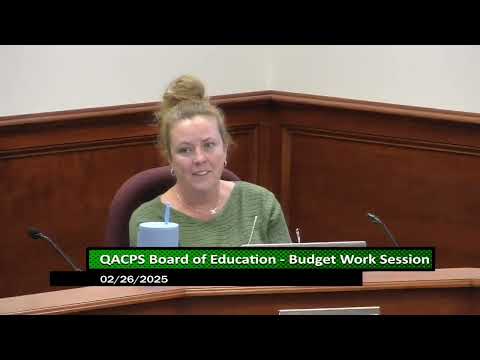
The Queen Anne's County Board of Education on Feb. 26 approved sending its fiscal 2026 local capital improvement program request — a $6.5 million package of 35 projects — to the county commissioners for consideration.
The package, presented by Daryl Baricla, supervisor of facilities and design for Queen Anne's County Public Schools, and Josh (supervisor of technology), includes security hardware and fencing, stormwater and paving work, three special‑needs buses, 600 Chromebooks for grades 1–4, server replacements and wireless upgrades, playground replacements, and a community health suite expansion at Bayside Elementary School. The board approved the submission by voice vote after brief discussion and questions about scope and timing.
Baricla told the board the capital program is “100% separate from the operational program” under consideration in the district's budget process, and that the local CIP list is intended to show the district’s full local need so county commissioners can see priorities if available funding falls short. He said the district typically receives about $4 million in local capital funds and that the running total on the CIP spreadsheet shows where projects would stop if funding remains at that level.
Board members and staff discussed several items at length. Top priorities in the request include a two‑part security hardware upgrade (a $500,000 request in FY26 with another $500,000 proposed for FY27) to standardize classroom and exterior door locking, and perimeter fencing at three elementary schools — Bayside, Kent Island Elementary and Graysonville — to address concerns about people accessing school grounds near trails and public paths. Baricla said the security work would start with a school survey by an architectural firm to define scope and then move to design and hardware procurement.
The CIP also lists construction funding for Kennard Elementary stormwater repairs, a previously approved contract for Kent Island High School stadium lighting (with contingency included), resurfacing of Kent Island High School tennis courts, and a phased milling and paving plan for Kent Island High School student parking. The district requested three county‑owned special‑needs buses to maintain a steady replacement schedule rather than purchasing a larger number in a single year.
On technology, Josh described three items: 600 Chromebooks for grades 1–4 intended to provide repair/rotation capacity for the existing fleet; replacement of school servers (last replaced about eight years ago) and a planned migration from VMware to Microsoft Hyper‑V to avoid annual VMware licensing costs; and replacement of school wireless networks, a project the district expects to fund 40 percent locally if E‑rate funding (federal) covers the remaining 60 percent. Josh said the 600 Chromebooks represent roughly a quarter of the elementary 1–4 device need of 2,400 units and should extend device serviceability for about a year.
The board also discussed the district’s school‑based health centers. Baricla and other staff described a planned expansion at Bayside Elementary for a community health suite in partnership with Choptank Community Health under an existing memorandum of understanding. Board members asked whether the centers serve the general public; staff clarified they are for students and school employees and that Choptank handles billing. The board also discussed Marathon Health, an employee health benefit provider, and how referral agreements and participation rates affect district costs.
Members asked about timing and likelihood of county funding for the full $6.5 million request. Baricla reiterated that commissioners prefer a smooth capital profile year to year. He noted the district expects a much larger county and state funding request next year for Centerville Middle School construction that could require asking for $10 million or more in the first year of a multi‑year build and the county match that accompanies state participation.
After questions and clarifications about project scopes, bidding and priorities, a board member moved to approve submission of the FY2026 local project CIP request to the county commissioners; another board member seconded. The motion passed on a voice vote. The board did not record individual roll‑call tallies in the meeting transcript.
The approved request will be sent to the county commissioners for their capital budgeting process. Several projects on the list will require later board approvals when design work, bidding, or contract awards are ready for the board’s consideration, according to staff.