Get Full Government Meeting Transcripts, Videos, & Alerts Forever!
Get email alerts on the Transportation topic
No spam. Unsubscribe anytime.
MAG study outlines near‑term mobility options for Queen Creek including microtransit and TNC subsidy pilot
Summary
MAG presented a feasibility study that recommends near‑term mobility options for Queen Creek — including a TNC subsidy pilot, an on‑demand microtransit pilot, micromobility education and mobility hubs — and noted the choices would require local funding and further council direction.
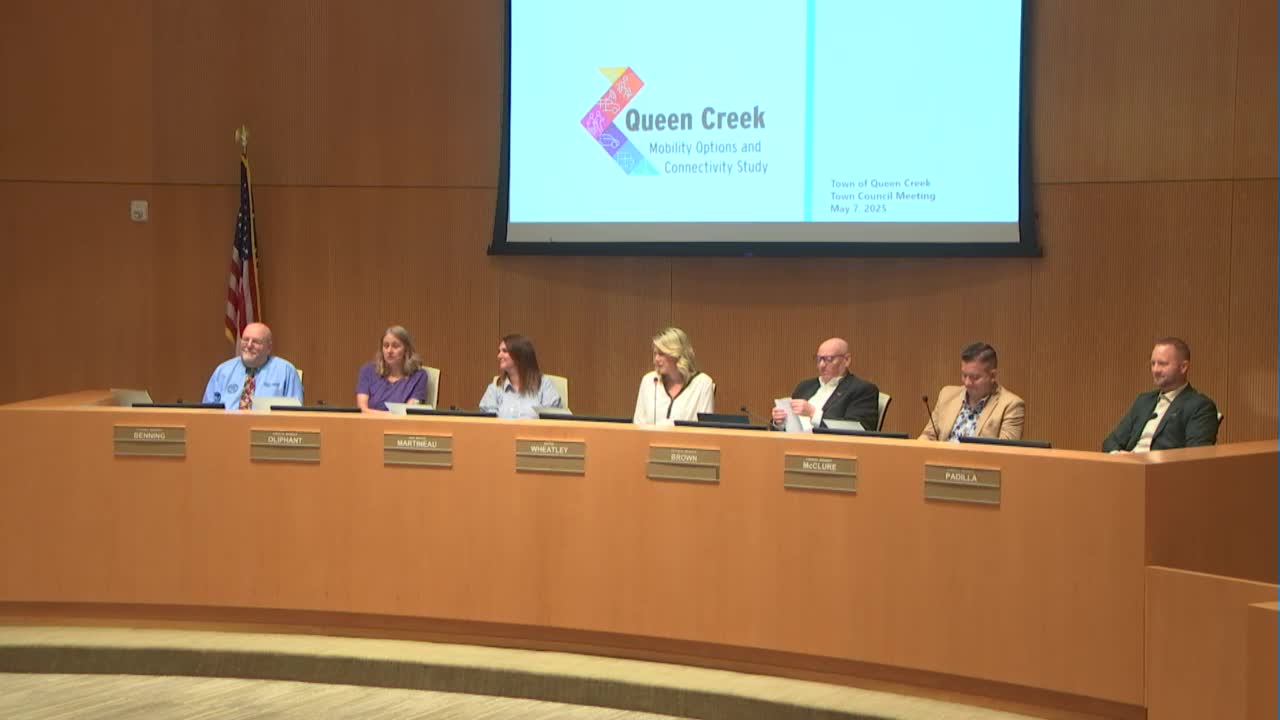
The Maricopa Association of Governments (MAG) presented the draft Queen Creek Mobility Options and Connectivity Feasibility Study, summarizing a statistically valid resident attitudes and awareness survey and proposing a set of near‑term and future mobility options for council consideration.
MAG project manager Hannah Quincy said the study gathered more than 1,000 resident responses and reported the top resident priorities: improved safety and reduced congestion. The study recommended a range of near‑term options that the town could evaluate over the next roughly five years, including:
- A transportation network company (TNC) partnership (a subsidized Uber/Lyft‑style program) with a sample fare structure described in the study as a $2 base fare paid by the rider, the town covering up to $10 of a trip, and the rider responsible for costs beyond that amount.
- A microtransit on‑demand pilot operating in a designated zone that the study estimates would reach about two‑thirds of the town’s population; MAG estimated a turnkey microtransit program for a roughly 19‑square‑mile service area at about $1,100,000 per year for weekday and weekend service, with a smaller weekend‑only pilot estimated at about $230,000 per year.
- A resident‑focused micromobility education and safety campaign for privately owned e‑bikes and e‑scooters, and identification of infrastructure needs such as secure parking at parks and civic sites. MAG noted Queen Creek adopted a local micromobility ordinance in November 2023 that governs device operation on town facilities.
- Mobility hubs co‑locating services (TNC pickup/dropoff, micromobility parking, signage) at key activity centers; MAG described hubs as a way to tie the other strategies together.
Quincy emphasized that many future options—robotaxi expansion, autonomous shuttles or third‑party shared micro‑mobility deployments—depend on private‑sector expansion and technological readiness and would be longer‑term considerations.
Councilmembers asked questions and discussed the report’s framing as a menu of options rather than a mandate. Councilmember Brown and others welcomed educational steps on micromobility and said any pilot program would need to be evaluated for cost, equity and likely resident uptake in a community where most households own one or more vehicles.
MAG will finalize the report after council feedback and provide the study as the transit element of the town’s transportation master plan; staff said implementation of near‑term options would require local funding decisions and further council direction.