Get Full Government Meeting Transcripts, Videos, & Alerts Forever!
Get email alerts on the Budget topic
No spam. Unsubscribe anytime.
Encinitas council sets preliminary FY 2025–26 budget priorities, directing staff to prepare proposed operating and CIP budget
Summary
At a May special workshop the Encinitas City Council gave staff direction on preliminary allocations for the fiscal year 2025–26 operating and capital improvement program, prioritizing public safety, drainage and pavement work, mobility projects and permit-parking software while deferring one historic preservation study for later consideration.
The Encinitas City Council met in a special budget workshop and provided staff direction to prepare a proposed FY 2025–26 operating and capital improvement budget for introduction on May 28, 2025, prioritizing public safety and infrastructure projects.
The council’s discussion centered on a suite of capital and operating requests staff added since the second workshop, including funding for temporary Fire Station No. 1, additional contracted deputy sheriff coverage, storm-drain design and relining, pavement rehabilitation, permit‑parking software, and several pedestrian and trail projects. Finance Director Tom Gallup opened the staff presentation, calling the session “the third public workshop scheduled to receive direction before introducing the fiscal year 20 25, 26 operating a capital budget on May 28.”
Why it matters: Council members framed the workshop as an opportunity to close longstanding maintenance and safety gaps—flood control, pavement condition and traffic enforcement—after years of constrained spending. Several projects discussed have grant or reimbursement dependencies that limit how council can repurpose funds, and staff repeatedly reminded members that some grant dollars must be spent within specified timeframes.
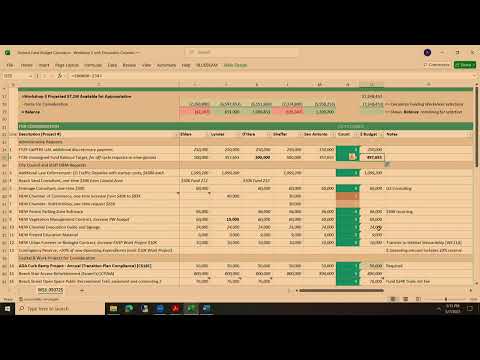
Most significant allocations and council direction - Public safety and enforcement: Council expressed support for funding two additional contracted deputy positions focused on traffic and DUI enforcement (startup and contract costs covered this year), saying the positions would provide broader shift coverage than adding a single deputy. Deputy Mayor Kellie Lyons and other council members emphasized enforcement’s role in traffic-safety goals. The sheriff’s office indicated some of that work could be used for proactive DUI detail. - Temporary Fire Station No. 1: Staff reported an increased estimate; an additional appropriation of $285,000 this fiscal year was discussed to complete the temporary facility, with most costs coming from the facilities fund and $285,000 from general fund anticipated. City Manager Josh Campbell and Director Gallup confirmed the additional appropriation would reduce available appropriations for next fiscal year. - Storm-drain and flood work: Council prioritized design and permitting for the South Vulcan Avenue storm‑drain mainline (design-only estimate discussed) and supported a continuing program of pipe lining and repair to reduce reliance on pumps and operational costs. Councilmembers discussed using a mix of general fund, grant funding and pending FEMA reimbursement to accelerate relining work; staff reported a FEMA reimbursement request of about $2.6 million was pending. - Pavement rehabilitation and mobility: Pavement rehabilitation and related ADA/crossing improvements were funded at the levels discussed in the staff spreadsheet (pavement rehab item funded at $600,000 for this year, plus separate allocations for ADA curb ramps and safe‑routes work). Council members emphasized making projects grant-ready so design work can leverage state and federal grants. - Permit‑parking software and enforcement: Council approved funding to purchase and implement permit‑parking software (startup cost discussed at about $80,000 and estimated annual licensing/operations thereafter). City Manager Campbell said the software would automate permit issuance and enforcement, provide plate-based enforcement capability and relieve staff time currently spent processing permits manually. - Vegetation management and evacuation signage: Council approved increases to the city’s vegetation‑management contract focused on high‑fire‑severity zones, funding for an evacuation guide and signage, printed public-education materials, and an urban-forester/biologist contract to support sensitive-habitat decisions tied to vegetation work.
What council did not finalize - Historic context statement: Council debated a proposed $140,000 consultant contract for a historic-context statement to support potential future historic-district designations. Several members described the study as a “first step” toward preservation policy; others called it a “nice to have” and urged deferral because the study would not itself confer legal protection from state actions. Council ultimately did not fund that item in the workshop allocations and agreed it could be reconsidered later if additional unassigned funds become available. - Chamber and marketing requests: The Encinitas Chamber of Commerce, Visit Encinitas and other business groups asked for additional one‑time and ongoing funding. Council left supplemental requests for further discussion at midyear—maintaining the city’s existing annual memorandum amounts while deferring extra one‑time funding pending more detailed MOAs and midyear budget performance data.
Process and timing Council’s direction was procedural—staff will prepare the proposed budget and return it for formal introduction at the May 28 council meeting and adoption on June 18, 2025. Multiple council members and staff noted that several items rely on outside grants (ATP, HSIP, FEMA reimbursement) that carry time limits or repayment risks if the city declines the funded scope. Director of Engineering Jill Bankston warned, for example, that the ATP grant tied to Santa Fe East improvements requires construction to begin within about a year or the city could be required to repay design funds already reimbursed.
Public comment Nine members of the public spoke in the workshop. Comments clustered around public-safety and homelessness concerns, support for additional deputies and funding for infrastructure and business‑support programs. Representatives of the Encinitas Chamber of Commerce and Visit Encinitas described proposed business-assistance programs and a request for $65,000 to support marketing and a small‑business accelerator; Visit Encinitas clarified the local ask was $65,000, not the larger figure a news report had suggested. Cottonwood Creek Conservancy requested $25,000 for interpretive signage and pointed to the site’s historical importance.
Council next steps Staff will incorporate the direction from the workshop into the proposed FY 2025–26 budget and return it for introduction on May 28. The council signaled willingness to revisit several deferred or contingent items at midyear or when external reimbursements (for example FEMA) are finalized. Several council members asked staff to prioritize making key projects shovel-ready for grant opportunities, and to return with clearer phasing and procurement schedules for large design contracts.
Quotes "This is the third public workshop scheduled to receive direction before introducing the fiscal year 20 25, 26 operating a capital budget on May 28," Finance Director Tom Gallup said at the start of the staff presentation. "We have about a year before we need to get out to construction on that one," Director of Engineering Jill Bankston said of the ATP grant tied to Santa Fe East improvements, referring to grant timing and potential repayment if the project is not advanced. "No one should die on a roadway because they've decided to move around the city," public speaker Christine Schindler said during public comment, urging renewed focus on Vision Zero and active-transportation safety.
Ending The council majority left the workshop with informal consensus to advance the prioritized items into the proposed budget for May 28 introduction, instructed staff to prepare contract scopes and grant strategies to make projects competitive for external funding, and deferred the historic-context study and supplemental one‑time business‑support funding for later consideration once the city’s unassigned fund balances and pending reimbursements are clearer.