Get Full Government Meeting Transcripts, Videos, & Alerts Forever!
Get email alerts on the Autism Services And Data Privacy topic
No spam. Unsubscribe anytime.
Senate adopts human‑services policy bill with new autism provider rules and data protections
Summary
The Minnesota Senate passed House File 21‑15 after adopting provisional licensure for certain autism intervention providers and a data‑privacy amendment banning dissemination of personally identifiable autism‑related information for the purpose described by the sponsor.
The Minnesota Senate passed House File 21‑15 after debate over staffing, provider licensing, and protections for personally identifiable information related to disability services.
What passed Senators adopted a set of policy changes that include technical fixes, provisional licensure for certain early intensive developmental behavioral intervention (EIDBI) providers, and new requirements for supervision and program oversight for autism intervention providers. Senator Abler described the licensure language as establishing provisional licensure and stronger supervision requirements (for example, a supervisory in‑person visit at least every three months) and giving DHS authority for unannounced site visits to enforce quality and safety.
Data‑privacy amendment adopted Senator May Quaid offered an amendment (A50) intended to prohibit license holders in certain statutes from sharing personally identifiable information (names, birth dates, addresses, telephone numbers, email addresses and biometric information) for the stated purpose the author identified on the floor (preventing the creation of an identifiable registry or similar uses). The amendment to the amendment clarified that the list includes biometric information; that change was accepted on the floor, and the A50 as amended was adopted. Sponsors said the change does not impede de‑identified research data used by university or agency researchers.
Other floor actions - A1 (technical) was adopted to align policy language with changes made in the budget bill. - A6 (targeted language for an assisted‑living facility on the National Register of Historic Places) was adopted. - A4 (a proposal to require MDH to evaluate cost and effectiveness before imposing new mandates on nursing homes) failed on a roll call.
Votes and final passage The final recorded vote on House File 21‑15 as amended was 35 ayes and 32 nays; the clerk recorded the bill as passed and title agreed to.
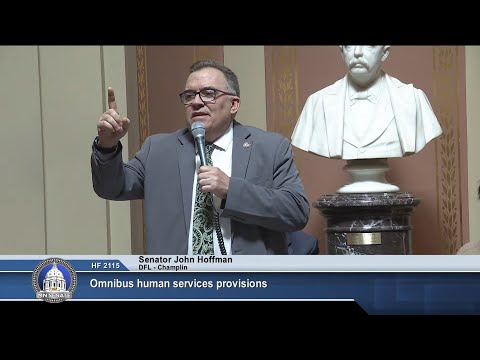
What supporters said Senator Hoffman, the committee chair, said the bill updates standards for long‑term‑care protections, modernizes training requirements and includes provisions intended to protect resident rights. Senator Abler described the provisional licensure as a measured approach to quality while trying not to overburden experienced providers.
What opponents said Some senators voiced concern about new training and regulatory requirements that they said could add cost and administrative burdens to already strained nursing homes and provider networks; one floor amendment (A4) sought to require MDH to demonstrate a direct positive safety impact and lack of financial hardship before ordering new mandates; that amendment did not pass.
Provenance: Floor remarks introducing the policy bill by Senator Hoffman began around 10005 seconds; the bill's final passage was recorded around 13422–13462 seconds.