Get Full Government Meeting Transcripts, Videos, & Alerts Forever!
Get email alerts on the Human Services Budget topic
No spam. Unsubscribe anytime.
Senate passes human‑services omnibus after contentious floor debate over nursing‑home cuts and county cost shifts
Summary
The Minnesota Senate passed the human‑services omnibus budget, House File 24‑34, after hours of debate and multiple amendments addressing county cost shifts, nursing‑home funding and program integrity.
The Minnesota Senate passed House File 24‑34 on May 7 after several hours of floor debate and a string of amendments. Sponsors described the measure as a bipartisan compromise intended to protect core services while managing an emerging budget shortfall; critics said the bill contains substantial cuts to nursing homes and some disability services and objected to how priorities were set.
Why it matters: The human‑services budget governs spending for long‑term care, disability services, direct care and treatment (DCT), substance‑use programs, and other social services that largely affect older adults and people with disabilities. Senators spent much of the floor time debating whether to shift costs to counties, how to grow capacity for DCT, and whether to redirect spending from other items to soften cuts.
Major floor actions and amendments - A19 (Abler): Senator Jim Abler offered the A19 amendment, described on the floor as eliminating the proposed county share and making a series of programmatic reforms and investments (for example, restoring certain disproportionate‑share assisted‑living payments, capping some waiver growth, and investing in assessments and training). Abler said the amendment would eliminate county cost shifts in the bill and identify reforms to produce savings. The A19 package was adopted by voice vote after debate and an amendment to the amendment (A23) addressing newborn screening/rare diseases was also accepted without roll calls. - A1 (Abler): A technical amendment clarifying autism early‑intensive intervention licensing and provisional licensure for early intensive developmental behavioral intervention (EIDBI) providers was adopted. - A24 (Gruenhagen): A proposal to prorate grants to pay for program‑integrity AI tools (reductions across many grant lines to fund data‑analytics tools) failed on a roll call; opponents said it would cut funds for services without sufficient detail on implementation. - A52 (Rasmussen): Reallocated unspent funds within an existing loan program to critical‑access nursing‑facility supports; adopted. - Other actions: Several amendments addressing newborn screening, licensing, and targeted investments were adopted; at least one amendment (A30) was ruled not germane and removed after a point of order and appeal.
Votes and final passage The final recorded vote on House File 24‑34 as amended was 35 ayes and 32 nays. The Senate clerk recorded the bill as passed and the title agreed to. Several roll calls on amendments and points of order punctuated the day.
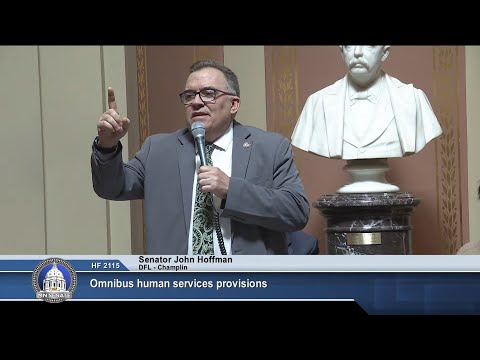
What sponsors said Senator Lindsey Hoffman (chair, Human Services Committee) framed the bill as a difficult but necessary response to a worsening fiscal outlook: "This budget makes responsible reductions... while still upholding our duty to serve Minnesotans with dignity," he said on the floor, and noted specific reductions across the biennium referenced in his remarks.
Senator Jim Abler, who offered major amendments tied to county relief and program reforms, argued his changes would prevent county property‑tax increases and generate savings through process reforms and targeted investments: "We do not believe we should tax our counties 1p more for the budget distress that the state is in," Abler said.
What opponents said Senator Glenn Gruenhagen and other critics argued the bill continues to fund some contentious items while imposing cuts on nursing homes and disability services. Gruenhagen repeatedly raised the question of MinnesotaCare expansion and federal match, and other senators representing rural districts described projected multi‑million dollar reductions for nursing homes in their districts.
Implementation and next steps The bill contains multiple programmatic provisions that will require Department of Human Services (DHS) and Minnesota Department of Health (MDH) actions, targeted investments in DCT capacity (including a $75 million Miller Building item referenced on the floor), and several studies or task forces to pursue savings. Conference negotiations with the House will determine final spending decisions.
Provenance: Floor debate opening remarks by committee chair Senator Hoffman began near 2420.26 seconds into the transcript; final passage and title agreement are recorded near 9984.86 seconds.