Get Full Government Meeting Transcripts, Videos, & Alerts Forever!
Get email alerts on the Home Initiative topic
No spam. Unsubscribe anytime.
Parker administration proposes $800 million HOME bond to fund housing production and preservation
Summary
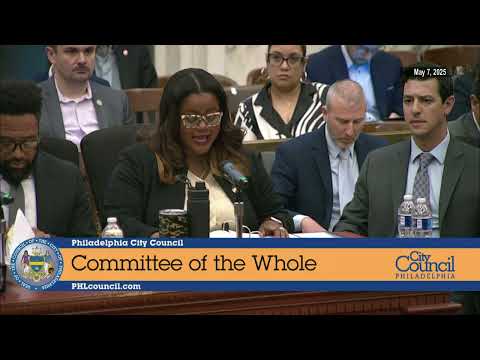
Philadelphia City Council continued a public hearing May 13 on the Parker administration's Housing Opportunities Made Easy (HOME) initiative, a comprehensive housing plan that would use an $800 million two-tranche city bond (part of a larger $2 billion proposal) to fund production, preservation and programmatic investments intended to produce or preserve tens of thousands of housing units.
Philadelphia City Council continued a public hearing May 13 on the Parker administration's Housing Opportunities Made Easy (HOME) initiative, a comprehensive housing plan that would use an $800 million two-tranche city bond (part of a larger $2 billion proposal) to fund production, preservation and programmatic investments intended to produce or preserve tens of thousands of housing units.
Administration witnesses, including Tiffany Thurman, chief of staff to Mayor Sherrell L. Parker, and city finance staff, told the Committee of the Whole the bond would be issued in two roughly $400 million borrowings and, as structured today, would be taxable to allow flexibility in how proceeds are used. "Over the life of the bonds, the total debt service would be, a little over 1,300,000,000.0," a finance official stated during questioning, and estimated interest of about $500 million over 20 years was described in the hearing record. The administration said each borrowing's annual debt service would be in the roughly $33 million'$35 million range per borrowing.
The administration presented the HOME package as a mix of production and preservation programs, and as a complement to existing efforts led by other agencies and partners. Tiffany Thurman said the plan is intended to "meet 78% of need for housing production and for preservation" and emphasized the initiative is designed to leverage philanthropic and private capital alongside city borrowing. The administration also said the HOME package includes roughly $492.5 million earmarked for preservation-oriented programs (adaptive modification, basic systems repair and other preservation lines called out in the plan) and that the full citywide proposal is a roughly $2 billion program in which $800 million is bond-funded, $1 billion is property-related investment, and $200 million would come from other sources.
Council members pressed officials on financial details, implementation, and oversight. Council President Johnson and members asked how the city will pay debt service and whether borrowing will increase the city's long-term debt burden. A finance official said overall city debt service is projected to decline after fiscal year 2029 because certain large pension obligation payments drop off, and that the HOME debt service was modeled against current and projected debt schedules. The official said the first $400 million tranche is expected to be drawn and spent within about two years and that the timing for a second borrowing would depend on observed drawdown and program spend.
Members also questioned how the administration would ensure the bond produces measurable value. The administration said it is carrying out multiple assessments and consulting engagements to evaluate program designs and fill capacity gaps; officials described roughly $4.56 million of line items for research, assessments and technical assistance across program categories. Jesse (staff) and consultants said new programs were selected based on data analysis and best-practice research from other cities.
Several council members urged prioritizing existing, proven programs and clearing long standing wait lists. Councilman Jamie Gauthier, chair of the Housing Committee, and others highlighted large backlogs for existing repair programs: the administration reported Basic Systems Repair (BSRP) typically serves about 2,500 homes per year and that adaptive modification has roughly 1,700 people on its wait list while Built to Last had about 2,800 expressions of interest. David Thomas, president and CEO of the Philadelphia Housing Development Corporation (PHDC), said previous income expansions did not produce the dramatic increases some feared and cautioned against making program eligibility overly subjective. He said "I don't wanna make it subjective" when asked about a waiver process for households slightly over income limits.
Implementation questions focused on capacity and partnerships. Council members and administration witnesses discussed the land bank's role in assembling publicly owned parcels for development. Angel Rodriguez of the Land Bank said a strategic plan and an operational assessment are being accelerated, with a vendor expected on contract by July 1 to conduct the strategic plan work. Officials said the Land Bank budget includes 32 positions they intend to fund and that internal assessments will be completed this summer.
Unions and private capital were also a point of focus. The administration described active conversations with unions and said it anticipates private capital and philanthropic support in addition to the bond; officials repeated a target to raise an additional $200 million from unions, philanthropic organizations and state or federal sources. Council members pressed for concrete commitments and asked that any institutional partners (including unions) disclose workforce and diversity metrics. A finance official said the city is in ongoing conversations with lenders and foundations but had not secured firm commitments at the hearing.
The Philadelphia Housing Authority (PHA) was discussed as a partner but not as a single recipient of dedicated HOME proceeds: the administration said PHA would be eligible to compete for acquisition funds and other program lines, just as other public or private developers would be. Ira Goldstein of the Reinvestment Fund, a consultant to the city, testified that the HOME analysis sought to map where production is needed and where preservation is urgent, and that the plan includes measures to address appraisal and assessment bias that have historically limited investment in some neighborhoods.
Council members also sought clarity on programmatic details: which items could be financed with tax-exempt versus taxable debt, the process and timeline for land disposition and pilot parcels, the structure of the proposed —one front door' intake or concierge clearinghouse for homeowners, and whether bond proceeds could fund staff. The administration said recent drafts removed language that would directly fund new permanent city staff with bond proceeds, and said the planning and development budget will cover necessary program administration and that existing vacancies and new positions are being evaluated and filled as needed.
What happens next: the administration said draft enabling legislation would be introduced to council the week after the hearing (May 15 was cited during the hearing), and officials promised follow-up written materials requested by council on debt-service modeling, program-by-program funding eligibility (taxable vs. tax-exempt), lender/philanthropic commitments, preservation/production unit-level estimates and how PHA and the Land Bank are incorporated into specific line items. Council members indicated they may hold additional sessions and review amendments before any bond authorization.
The public hearing on HOME continued the prolonged council-administration review of a sweeping housing proposal; council members repeatedly requested more detailed financial commitments, clearer spending timelines and program-level performance metrics before granting final approval.