Get Full Government Meeting Transcripts, Videos, & Alerts Forever!
Get email alerts on the Economic Mobility Columbus topic
No spam. Unsubscribe anytime.
Panel: Centuries-long racial gaps threaten Columbus growth; panelists call for neighborhood-scale, coordinated investments
Summary
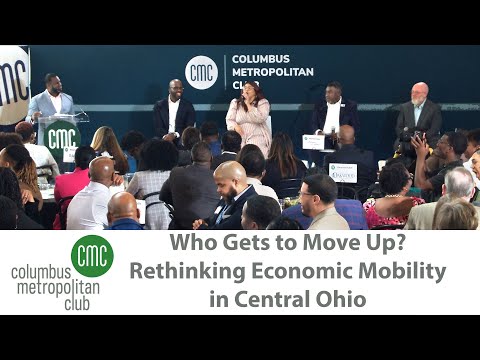
Columbus — New research and local leaders at a Columbus Metropolitan Club forum warned that racial economic gaps in Franklin County are so large they would take centuries to close and urged coordinated, neighborhood‑scale investments, scaled family‑stability programs and aligned housing and transit policy.
Columbus — New research and local experience presented at a Columbus Metropolitan Club forum showed that racial disparities in economic outcomes in Franklin County are exceptionally large and persistent, and panelists said those gaps threaten the region’s long-term growth unless the public, private and social sectors mount sustained, coordinated responses.
Dwayne Pinder, a partner at McKinsey & Company and a founder of the McKinsey Institute for Economic Mobility, summarized the institute’s findings, saying, “At the current pace of change, it would take over 300 years” to close national disparities between Black and white residents, and that for Franklin County the gap would take “700 years.” He added, “we don’t find a county where Black residents have the same outcomes or better as white residents.”
The numbers matter because Columbus is one of the fastest‑growing U.S. regions and the Black population is a principal driver of that growth, Pinder said. “If we do not fix that problem, we could see our population growth and our economic growth not just decline but go away,” he told the audience.
Panelists described practical steps they said should accompany those findings. Jason Rees, an associate professor of city and regional planning at Ohio State University’s Knowlton School of Architecture and an evaluator of Families Flourish, cited program outcomes: "Families in the pilot program for Families Flourish saw their incomes increase by 58%." Rees said more recent data show about 75% of enrolled families had “substantial income growth” after two years, alongside credit‑score and financial‑health gains tied to stable, healthy housing.
Keith Jones, president and CEO of Oakwood Management, emphasized the role of neighborhoods and supports that families need: “When you put them in a neighborhood where the kids can now get a better education, then now we're talking change generationally.” Jones and others said housing stability, access to quality schools, mental‑health and job coaching and financial counseling are part of that package.
Councilwoman Lourdes Barroso de Padilla of the Columbus City Council said the city has adopted policies intended to protect tenants and expand opportunity — citing the Columbus Promise and recent local housing measures — and stressed limits on municipal power. “What you feel every day comes from that State House,” she said, urging residents to track state policy because state actions often override city initiatives. She also characterized current political pressures on language and policy as “modern day censorship” in the context of debate over how to discuss and defend inclusive policies.
Panelists pressed the private sector to go beyond philanthropy and change core business practices. Pinder urged employers to expand hiring in neighborhoods and to adapt products and services — for example, addressing food‑access gaps rather than only funding programs — while Barroso de Padilla and others said private investments in education and workforce training underpin long‑term results.
Several audience questions reinforced policy and program themes. A moderator noted the forum would post a link to the McKinsey report, and the panel referenced local initiatives: Columbus’ recent zoning update (known as Zone In) and the LinkUS transit corridor strategy as tools to concentrate density, amenities and affordable housing along corridors; small‑business supports and targeted neighborhood investments were also discussed as levers to broaden opportunity.
Panelists and questioners also discussed family structure and early childhood investment. Rees and Pinder said research links early childhood programs to later mobility: Pinder cited a commonly used estimate that early‑childhood investments can yield large social returns and increase parental labor‑force participation; Rees highlighted the dual benefit that many early‑childhood educators are Black women, so investment can raise employment and incomes for that workforce while supporting children’s development.
Speakers repeatedly urged a two‑track approach: scale long‑term neighborhood transformation while delivering immediate supports to families. “To turn around a neighborhood that has been disinvested in for 30 or 40 years is going to take 10 or 20 years. Our families can't wait that long,” Rees said.
The forum did not include formal votes or policy actions. Panelists asked for coordinated, accountable efforts focused on a limited number of chronically underserved neighborhoods; concrete proposals included sustained funding commitments, neighborhood‑scale coordination among city, state, philanthropic and corporate actors, and expansion of proven family‑stability programs.
The McKinsey Institute report and the examples given at the forum framed the problem as both an equity and an economic‑growth issue: speakers argued that inclusive growth is necessary to preserve Columbus’s competitiveness and that targeted, sustained interventions are the fastest route to narrowing the gaps documented by the institute.