Get Full Government Meeting Transcripts, Videos, & Alerts Forever!
Get email alerts on the Transit topic
No spam. Unsubscribe anytime.
Lextran presents $37.97 million FY2026 budget, outlines microtransit pilot and fleet priorities
Summary
Fred Combs, general manager of Lextran, presented a balanced FY2026 proposal of $37,968,002 to the Lexington-Fayette Urban County Council work session and described a microtransit feasibility study, a push to replace aging paratransit vehicles and recent gains in paratransit on‑time performance.
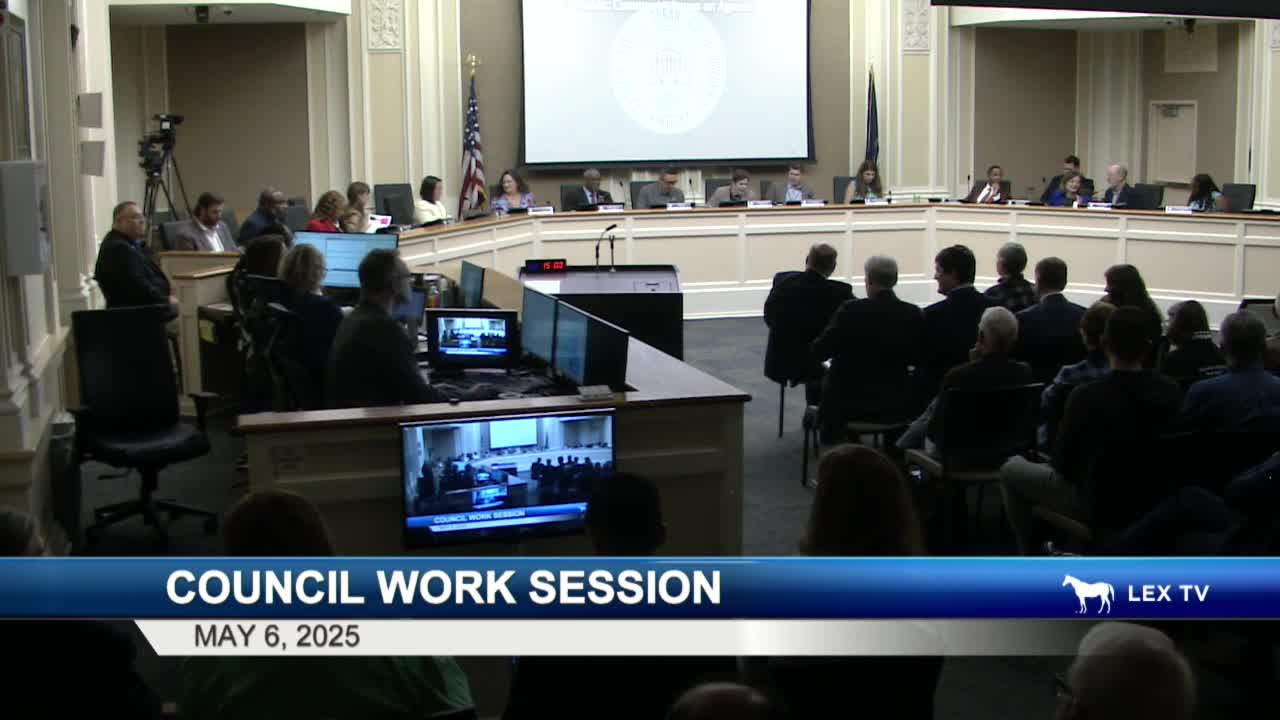
Lexington-Fayette Urban County Council heard a presentation on the Transit Authority of Lexington-Fayette (Lextran) fiscal year 2026 operating and capital budget at its May work session and voted to place a resolution approving the budget on the May 29 council meeting docket.
Fred Combs, general manager of Lextran, told the council the FY26 proposal is a balanced budget of $37,968,002, with about 70% of revenues driven by property tax and a roughly $6 million reserve. Combs said the authority expects about 3.5 million fixed-route trips next year and about 170,000 paratransit (Wheels) trips.
Why it matters: Lextran’s budget sets spending and capital priorities that affect transit frequency, paratransit service quality and the timing of fleet replacements. Combs warned tariffs and uncertain federal funding add pressure to costs and capital planning, especially for paratransit vehicles the authority says are its most significant unmet need.
Combs highlighted capital and service items included or planned in the FY26 package: a transit center interior renovation already under way; completion of compressed natural gas (CNG) fueling and maintenance improvements; ten fixed-route buses and ten paratransit cutaway buses currently in the budget; one additional electric bus covered by an existing grant; and backend technology upgrades for real‑time information. He said the authority has ordered vehicles aggressively because unit prices are rising: “we did take the step of adding to our materials and supplies budget just to be safe.”
On-time performance and paratransit capacity drew sustained council attention. Combs said recent gains moved Lextran’s unaudited monthly paratransit on‑time performance above 80% in April for the first time in years, and he framed that as a step toward a 90% goal: “if that holds to the audit, we’re gonna be very happy. We’re going to celebrate, but we’re gonna remind ourselves that that’s just a stepping stone to the goal of 90%.” He repeatedly tied on‑time performance to fleet capacity for Wheels, noting many of the existing paratransit vans were leased as a short-term measure and the system needs larger vehicles to improve reliability.
Microtransit feasibility and potential pilot Combs reviewed an ongoing microtransit feasibility study funded at roughly $75,000 and described five candidate zones for a pilot. He cautioned the public survey used in the study was not demographically representative and emphasized a communications challenge: many respondents indicated they would use microtransit but fewer said they would use it to access fixed-route bus stops. Combs gave planners’ back-of-the-envelope operating cost assumptions: roughly $100 per vehicle per hour, excluding marketing and overhead, and noted most proposed zones would need two vehicles while a South Side zone would need three.
Combs said the budget submitted for council consideration does not include new recurring operations for a microtransit pilot because operating funds were not identified; he asked for council support for follow-up outreach if the authority proceeds. Council member Ehlinger said he intended to move the budget be docketed for May 29 and scheduled for a June 12 vote; after discussion that motion was made, seconded and approved by the council.
Council questions and context Council members pressed staff on several items: the make-up of Lextran’s operating cash (Combs said large property-tax receipts are received each November and spent throughout the year and that the authority must hold liquidity to match federal grants), the $6 million reserve (Combs described it as an economic contingency “do not touch until it’s an absolute emergency”), staffing and collective bargaining progress, and how tariffs and supply chain uncertainty might affect vehicle procurement. Combs said Lextran pushed to get 10 paratransit vans on order because vendor pricing is expected to rise.
Combs outlined unfunded priorities that would require future capital or operating dollars: additional paratransit vehicles, transit center exterior safety upgrades, and replacement of an aging fare-collection system. He said service improvements (more frequency or new direct routes) are not in the FY26 operating budget but remain policy priorities if funding becomes available.
Public comment and stakeholder remarks Several public speakers at the work session urged faster progress on microtransit and broader transit access. Gail Swanson, board member of BUILD, said transportation is a major barrier to health care and employment and urged Lextran to adopt a microtransit pilot that serves people with mental‑health needs. Pastor Adam Jones described church-led van transportation and said many congregation members had stopped using buses because service was unreliable; he urged a pilot sooner than later.
What’s next The council voted to place a resolution approving Lextran’s FY26 budget on the May 29 council meeting docket; the motion was moved by Council member Ehlinger and seconded by Council member Morton. The council will take up first reading on May 29 and second reading on June 12 per the motion on the floor.
Details clarified at the meeting: the FY26 budget number ($37,968,002); the $6 million reserve; an anticipated 3.5 million fixed-route trips and 170,000 paratransit trips; planned procurement of ten fixed-route buses and ten paratransit cutaways; one electric bus funded by an existing grant; and the microtransit cost assumption of about $100 per vehicle per hour.
— Reporting from the Lexington-Fayette Urban County Council work session