Get Full Government Meeting Transcripts, Videos, & Alerts Forever!
Get email alerts on the Water Wastewater topic
No spam. Unsubscribe anytime.
County says spreading service‑area debt 'not feasible'; water/wastewater rate options draw resident concern
Summary
County staff told commissioners that distributing existing water/wastewater service‑area debt and deficits across all equivalent dwelling units—the previously advertised “option 3”—is not feasible, and staff presented alternative rate structures that residents said could sharply increase quarterly bills for some communities.
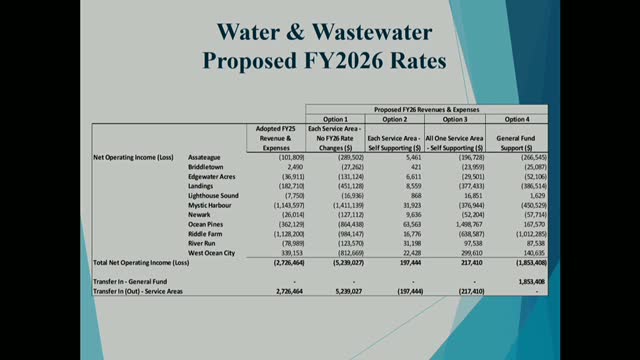
County staff presented four advertised options for balancing water and wastewater enterprise funds and the proposed FY2026 rates for about 18 service areas, then told the commissioners that the option that would have spread existing debts and deficits equally across all equivalent dwelling units (EDUs)—previously advertised as “option 3”—is not technically feasible.
Weston Young explained the enterprise funds include one solid‑waste fund and 11 water/wastewater service areas; the total enterprise budgets rely heavily on charges for services. He described four scenarios: a do‑nothing option with no rate changes; an option where each service area charges what it needs to be self‑supporting (which would produce very large quarterly bills for some small service areas); “option 3,” advertised earlier, that assumed spreading existing service‑area debt and deficits equally per EDU; and “option 4,” similar to option 3 but using a general‑fund loan to cover the deficit. Young told commissioners that since the budget was locked in March staff concluded spreading deficits and debts as contemplated would require code changes or bond counsel reservations, and therefore option 3 (and similarly option 4 in its advertised form) is effectively off the table.
Young outlined proposed rate changes: a uniform base fee per EDU, a uniform $5 per 1,000 gallons usage fee for baseline single‑family usage and $15 per 1,000 gallons for usage above the quarterly baseline (22,500 gallons), and a uniform accessibility fee for EDUs that are connected but not in service. He said some service areas that purchase water or sewer from third parties would simply pass through those third‑party rates.
Staff presented specific service‑area impacts. Examples from the presentation included Ocean Pines (about 9,200 EDUs; roughly $1,000,000 projected expense increase over FY25), Mystic Harbor (about 1,600 customers; $454,000 projected increase), Riddle Farm (over 600 customers; plants offline and costs for pumping and hauling), Assateague Point (500+ non‑metered trailers; $227,000 projected increase largely for capital), and Landings (about 300 customers; County said a wastewater plant cannot yet adequately dispose of effluent and the proposed self‑supporting rate would exceed $600 per quarter under one option).
Public commenters representing service areas and boards warned that the scale of potential rate increases would be cost‑prohibitive for many residents and urged commissioners to avoid spreading debt beyond the service areas where it originated. Jenny Mumford, speaking for the Newark service area, said enterprise funds should remain self‑supporting under law and warned against centralizing control; Richard Engleman and other Landings residents said a proposed option would add roughly $1,300 in annual cost per owner and urged alternatives; Elaine Brady and other Ocean Pines representatives asked for an audit of the enterprise funds and called for careful, fair solutions rather than rushing.
Young and commissioners said staff will return with alternative scenarios at the next budget work session. Commissioners and staff also noted that some previously‑advertised scenarios are infeasible without code changes or bond counsel approval, which affects timing and the legal authority to spread debt across service areas.
Ending: Staff scheduled further budget work sessions the week of May 13 to present revised enterprise‑fund scenarios and options for commissioners to consider prior to June adoption votes.