Get Full Government Meeting Transcripts, Videos, & Alerts Forever!
Get email alerts on the Senior Needs Assessment topic
No spam. Unsubscribe anytime.
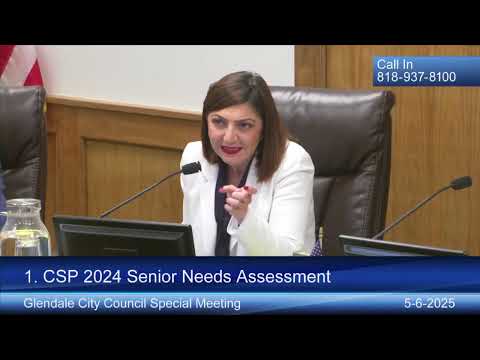
Glendale council accepts 2024 Senior Needs Assessment, highlights housing and transportation gaps
Summary
At a May 6 special meeting the Glendale City Council accepted an updated 2024 Senior Needs Assessment that documents rising housing cost burdens, transportation and nutrition gaps and proposes five recommendations including expanded housing support, a service navigator program and transportation and emergency-preparedness measures.
The Glendale City Council on May 6 accepted the City’s 2024 Senior Needs Assessment, an update to a 2017 study that the consultant said was conducted from 2023–24 to guide services for a rapidly growing older-adult population.
The study, presented by Aaron Salios of Maroon Society Incorporated, surveyed 1,205 community members and used stakeholder interviews and focus groups to analyze needs across 10 domains of livability. "This is a study that has been conducted over the past 2 years," Salios said during the presentation.
The report found the city’s older-adult population has grown by about 42% over two decades—rising from roughly 35,000 to nearly 50,000 based on 2023 estimates—and identified housing as the primary need. Among renters in the survey, 70% were cost-burdened (defined in the report as spending more than 30% of household income on housing), while only about 21% of senior homeowners were cost-burdened. The report recommends exploring more affordable-housing options, financial assistance programs and landlord incentives or other measures to reduce seniors’ housing costs.
Health and community support needs also emerged: only about 45% of older adults who said they need help with activities of daily living are receiving adequate support, and 11% of surveyed seniors reported going hungry sometimes. The consultant recommended a service navigator program and an annual nutrition outreach initiative; Salios noted that the city’s existing nutrition program reaches relatively few of those reporting food insecurity.
Transportation findings showed 70% of surveyed older adults drive, 30% do not, and only about 11% rely on public transit. The assessment documented a concentration of seniors in northern neighborhoods and senior housing in southern neighborhoods and showed a visual relationship between areas of higher senior population density and pedestrian collisions. Salios said data provided by Glendale Police Department indicate older adults are overrepresented in pedestrian fatalities over the past five years.
Council members asked for more granular data and follow-up. Councilmember Brotman pressed the consultant on landlord incentives and cited Santa Monica as an example of city-level rent controls or additional protections; the consultant cautioned that he did not have a specific local recommendation and that political feasibility would vary. Brotman also urged the city to examine intersection design and traffic-control devices as part of efforts to reduce pedestrian collisions involving seniors.
Public commenters urged quicker financial relief for seniors. Beth Brooks, who identified herself as a resident, called the situation "a huge crisis" and urged direct rental assistance rather than waiting for new construction. Herbert Molano, a longtime advocate who spoke during public comment, said the assessment should inform budget priorities and urged aligning departmental spending with the report’s findings.
City staff said the report’s appendices contain the raw data and would be shared with council members on request; during roll call the council voted to accept the report. The council did not take budgetary action at the May 6 meeting; staff and council members discussed using the findings to inform future budget decisions and program development.
The report’s five headline recommendations are: expand housing support for older adults; enhance access to health, nutrition and community supports (including a service navigator and outreach); improve transportation infrastructure and pedestrian safety (including shuttle pilots and pedestrian improvements); increase senior-focused emergency-preparedness outreach and multilingual toolkits; and combat isolation through village-style mutual-support programs coupled with technology-literacy training.
Council members and staff said they expect departments to use the assessment when preparing budget requests and program plans; the report was accepted and placed on file, with staff to return with supporting data and, where appropriate, proposals for implementation.