Get Full Government Meeting Transcripts, Videos, & Alerts Forever!
Clear Creek delays final decision on I‑70 Floyd Hill 10‑41 permit, asks CDOT for clearer monitoring and lasting operations oversight
Summary
After a day‑long public hearing and hours of discussion, Clear Creek County commissioners continued the county's review of CDOT's central Floyd Hill 10‑41 permit package to May 13 and required clearer, written commitments on air, noise and water monitoring, ongoing operations oversight and truck access rules.
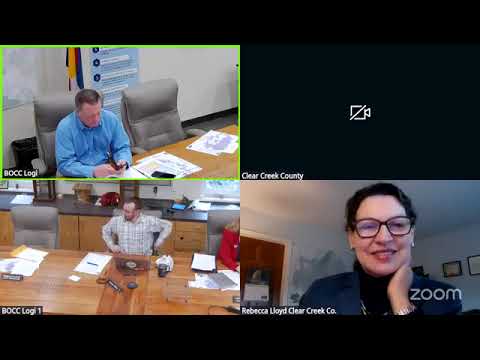
Clear Creek County commissioners on Tuesday continued their review of the Colorado Department of Transportation's (CDOT) "central section" 10‑41 permit for the Floyd Hill project, delaying a final vote until a special meeting May 13. Commissioners asked CDOT and county staff to return with tightened, written conditions on long‑term monitoring, reporting and an operations oversight team before the board signs off.
The continuation came after roughly four hours of testimony and back‑and‑forth between county staff, CDOT project leaders and residents. Commissioners, staff and some public commenters said the county lacks a clear, durable plan to measure the project's local impacts and to make operational fixes after construction ends.
Why it matters: The Floyd Hill project is the central, most complex phase of an 8‑mile reconstruction of I‑70 between the top of Floyd Hill and the Veterans Memorial Tunnel. CDOT plans to add a third westbound lane with an express/toll component and to realign curves, build multiple bridges and complete frontage roads. Commissioners acknowledged safety, mobility and environmental benefits CDOT asserts, but said county impacts on air quality, noise and emergency response require firmer commitments from the state before the permit is finalized.
Most important facts
- The board continued consideration of Resolution 25‑47 — the county's 10‑41 permit for the Floyd Hill project — and set a follow‑up hearing for May 13 at 10:30 a.m. at the Health & Wellness Center in Idaho Springs.
- County staff identified four of the 35 10‑41 approval criteria the application did not meet as submitted, including: (1) potential adverse effects on local public services and emergency responders, and the resulting financial burden on the county, and (2) noise limits the project would exceed. Staff also reported the county lacked a usable baseline for some air‑quality measures, making impacts difficult to interpret.
- Commissioners required CDOT to return with clarified, written conditions that include: a continuing operations and safety/maintenance (CSS) team with county participation; annual reporting on water, noise and mobility; a plan for particulate monitoring during construction and a pre/post sampling plan for gases; a timetable and public meeting schedule for reviewing monitoring results; and proposed language to reflect current state law restricting commercial vehicle access to the express lane on Floyd Hill.
What CDOT told the board
Kirk Kianka, Floyd Hill project director for CDOT, described the central package as the section with the largest structures and the biggest geometric fixes, and said the planned third westbound lane will reduce recurring congestion when the Mountain Express lane is open. "Adding that lane and connecting it into the Mountain Express lane will provide that relief," Kianka said.
CDOT environmental manager Abby Madoffrey reviewed mitigation and monitoring CDOT has committed to under the project's NEPA record: riparian bench work, habitat connections beneath structures, a new 5th continuous creek monitor downstream of Johnson Gulch and a discrete water‑sampling plan with nine sample points sampled four times per year (including storm‑event sampling).
What county staff said
County planning staff warned the board that, as submitted, the application left several public‑interest criteria unresolved. "We determined ... the existing adverse effects of I‑70 are significant and the added capacity will only exacerbate those adverse effects," the staff report said; staff recommended approval only after adding substantial monitoring and reporting conditions.
Chair Marlon pressed for clearer, actionable reporting. "We cannot accept this project without knowing that we're gonna be monitoring air quality so that at least we have the information to respond," the chair told CDOT and staff during the hearing.
Key numbers and monitoring commitments discussed
- Noise: CDOT's most recent noise modeling shows one‑hour equivalent levels averaging roughly 67–80 A‑weighted decibels in some locations noted in the staff report; county noise standard used for review is 55 dB (1‑hour equivalent).
- Water sampling: CDOT agreed to a discrete water sampling plan during construction and a commitment to continue sampling for two years after construction for the discrete sampling program. Separately, CDOT agreed to keep the continuous stream monitoring network (the corridor's four/five monitors) operating for the foreseeable period agreed to by stakeholders.
- Air quality: the parties agreed to a pre‑project gas sampling report and a comparable six‑month post‑project gas sampling window that mirrors the preconstruction sampling window; particulate matter (PM) monitoring will continue during construction and through the two‑year discrete sampling period. County staff asked CDOT to prioritize a monitoring approach that produces usable data for county planning and public health purposes.
- Safety and finance: county staff documented that Clear Creek County provides incident response far more often than its resident population would suggest, and that increases in corridor capacity could increase incident volume and local costs. Commissioners asked CDOT to convene a standing incident debrief team and to provide twice‑annual safety reporting to the county for review.
What the board asked CDOT to return with
- Written, final permit conditions that include: (a) an operations‑phase CSS maintenance/safety team with county representation and a public meeting schedule; (b) annual and biannual reporting templates for water, noise, particulate matter and safety statistics; (c) a gas sampling plan that matches the preconstruction sampling windows; (d) an explicit plan for coordinating river sampling with the county and with contractors; (e) a proposed toll‑lane enforcement/toll‑data reporting approach, to the extent legally available; and (f) specific signage and operational language tied to the current state statute restricting commercial vehicles in the express lane on Floyd Hill.
Board action and next steps
The board voted to continue the hearing and reconvene May 13, 2025 at 10:30 a.m. at the Health & Wellness Center in Idaho Springs so staff and CDOT could finalize the written conditions. The board requested draft language for the truck/access restriction and a consolidated draft of the conditions in advance of the reconvened hearing.
Ending
Commissioners said they remain broadly supportive of safety features CDOT described but want concrete, durable commitments the county can use to evaluate the project's long‑term local impacts and to trigger remedial steps if monitoring shows unacceptable effects.
Speakers
- Garrett McAllister, planner/project panelist, Colorado Department of Transportation (CDOT). First referenced 2025-05-06T12:01:00Z (topicintro) - Kirk Kianka, Floyd Hill project director, Colorado Department of Transportation (CDOT). First referenced 2025-05-06T12:46:00Z - Abby Madoffrey, Floyd Hill and I‑70 corridor environmental manager, CDOT. First referenced 2025-05-06T13:17:00Z - Amy (last name not specified), planning manager, Clear Creek County. First referenced 2025-05-06T13:33:00Z - Chair Marlon, Clear Creek County Board of County Commissioners (referred to in transcript as Chair Marlon / George). First referenced 2025-05-06T12:09:00Z - Joanne (resident), Mill Creek Road, public commenter. First referenced 2025-05-06T15:17:00Z
Authorities
- statute: type: "statute", name/description: "Senate Bill 24‑100 (commercial vehicle restrictions)", citation: "SB 24‑100; see 42‑4‑1014", referenced_by: ["truck_access"] - other: type: "other", name/description: "Clear Creek County 10‑41 permit criteria (local review standard)", referenced_by: ["project_review"]
Actions
- kind: "other", identifiers: {resolution_number: "25‑47"}, motion: "Continue consideration of the 10‑41 permit for the Floyd Hill central section and reconvene May 13, 2025 at 10:30 a.m. (Health & Wellness Center, Idaho Springs)", mover: "Commissioner (unnamed)", second: "Commissioner (unnamed)", vote_record: [{member:"Board of County Commissioners",vote:"yes"}], tally: {yes:3,no:0,abstain:0}, outcome: "postponed", notes: "Board requested consolidated draft conditions and statutory language on commercial vehicles before final action."
Discussion_decision
- discussion_points: ["Noise modeling shows 1‑hour equivalent levels higher than county threshold in some locations (approx. 67–80 dB)","CDOT to add a fifth continuous creek monitor and perform discrete sampling at nine locations; discrete sampling to continue through construction + 2 years","County staff concerns that increased corridor capacity could increase incidents and local emergency costs","Need for annual/biennial reporting templates and public meetings to review results"], - directions: ["CDOT to provide written draft permit conditions, including monitoring schedules and operational CSS team membership, before May 13 public…
Already have an account? Log in
Subscribe to keep reading
Unlock the rest of this article — and every article on Citizen Portal.
- Unlimited articles
- AI-powered breakdowns of topics, speakers, decisions, and budgets
- Instant alerts when your location has a new meeting
- Follow topics and more locations
- 1,000 AI Insights / month, plus AI Chat