Get Full Government Meeting Transcripts, Videos, & Alerts Forever!
Get email alerts on the Athletics Policy topic
No spam. Unsubscribe anytime.
Board reviews 2025–26 athletic handbook updates including FHSAA sportsmanship course, transfer appeals process and ticketing change
Summary
Coach Cupp presented proposed revisions to the 2025–26 athletic handbook covering required NFHS/FHSAA training, attendance and eligibility clarifications, a good-cause transfer review committee, a clearer sideline-cheer policy, and a plan to raise varsity football ticket prices while eliminating parking cash collection.
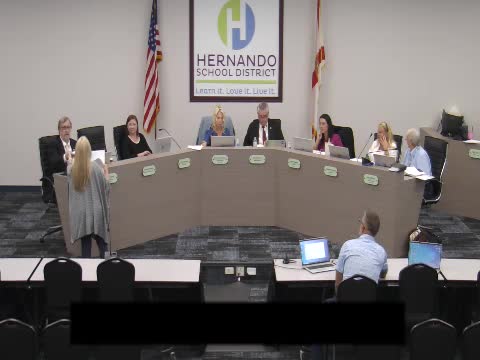
Coach Cupp presented proposed changes to the district’s 2025–26 athletic handbook at a Hernando County School Board workshop and answered board questions about eligibility, transfers and fees.
Cupp told the board the Florida High School Athletic Association (FHSAA) recently added a sportsmanship module to required coursework for student-athlete registration; the handbook language was updated to include that new requirement in the list of mandatory modules. Cupp also described a number of clarifications intended to make athletic eligibility and discipline language more explicit, including how excessive unexcused absences and ISS/OSS affect participation and practice status.
Cupp said the handbook will explicitly state that students placed on 45 days of home instruction through an IEP committee are ineligible to participate or practice during that period. He also discussed adding a "good-cause" transfer review committee for contested in-season transfer cases; that committee would be convened on request, include rotating principals and athletic directors (not from the schools involved), the supervisor of school choice, and the director of student services or designee, and would provide a transparent, external review when a principal needs assistance deciding whether a transfer meets FHSAA good-cause criteria.
The handbook draft distinguishes competitive cheer (a sanctioned sport) from sideline cheer (treated as a club) and sets minimum expectations for tryouts and eligibility while allowing local administrators to set additional standards. The draft also clarifies that coaches are responsible for student-athletes while administrators are responsible for adult spectators.
On transportation, board member Dustin raised concern about students leaving events with non-parent drivers and asked the district to capture rideshare or alternate-driver details (driver name, plate, vehicle make/model) when students depart with nonparents. Cupp said he would work with athletic directors and administrators to add clearer procedures.
Cupp told the board the draft removes cash parking collections (frequently used at varsity football) and proposes raising single-game varsity football ticket prices to $10 to offset lost parking revenue. He said that among surveyed counties, several charge $10 and that $10 for varsity football would be within regional norms. A board member noted the cost of officials and clock operators (an official may be paid about $125, a clock operator about $77 for a varsity football game) as context for the revenue discussion.
The handbook would add use of the SportsU communication app and a platform called HonestGame to help student-athletes track NCAA eligibility steps. Cupp also described language to give athletic discipline "teeth" (for egregious unsportsmanlike acts) while noting that some athletic misconduct may also trigger school-based discipline under the student code of conduct.
Cupp closed by noting the handbook committee included coaches, athletic directors, principals and parent members; he asked the board to review the packet and offer feedback. The workshop recorded the item as a review/tentative-approval presentation; no formal roll-call vote to adopt the handbook was recorded in the workshop transcript.