Get Full Government Meeting Transcripts, Videos, & Alerts Forever!
Get email alerts on the Land Use Development topic
No spam. Unsubscribe anytime.
Planning commission denies Epiphany Cathedral parking-lot site plan after residents and commissioners raise stormwater and access concerns
Summary
The City of Venice Planning Commission voted 6–1 to deny a site development plan to pave and reconfigure an overflow parking lot at Epiphany Cathedral, citing insufficient information on stormwater, ingress/egress and parking impacts despite staff and technical reviews that found the proposal compliant with code.
On May 2025 the City of Venice Planning Commission voted 6–1 to deny site development plan petition 24-47-SP, a proposal to pave and reconfigure an existing “shell” overflow parking lot used by Epiphany Cathedral.
The petition would have replaced the gravel lot with a paved surface, added sidewalks on three sides, parking medians and landscaping, and relocated the lot entrance to Park Lane Drive. Staff said the Technical Review Committee (TRC) reviewed the plan for parking, lighting, landscaping and the city standard that remote parking be within 1,000 feet of its principal use, and that the city engineer had determined the proposed stormwater design met the city’s 25-year, 24-hour storm-event threshold. Staff also reported that the city’s traffic consultant found the proposal compliant with applicable standards.
Neighbors who spoke at the public hearing opposed the Park Lane entrance and cited safety and drainage problems. Residents said Park Lane and nearby Tarpon Street and Bayshore frequently flood during heavy rain and that the neighborhood includes elderly pedestrians, young children and park users who use Prentice French Park adjacent to the site. One resident suggested rotating the entrance back to Harbor Drive to keep traffic off the residential street. Speakers also questioned whether paving the lot would increase runoff into nearby streets and private yards.
Representatives for the applicant said the project would improve safety and accessibility. A representative identified himself as the chair of the Epiphany Cathedral building committee said the church has invested in landscaping to screen the lot, that the paving project would cost “in excess of $200,000,” and that the work would add lighted crosswalks, sidewalks and landscaping. Agent Alex Wordsworth (DMK) told commissioners the design included a dry retention area in the median and a proposed drain that would convey runoff to an outfall at Harbor Drive; he said the outfall segment on Harbor Drive would be above ground.
City Planning and Zoning Director Roger Clark confirmed to the commission that the stormwater improvements shown on the plan are proposed additions and that engineering staff had reviewed the calculations and determined the design complied with the city’s stormwater standard for the 25-year, 24-hour event.
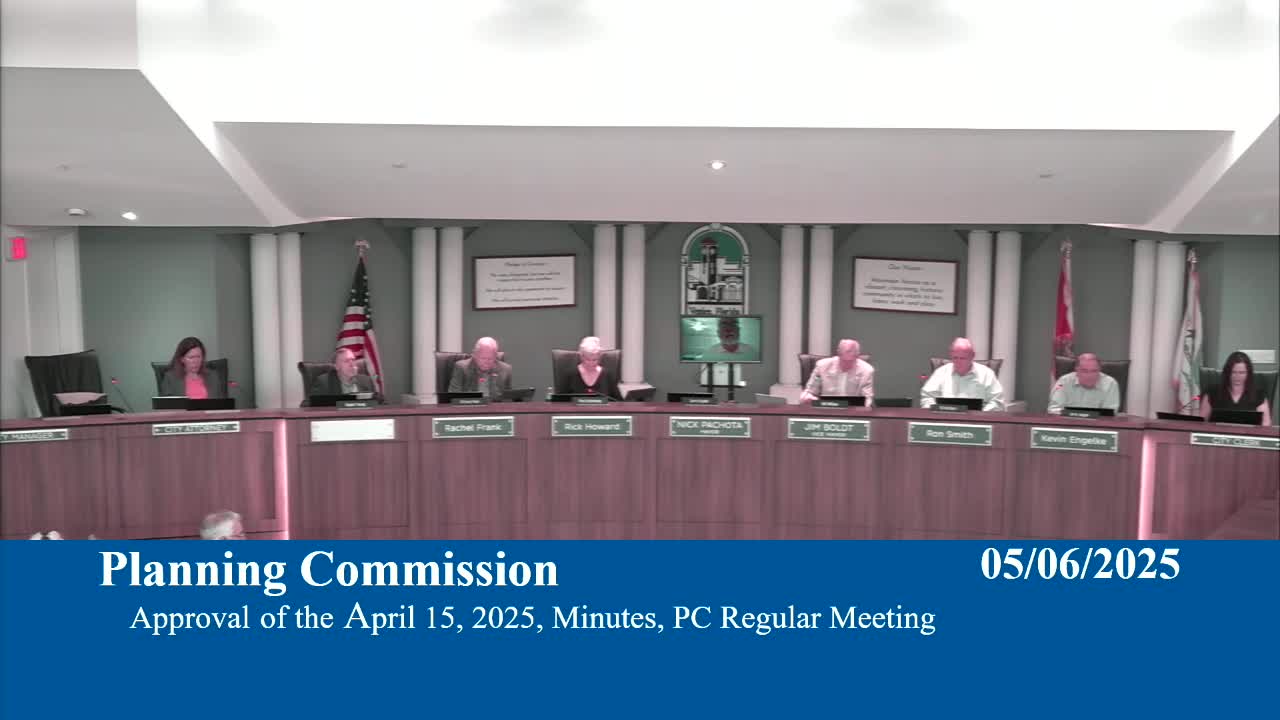
Several commissioners said they were not satisfied with the level of technical detail available at the hearing. Commissioner Kent moved to deny, saying the commission had “insufficient information at this point in time to make a decision” on elements including stormwater mitigation, ingress/egress and parking. The motion was seconded and amended during discussion to cite the decision criteria in City of Venice Land Development Code section 1.9.0.4 (general review criteria, including layout and drainage). The motion to deny carried 6–1; the chair recorded six votes for denial and one against.
The record shows competing factual claims: staff and the TRC reported plan-level compliance with the land development code and with city engineering and transportation review, while multiple residents and several commissioners said the hearing lacked ready access to the project’s engineering and design professionals and therefore lacked the information they needed to approve the plan.
The hearing was closed after the vote and the commission moved on to the next agenda item.