Get Full Government Meeting Transcripts, Videos, & Alerts Forever!
Get email alerts on the Tax Policy topic
No spam. Unsubscribe anytime.
Delaware City finance committee begins workshop to craft written taxation policy
Summary
At a May 6 Finance Committee workshop, consultant David Conley outlined a framework for a written taxation policy for Delaware City, stressing demographic trends, the city’s heavy reliance on income tax revenue and options to diversify revenue and set long-term fiscal goals.
Delaware City’s Finance Committee on May 6 held a workshop with consultant David Conley to begin drafting a written taxation policy intended to guide long-term revenue and spending choices.
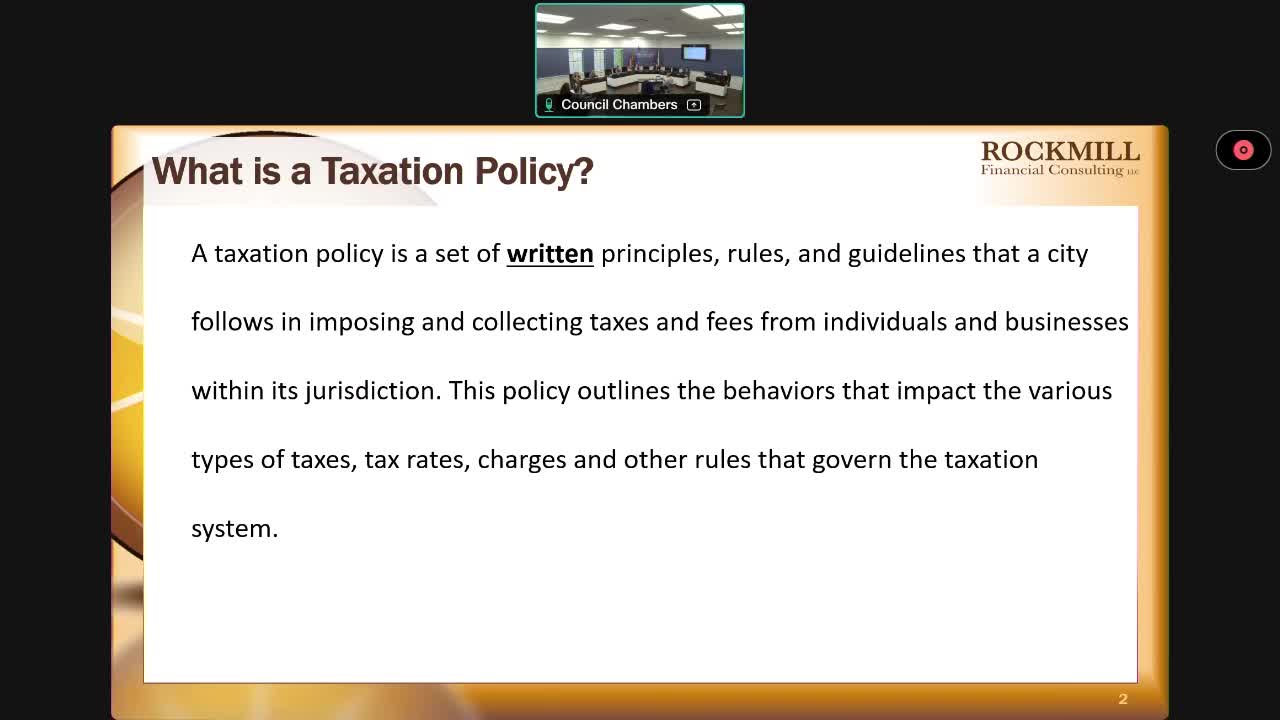
David Conley, president of Rock Mill Financial Consulting, led the session and asked committee members to treat “tax” broadly. “When I use the word tax, it isn't just the income tax. It's every way that you bring money into the city to support the services that you provide to your residents,” Conley said, urging the committee to document the city’s implicit priorities in a formal policy or set of guidelines.
Why it matters: Conley said Delaware City currently relies heavily on income taxes (about two-thirds of general fund revenue), has relatively low property millage compared with peer cities and is experiencing demographic shifts that could raise the share of residents on fixed incomes over time. Those factors, he said, create trade-offs about affordability, service quality and how often officials should return to voters for new revenue.
Major points from the presentation
- Demographics and revenue implications: Conley showed U.S. Census updates and argued Delaware City’s median age and income distribution are changing. He said the city’s population now includes a larger share of residents in the 45–64 and 65+ age brackets and that roughly a quarter of residents are on fixed incomes. He warned that growing shares of residents on fixed incomes could increase sensitivity to fee and rate changes.
- Current revenue mix and property tax mechanics: Conley said roughly 66 percent of Delaware City’s general fund revenue comes from income tax and that inside property millage assigned to the city is 2.7 mills. He also highlighted that one mill in Delaware generates roughly $1,700,000 annually. Conley noted the city recently paid off a long‑standing police/fire pension obligation and that about 0.6 mills tied to that obligation will flow to the general fund beginning in 2026.
- Options and policy goals: Conley recommended the committee consider an explicit sustainability horizon (for example, a goal to avoid returning to voters for a set number of years), a clear statement about whether the city prioritizes residents or businesses for tax burden, and specific objectives such as diversifying revenue, limiting reliance on a single revenue source, or creating tax incentives and disincentives to shape development.
- Fee and assessment reviews: Committee members and Conley discussed reviewing fees and permits on a regular schedule (Conley and a member suggested at least once every three years), evaluating parking fees as a potential visitor revenue source, and reexamining impact fees, assessments and utility capacity charges tied to growth.
- Debt and cash management: Conley reviewed the city’s outstanding general obligation debt schedule and urged the committee to include guidance on when to use debt versus pay-as-you-go approaches. He described a possible policy waterfall for excess fund balances (for example: invest in capital or services, pay down debt, then consider tax reductions).
- Relationship with school district and annexations: Conley warned that development which falls into other school districts (he cited new residential development in the Bixby area in Buckeye Valley) could change the combined tax burden for some residents, and suggested the city consider that overlap when evaluating affordability and competitiveness.
Committee input and next steps
Alicia (Finance Committee member) called Conley’s demographic slides “a static snapshot in time,” noting the city can use policy to shape future demographics. Committee members urged closer coordination with the Delaware City School District on shared impacts and asked Conley for more detailed financial models.
Conley said he will provide a follow-up package that includes: a merged analysis of city and school tax costs for comparison with peer jurisdictions; an actuarial-style volatility model to propose minimum and maximum general fund balances; a detailed look at debt capacity and payoff timing; and suggested language drafts for policy goals and objectives. The committee scheduled a longer follow-up meeting to review those materials.
Votes at a glance
- Approval of motion summary from the Finance Committee meeting of Jan. 21, 2025: motion made and seconded; committee approved (no roll-call recorded on transcript). - Motion to adjourn at 5:25 p.m.: motion made and seconded; passed.
Ending
Conley closed by encouraging members to send questions and suggestions ahead of the next session. He said the forthcoming materials will move the committee from broad principles into specific policy language and fiscal modeling for committee review.