Get Full Government Meeting Transcripts, Videos, & Alerts Forever!
Get email alerts on the Transportation Impact Fees topic
No spam. Unsubscribe anytime.
Marion County staff to draft ordinance seeking extraordinary-circumstance waiver to raise transportation impact fees
Summary
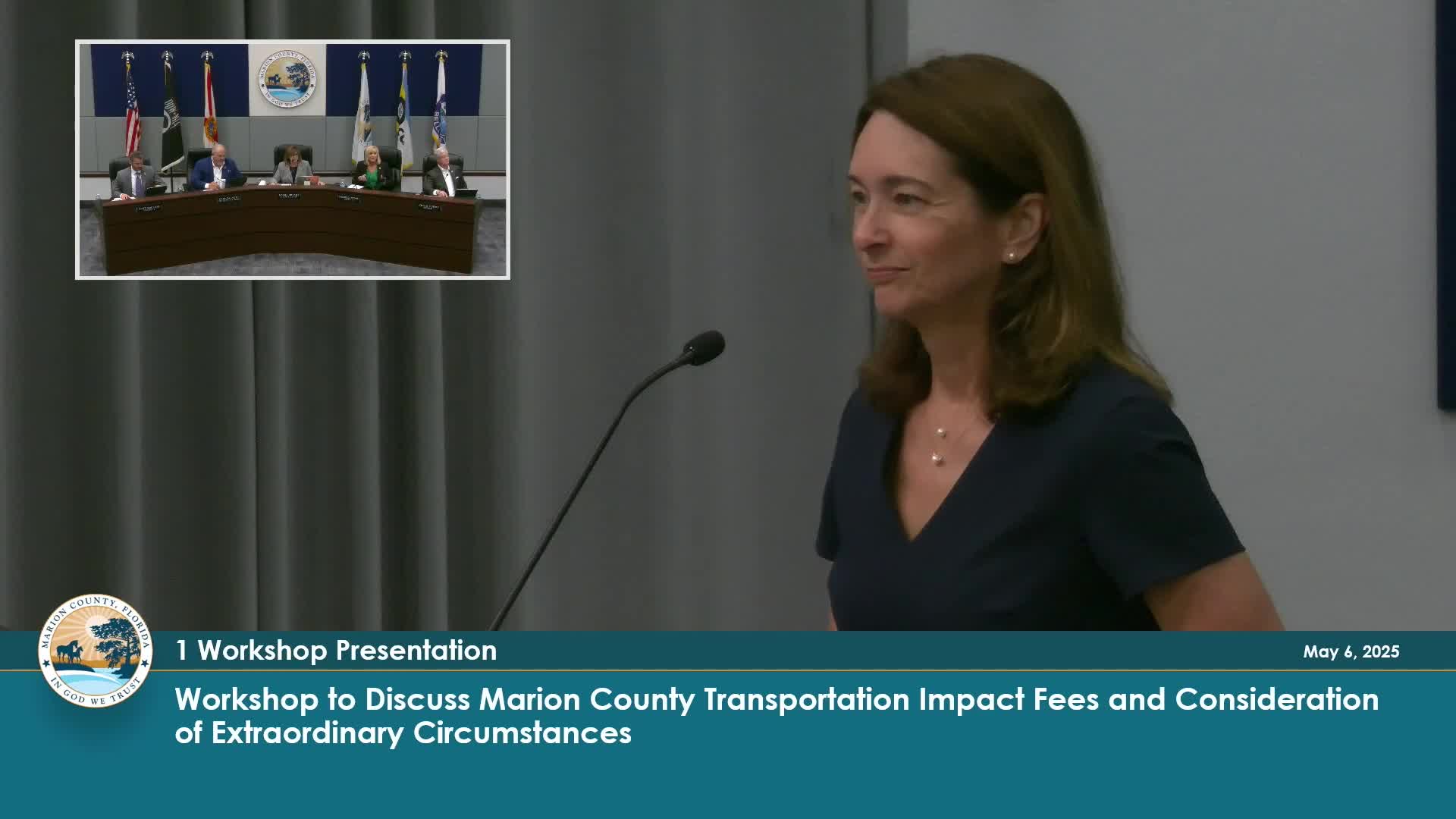
Marion County commissioners directed staff at a May 20 workshop to prepare a draft ordinance declaring ‘‘extraordinary circumstances’’ so the county can consider raising transportation impact fees above statutory phasing limits and bring the proposal to a May 23 public hearing.
Marion County commissioners directed staff at a May 20 workshop to prepare a draft ordinance declaring ‘‘extraordinary circumstances’’ so the county can consider raising transportation impact fees above statutory phasing limits and bring the item to a public hearing on May 23, 2025.
Assistant County Administrator Tracy Straub opened the workshop and described the statutory framework that governs impact‑fee increases. ‘‘Florida Statute 163.3801 allows the board to consider extraordinary circumstances necessitating the need to exceed the phase‑in limits associated with transportation impact fees,’’ Straub said, noting this was the second of two required public workshops and that any adopted increase would become effective at least 90 days after adoption.
Consultant Niigun Kemp of BNISH summarized the study results and the financial gap the county faces. Kemp said the county adopted impact fees in 2015 at 11%–20% of the calculated full rates and that, because of recent permitting and construction‑cost increases, the ‘‘calculated rates indicate a significant increase compared to those fees.’’ Kemp told commissioners the county has identified roughly 36 transportation improvements totaling about $800 million and that long‑range modeling shows about 20% of lane miles would remain over capacity after projects in the cost‑feasible plan are built. Kemp said estimates to bring those over‑capacity lane miles up to standard approach $1.6 billion.
Kemp presented revenue scenarios: at the full calculated fee the county could generate an estimated $23 million–$29 million per year; under the statutory 50% increase cap the county would generate roughly $9 million–$11 million per year. Over 20 years, Kemp said full rates could yield about $470 million–$578 million while the phased/capped revenues would be substantially lower, producing a shortfall relative to identified needs.
Commissioners debated pace and scale of any increase. Commissioner McLean said he understood the need but opposed ‘‘implementing in one fell swoop too high of an impact fee’’ and preferred a gradual increase. Commissioner Bryant argued the county needs additional revenue tools to fund a ‘‘first‑class transportation system’’ and said impact fees are one tool alongside the sales tax. Vice Chairman Zalick and others emphasized both the county’s rapid growth (top third of Florida counties by several metrics, the consultant noted) and the uncertainty of future state‑level changes to revenue sources.
The board also discussed a letter from the City of Ocala asking for a separate impact‑fee district inside the city and for clarity on coordination and transparency so fees collected inside city limits would benefit the city system. A county speaker said an ordinance could be drafted to create a third district for Ocala and that staff can explore an interlocal agreement covering timing and project coordination.
Straub summarized next steps: staff will prepare a draft ordinance with options (including a 50% increase and a stepped/phased approach), advertise for the May 23 public hearing, and present finalized language for the board’s decision. Straub cautioned that the workshop itself cannot adopt the ordinance and that state law requires either a two‑thirds vote to exceed phasing limits (per currently effective statute) or—if recently proposed state changes take effect—a unanimous vote and additional conditions.
The workshop included extended discussion of implementation capacity, maintenance versus capital funding limits, and the effect of permitting and cost volatility on projections. County Engineer Stephen King said design and construction work is in progress and estimated the county would spend more than $120 million this calendar year on projects that are under contract or purchase order. The board scheduled the public hearing for May 23, 2025, with transportation on the afternoon agenda.