Get Full Government Meeting Transcripts, Videos, & Alerts Forever!
Get email alerts on the State Tax Bill topic
No spam. Unsubscribe anytime.
House Taxes Committee advances $0-tax-increase omnibus; moves bill to Ways and Means after adopting amendments
Summary
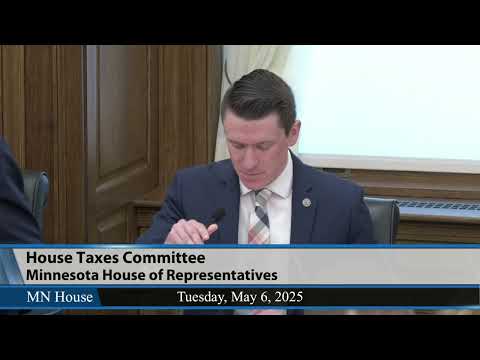
The Minnesota House Taxes Committee on Tuesday voted to re‑refer House File 2437, the 2025 tax omnibus, to the Ways and Means Committee after adopting two amendments by voice vote.
The Minnesota House Taxes Committee on Tuesday advanced House File 2437 — the 2025 tax omnibus — by voice vote after adopting two amendments and hearing a multi-hour overview from nonpartisan staff and testimony from state officials, municipal leaders and interest groups.
The committee adopted the DE amendment (A25‑75) and the author’s amendment (A1) by voice vote and then re‑referred the bill to the House Ways and Means Committee. Nonpartisan staff walked members through the bill’s 10 articles; House Fiscal provided a spreadsheet showing estimated fiscal effects, and several public witnesses offered support or warned about specific provisions.
Why it matters: HF2437 packages numerous tax policy items that would affect state revenues, local aid and targeted programs across Minnesota. Key proposals include a $100 “baby bonus” added to the Minnesota Child Tax Credit effective tax year 2028, a direct free‑file option for state returns, changes to tax increment financing (TIF) authority for specified cities, modifications to property‑tax classifications and exemptions, and programmatic changes such as an upfront premium‑cigar exemption for certain out‑of‑state sales and alterations to Sustainable Forest Incentive Act (SFIA) payments. The bill also proposes canceling balances in the local government cannabis aid account and repealing the state tax on illegal cannabis and controlled substances — changes that several local governments and counties flagged during testimony.
Most important provisions and fiscal notes
- Child tax credit newborn bonus: The bill, as amended, adds a $100 newborn bonus to the Minnesota Child Tax Credit, effective in tax year 2028. Nonpartisan fiscal staff estimated a $2.4 million fiscal impact in the tail biennium for that provision alone.
- Direct free file (tax modernization): The bill funds a state‑run direct filing option for Minnesota taxpayers. House Fiscal showed a transfer into the tax modernization account (a general‑fund transfer of roughly $2.397 million in the fiscal 2027 year was noted) and one‑time costs for implementation (special revenue spending lines showed multi‑hundred‑thousand to several million dollar programming and operating estimates across the 2026–2029 period).
- Vendor allowance and sales tax changes: The bill creates a vendor allowance for sales tax collectors with liabilities between $20,000 and $250,000. House Fiscal presented rates of 0.254% for the 2026–27 biennium and 0.159% in the tails, with estimated general‑fund costs of about $6.87 million in 2026–27 and $4.89 million in 2028–29. The bill retains numerous other sales‑tax and excise tax adjustments, including accelerating June payments for cigarette, tobacco and alcohol excises from 84.5% to 90% of estimated liability.
- Tax increment financing (TIF): Article 5 authorizes special TIF powers or rule extensions for many cities (Minneapolis, St. Paul, Duluth, Edina, Brooklyn Park, Eden Prairie, Plymouth, St. Cloud, Minnetonka, Moorhead, Marshall, Oakdale and others). Provisions include allowing redevelopment districts for underused commercial or industrial property, extending certain temporary TIF authorities by one year, and increasing the share of non‑housing increment eligible for housing purposes from 10% to 15%, with rules permitting transfers to local housing trust funds.
- Property tax and aids: Articles 3 and 4 make changes to property tax classifications and local aids, including exemptions for tribal property, a 12‑year 50% net tax capacity reduction for certain airport hangars in cities between 50,000 and 150,000 population, adjustments tied to the Alliance Court decision to limit charitable rental housing exemptions, increases to disabled‑veteran homestead market value exclusions, expansions to senior deferral income limits, and penalty forgiveness and LGA adjustments for small cities (Alpha, Oden, Stewart, Trotsky) and a base‑year adjustment for the newly incorporated city of Baldwin.
- Sustainable Forest Incentive Act (SFIA): Article 7 includes a proposal to limit SFIA payments so that payments do not exceed 100% of prior‑year property tax per SFIA formula, and to proportionally adjust payments to meet an overall fiscal threshold. Conservation organizations and forestry interests warned this would reduce payments, risk enrollment and undermine long‑term conservation on private forest lands.
- Cannabis tax and local cannabis aid: Article 7 contains a repeal of the state tax on illegal cannabis/controlled substances and cancels the balance in the local government cannabis aid account. Several local government witnesses and counties urged caution or opposed repeal, saying local governments rely on implementation funding.
Testimony and reaction
Department of Revenue Commissioner Shannon Marcourt (testifying for the record) thanked the committee and described the bill as bipartisan. He told members the department stands ready to assist during conference committee.
Child advocates, including Alexandra Fitzsimmons of Children’s Defense Fund Minnesota and Maggie Hangie of the Minnesota Catholic Conference, urged support for the newborn bonus and broader Child Tax Credit expansions, emphasizing early‑childhood outcomes and racial equity in child poverty rates.
Local governments and developers praised several TIF and grant provisions. City officials from Minnetonka and St. Cloud described planned redevelopment projects and asked for timing or duration flexibility on district extensions to coordinate complex road and parcel work.
Conservation groups and timber industry representatives opposed the SFIA payment reductions. Stephanie Pincala of The Nature Conservancy and Rick Horton of Minnesota Forest Industries warned that the change would reduce landowner confidence, harm enrollments and imperil conservation outcomes tied to private forest stewardship.
Other organizations noted wins or outstanding concerns: the Minnesota Business Partnership and the Coalition of Greater Minnesota Cities welcomed vendor‑allowance and TIF provisions; Beacon Interfaith Housing Collaborative lauded allowing supportive‑housing services as an eligible use of the state housing tax credit; tenant advocates said the Alliance‑related fixes protect renter access to the renter’s credit.
Committee action and next steps
After nonpartisan staff answered members’ questions and fiscal staff summarized spreadsheet changes, the committee adopted the DE amendment (A25‑75) and an author’s amendment (A1) by voice vote. Chair Davids then moved that HF2437, as amended, be re‑referred to the Ways and Means Committee; members approved the motion by voice vote. The committee also re‑referred two vehicle bills: House File 2257 (Alliance‑related measures) to Ways and Means and House File 2730 (public finance vehicle) to the General Register.
The bill will now proceed to the Ways and Means Committee, then to the House floor and, if enacted, to conference committee for negotiation with the Senate. As members and stakeholders noted in testimony, several provisions will be closely watched in conference — particularly SFIA changes, the direct‑file implementation plan and funding, the handling of the cannabis aid repeal, and the scope and duration of the special TIF authorities.
Ending
Committee chairs and staff emphasized the bill’s bipartisan elements and thanked participants and staff. Committee members and witnesses noted the tight fiscal environment and the choices that required tradeoffs across local aid, conservation programs and tax policy. HF2437 now enters the next stage of the legislative process, where its many technical provisions and fiscal interactions will be parsed further.