Get Full Government Meeting Transcripts, Videos, & Alerts Forever!
Get email alerts on the Municipal Charter topic
No spam. Unsubscribe anytime.
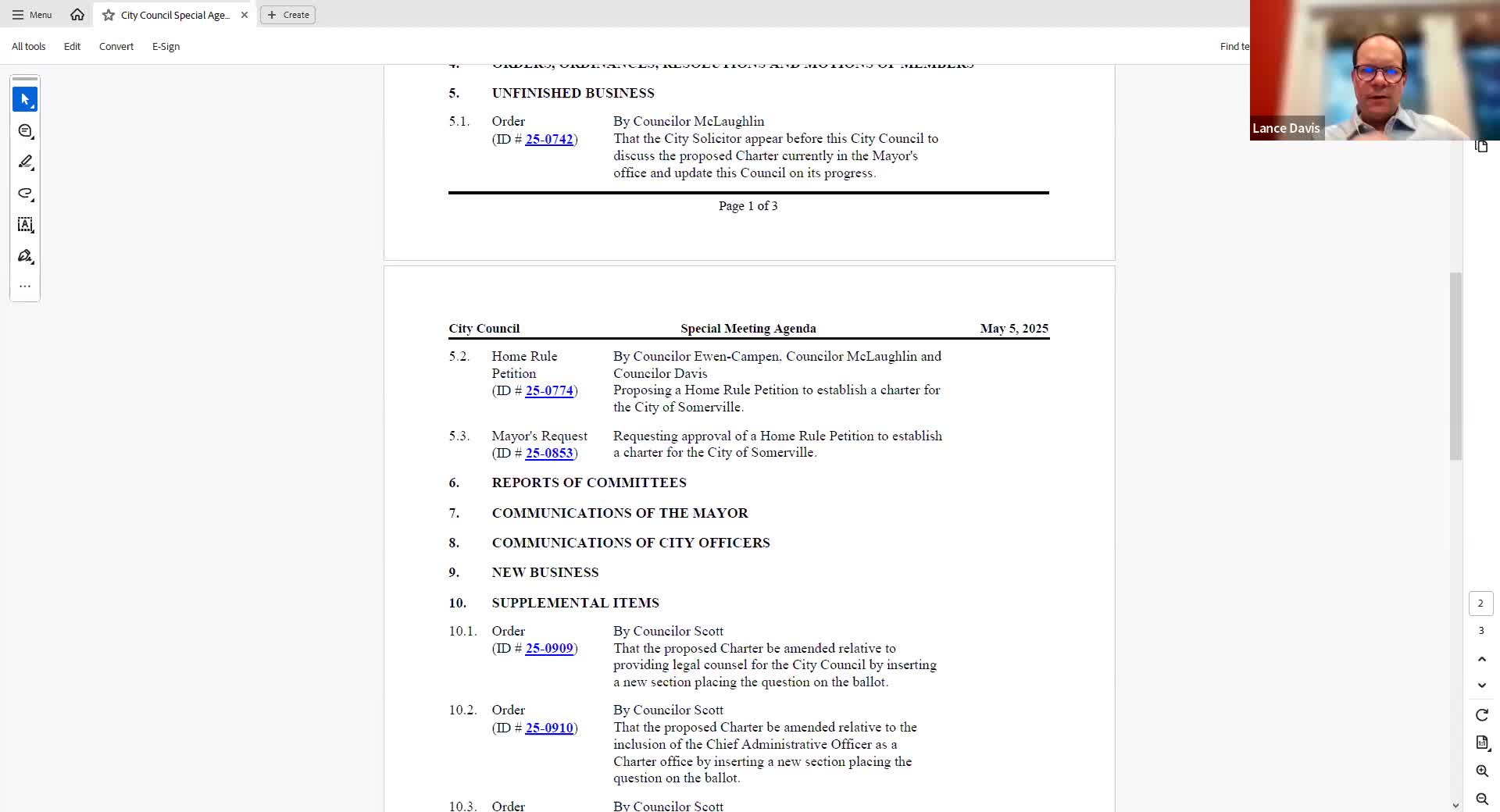
Somerville council approves home-rule petition to send new charter to state; multiple supplemental ballot questions rejected
Summary
The Somerville City Council voted 9–1, with one member absent, to approve a home-rule petition that would send a proposed new city charter to the state legislature, after rejecting several proposed supplemental ballot questions on issues including a chief administrative officer, budget reallocation authority, voting rights and ranked-choice voting.
The Somerville City Council voted 9–1, with one member absent, to approve a home-rule petition that would place a proposed new city charter before the state legislature for consideration and, if approved, on a future municipal ballot.
The petition approved Friday night contains the revised charter text the council had negotiated in recent meetings and also carries an appended ballot question about giving the mayor a four-year term. Council President Pineda Neufeld presided over the remote special meeting.
The petition’s approval follows hours of debate over whether to append other, separate ballot questions to the home-rule petition. Councilors debated — and ultimately rejected — a package of proposed supplemental questions that would have separately asked voters about creating a charter office for a chief administrative officer, giving the council authority to redirect budget funds, lowering the municipal voting age, allowing noncitizen resident voting, adopting ranked-choice voting for single-seat offices and making the annual budget available to the public earlier.
Councilor Scott, who introduced most of the supplemental questions, framed them as a check on executive power and as issues the council had previously debated. "Is the council willing to extend to itself the same respect that it grants the executives?" Scott asked, arguing that procedures for putting questions on the ballot should apply equally to the council and the mayor. Scott said he would withdraw his proposed amendments if colleagues removed the mayoral four-year-term question; that offer was not accepted.
Councilor Davis, who moved approval of the home-rule petition as amended, said she accepted the council’s vote on the four-year-term question despite disagreeing with the method. "While we didn't get a lot of the things we hoped, we did get a meaningful change in the way that process works," Davis said, asking colleagues to vote for the petition so the effort could move to Beacon Hill.
Other speakers repeatedly cited the practical constraints of state law and the need to present a document that the state legislature would be willing to consider. Councilor McLaughlin and several colleagues warned that adding many contested ballot questions alongside the charter could lead the Legislature to reject or substantially alter the petition. Councilor Burnley and others argued the mayor’s office had delayed the process and that the mayor’s proposed changes made the charter more contentious.
Votes at a glance: - Home-rule petition to establish a charter for the City of Somerville (Item 25-0774): APPROVED — 9 in favor, 1 opposed (Councilor Scott), 1 absent. The motion to reconsider failed (0 in favor, 10 opposed, 1 absent), so the approval stands. - Amendment inserting language clarifying that Section 2-8a procedures apply to appointments and reappointments (amendment to Sec. 3.5b): APPROVED — unanimous vote reported (9 in favor, 0 opposed, 2 absent). - Proposed charter amendment to make chief administrative officer a charter office and place that question on the ballot (Item 25-0910 / 10.2): NOT APPROVED — 2 in favor, 7 opposed, 2 absent. - Proposed charter amendment to grant City Council authority to redirect budget funds and place that question on the ballot (Item 25-0911 / 10.3): NOT APPROVED — 2 in favor, 7 opposed, 2 absent. - Proposed charter amendment to lower municipal voting age to 16–17 and place that question on the ballot (Item 25-0912 / 10.4): NOT APPROVED — 2 in favor, 7 opposed, 2 absent. - Three appended questions taken together (Items 25-0913, 25-0914, 25-0915 / 10.5–10.7): extending municipal voting rights to noncitizen residents; using ranked-choice voting for single-seat offices; expanding public availability of the annual budget — NOT APPROVED — 2 in favor, 8 opposed, 1 absent.
The council’s discussion repeatedly returned to process and strategy. Councilor Ewan Kampen and others urged sending a clean, broadly supported charter to the state in order to maximize the chance Beacon Hill will act favorably. "If they get to the Somerville City Charter and there were 10 ballot questions on it ... I would say, I'm not wasting my time on this," one councilor warned, arguing that a crowded petition would appear unready to state lawmakers.
Clerk Wells read items and roll-call votes throughout the meeting. City Solicitor Mara appeared to answer queries about legal language; an order requesting the solicitor to appear was placed on file earlier in the meeting. The council also placed on file a mayoral request to approve the city's home-rule petition (Item 5.3).
The council discussion and votes leave the new charter now headed to the state legislature for committee referral and consideration. If the Legislature approves a home-rule petition for a municipal charter, further state-level steps and potential edits remain before the proposed charter could appear on a Somerville ballot. Council members noted multiple remaining hurdles: mayoral signature, committee review at the State House, possible changes by state legislators and the requirement of further approvals before placement on the municipal ballot.
Ending The council's approval sends the negotiated charter text and an appended question on the mayoral term to Beacon Hill. Several councilors who opposed adding additional ballot items urged using other avenues — including separate home-rule petitions — to pursue measures they support, while proponents said placing questions before voters now would clarify the community’s preferences. The council did not adopt any of the supplemental ballot questions proposed by Councilor Scott; it did approve the cross-reference amendment clarifying appointment/reappointment procedures and moved the main home-rule petition forward.