Get Full Government Meeting Transcripts, Videos, & Alerts Forever!
Get email alerts on the Historic Preservation topic
No spam. Unsubscribe anytime.
SHPO outlines Certified Local Government program, grant opportunities for Petoskey
Summary
A Michigan State Historic Preservation Office coordinator briefed the Petoskey City Council on the Certified Local Government (CLG) program, eligibility requirements and grant options that can help fund surveys, planning and rehabilitation projects for municipal and nonprofit-owned historic properties.
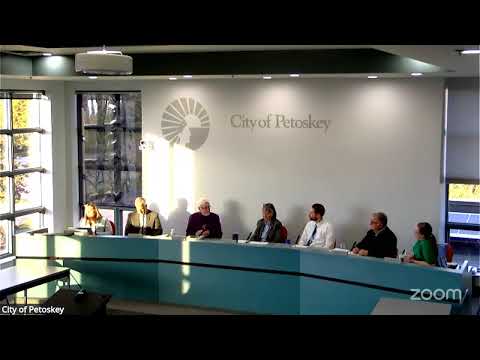
Haley Schreiber, certified local government and community preservation coordinator at the Michigan State Historic Preservation Office, told the Petoskey City Council on May 5 that enrolling in the CLG program gives local governments access to technical assistance, training and a competitive subgrant program funded by the National Park Service.
Schreiber said the program’s baseline requirements are (1) an enacted historic district ordinance that complies with state law (Public Act 169), (2) an established historic district commission, (3) a systematic plan for surveying historic resources, (4) public participation in the local program and (5) annual reporting to the SHPO. She said CLG grants are restricted to municipal- or nonprofit-owned properties and that eligible projects must follow the Secretary of the Interior’s standards for rehabilitation.
“CLG subgrants can support preservation planning, documentation and education — such as National Register nominations, design guideline updates and training — or rehabilitation planning and predevelopment work, including historic structure reports and feasibility studies,” Schreiber said. She told the council the SHPO typically awards three to seven CLG grants each year and that the award amounts this cycle ranged from about $10,000 to $75,000.
Councilmembers asked for clarifications. Councilmember Shields asked whether a local district can be a single building; Schreiber confirmed a local historic district can apply to an individual resource or a group of properties. Councilmember Walker asked whether being a CLG is required to apply for state or federal historic tax credits; Schreiber said it is not required but that CLG participation provides extra guidance and that tax-credit eligibility requires a property to be individually listed or a contributing resource in a National Register district.
Schreiber gave examples of recent CLG-funded work, including Charlevoix’s train depot roof repair and Washtenaw County’s thematic survey and heritage tourism materials. She said CLG funds cannot be used to reimburse work already started before a grant agreement, cannot fund private-property work unless the property is nonprofit- or municipality-owned, and typically require adherence to federal preservation standards.
Lindsay Dodson, a resident who said she helped with Charlevoix’s CLG application in the past, urged the council to note that a local historic district ordinance is the tool that gives a municipality regulatory authority over alterations in a district; she said a local historic district is distinct from a National Register listing and that nonprofit-owned historic properties are eligible for CLG grant support.
Councilmembers said they would revisit the program as a possible tool for Petoskey’s preservation goals and asked staff to follow up with Schreiber on ordinance review and next steps if the city chooses to apply.