Get Full Government Meeting Transcripts, Videos, & Alerts Forever!
Get email alerts on the Indoor Heat topic
No spam. Unsubscribe anytime.
University of Miami study finds many homes in Miami‑Dade reached dangerous indoor heat levels; researchers point to energy burden and ineffective cooling
Summary
A countywide 2022 study of 57 households found some homes registering indoor heat-index values high enough to cause health effects even when residents paid high energy bills; researchers and city staff discussed implications for targeting cooling, weatherization and assistance programs.
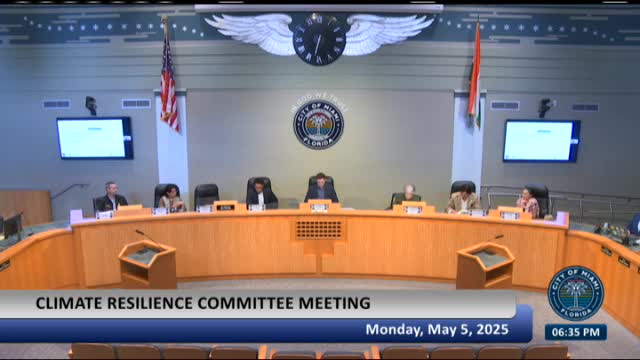
Myra Cruz, a Ph.D. candidate at the University of Miami, told the City of Miami Climate Resilience Committee on May 5 that a countywide study of 57 households found indoor heat and energy burdens that left some residents at risk even when they were spending a large share of income on cooling.
"We essentially were trying to understand what indoor heat looks like across Miami‑Dade County," Cruz said during a presentation to the committee. She described sensors that collected indoor temperature and humidity every 10 minutes from June 1 through Oct. 31, 2022, allowing the team to compute an indoor heat index for participating homes.
The study found several distinct patterns: homes that behaved like "greenhouses" with indoor temperatures exceeding nearby airport outdoor readings; homes where indoor temperatures tracked outdoor swings; and homes where thermostats were set high enough that interiors remained warm. Researchers categorized households by thermal comfort (82°F threshold) and energy burden (6 percent of income spent on energy bills). Several households were both heat‑ and energy‑burdened, Cruz said.
The team reported households paying well above the 6 percent threshold in some cases — with some families reporting double‑digit percentages of income spent on energy — yet still experiencing indoor heat above comfort levels. Cruz said that combination suggests structural problems such as ineffective cooling systems, poor building envelopes or inability to afford repairs.
Dr. Lanae ("Terri") Kinkins, the study's lead analyst cited by Cruz, produced the heat‑and‑energy burden categories used in the analysis. Cruz said the sample included both renters and owners across a wide geographic spread — from Homestead to North Miami Beach — and was disproportionately represented by households with incomes under $60,000.
Committee members asked about lower‑cost interventions such as ceiling fans, window screens and cross‑ventilation. Cruz said the study did not evaluate the effectiveness of individual responses; she flagged humidity and mold as complicating factors and noted that fans can be counterproductive in high‑humidity conditions. Alyssa Ferrana, Assistant Director in the city’s Office of Resilience and Sustainability, said the city is using the study to shape a summer research program focused specifically on City of Miami households and to better substantiate its Extreme Heat Action Plan.
Cruz and the committee highlighted several possible programmatic responses: targeted weatherization and repairs for low‑income homeowners whose homes are inefficient; prioritizing repairs and AC support for senior homeowners; and using existing programs such as LIHEAP to address root causes rather than repeatedly paying high energy bills.
The researchers recommended further work on intervention effectiveness — for example, pre‑ and post‑testing of different cooling upgrades — and suggested aligning research with city programs to pilot repairs and weatherization. The committee asked staff to circulate the study and follow up as the city's summer sensor pilot proceeds.
The presentation and discussion underscored the committee’s interest in pairing heat‑exposure data with program design, particularly for renters, low‑income households and seniors who reported health impacts.
Members said the findings should inform the city’s budget priorities for heat season, including cooling centers, bus‑stop shade, targeted weatherization funding and assistance for households with ineffective AC systems.