Get Full Government Meeting Transcripts, Videos, & Alerts Forever!
Get email alerts on the Housing Affordability topic
No spam. Unsubscribe anytime.
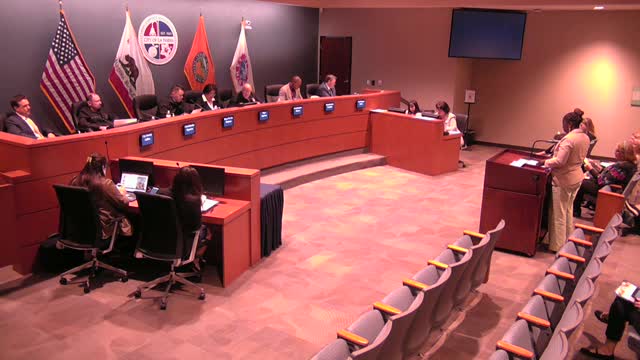
La Habra council approves regulatory agreements for two Whittier Boulevard townhome projects, reserving five moderate‑income units
Summary
The La Habra City Council on May 5 approved regulatory agreements with La Habra 4 INV LLC that will restrict five for‑sale townhomes for moderate‑income households under Californiadensity bonus law; council members voiced frustration about state rules that reduced local parking and undergrounding requirements.
The La Habra City Council on May 5 voted unanimously to approve regulatory agreements with La Habra 4 INV LLC that will reserve five for‑sale townhome units for moderate‑income households under Californiadensity bonus law.
The agreements apply to two separate developments on East Whittier Boulevard: an 18‑unit project at 120 E. Whittier Boulevard that will include two restricted moderate‑income units, and a 22‑unit project at 310–330 E. Whittier Boulevard that will include three restricted moderate‑income units. The councilapproved both agreements after a staff presentation and public comment; both projects previously won planning commission approval on April 22, 2024.
City staff said the restricted units will be sold initially at maximum prices tied to state median‑income limits and standard homeownership cost allowances. Using the Department of Housing and Community Development income limits released May 9, 2024, staff said a four‑person household earning $154,800 or less would qualify as moderate income. Based on current limits and typical ownership costs, staff set the affordable sales price at $482,062 for two‑bedroom units and $563,253 for three‑bedroom units; those prices may be adjusted annually after the state updates income limits.
Nut graf: The regulatory agreements translate the developerchoice to provide the five moderate‑income homes (and to pay an in‑lieu fee for two additional required inclusionary units) into legally enforceable restrictions that limit initial purchasers and bind resale through an equity‑share requirement that returns the initial subsidy plus a proportional share of appreciation to the cityhousing authority account for reinvestment.
Details and legal basis
Miranda Co Corona of the cityCommunity and Economic Development Department presented the agreements to the council and answered technical questions. She said project 1 (120 E. Whittier) will deliver 18 for‑sale townhomes of which two will be sold to moderate‑income households; project 2 (310–330 E. Whittier) will deliver 22 townhomes of which three will be sold to moderate‑income households. The developer is using the state density bonus to gain concessions and incentives available under state law.
Under the cityInclusionary Housing Ordinance the projects would normally be required to provide 15% of units as affordable or pay an in‑lieu fee. Because the developer elected to provide the five units under the state's density bonus framework, the developer will construct those five restricted units and pay an in‑lieu fee for the two remaining units that would have been required under the city ordinance.
Parking and other concessions
Staff and council discussed parking counts and other concessions granted under density bonus law. For project 1, staff said the state density bonus calculation required 33 parking spaces while the La Habra municipal code would require 68; the developer is providing 40 spaces. For project 2, staff said the state calculation required 44 spaces while the city code would require 77; the developer is providing 53 spaces. Council members expressed frustration that state law preempts local standards and reduces the city's ability to require higher parking counts or undergrounding of utilities.
Council debate and vote
During council discussion several members criticized aspects of state preemption over local development rules, citing concerns about reduced parking, smaller rear setbacks (reduced in some cases from a city standard of 20 feet to as little as 5 feet under concessions), and the loss of local control over undergrounding of overhead utilities. Council remarks emphasized the city's limited land capacity and the difficulty of balancing housing production with neighborhood impacts.
After discussion, the council approved two regulatory agreements restricting the five moderate‑income units and authorizing the city manager to finalize documents. The motion passed unanimously.
What happens next
The restricted units must be sold initially to qualifying moderate‑income households at the affordable prices established in the agreements. On resale, equity‑share provisions require the original subsidy plus a proportionate share of appreciation be returned to the city's housing authority account for future affordable housing investment. The record shows both developments received planning commission approval on April 22, 2024.
Ending: The approvals put five for‑sale townhomes on the market at prices intended for moderate‑income buyers and formalize the city's mechanism to recycle subsidy dollars, while leaving unresolved local concerns about parking and other concessions that state density bonus law permits.