Get Full Government Meeting Transcripts, Videos, & Alerts Forever!
Get email alerts on the Historic Preservation topic
No spam. Unsubscribe anytime.
Idaho Falls council to consider 10-year historic preservation plan as SHPO outlines Section 106 review process
Summary
City staff and the Historic Preservation Commission presented a draft 10-year preservation plan that will be on the council agenda for adoption; State Historic Preservation Office officials outlined how Section 106 reviews of federally funded projects can require mitigation even for buildings found "eligible" for the National Register.
Idaho Falls officials presented a draft historic preservation plan for potential adoption and heard a detailed briefing from the Idaho State Historic Preservation Office (SHPO) on how federal funding triggers Section 106 reviews and possible mitigation requirements.
The plan, presented by Caitlin Long, long-range planner for the Community Development Services (CDS) department, was drafted with consultant Kurt Cutbaker Preservation Strategies and is slated to appear on the council agenda on Thursday for potential adoption. Long said the plan was partially funded through a Certified Local Government (CLG) grant and reflected public outreach, including a community survey and a January open house that drew about 30 attendees.
"We are gonna be talking about the historic preservation plan that has been drafted and will be, on the Thursday's council agenda, for potential adoption," Caitlin Long said.
The plan establishes four broad goals: identify and designate areas of historic significance; cultivate community through education and partnerships; coordinate preservation with city planning and incentives; and provide training and capacity building for staff and volunteers. Mary Scales, chair of the Historic Preservation Commission, said the plan is intended to give the commission a clearer, multi‑year work program.
"Ideally, this helps us to solidify some of the paths forward for the next 10 years," Mary Scales said.
Public outreach included an online survey with roughly 200 responses. According to staff takeaways, respondents expressed interest in documenting downtown and commercial buildings, increasing cultural and religious diversity in the city’s narratives, and receiving information through public events and targeted educational materials.
SHPO staff traveled from Boise to brief the council on the federal regulatory context. Dan Everhart, outreach historian with SHPO, explained that the national framework—centered on the National Historic Preservation Act and the National Register of Historic Places—serves cultural, environmental and economic purposes and that CLG partnership funding helps cities prepare inventories and plans.
"We do it because of culture and history and the idea that we share something in common," Dan Everhart said. He noted that Idaho Falls has multiple properties and districts already listed on the National Register and that the SHPO provides review and grants to certified local governments.
Ashley Malloy, historic preservation review officer with SHPO, described Section 106, the federal review process that applies to projects using federal funds, land or permits. She said Section 106 is a process statute created in 1966 to ensure that federal undertakings consider effects on historic resources and include public involvement.
"Anytime you have an undertaking as what we call it, a project that uses federal money, land, or permits, it has to be reviewed by our office," Ashley Malloy said.
Council members pressed staff on two practical concerns: whether homeowners face restrictions if their property appears in the plan, and how the city will pay for surveys or mitigation activities when federal reviews require them. Long and SHPO staff repeatedly said that listing in the National Register is honorific and that the plan focuses on education and voluntary support unless separate local ordinances apply. Long described the CLG grant as reimbursable and a 1:1 match, and reported that the consultant contract and plan cost were developed within a budget cap.
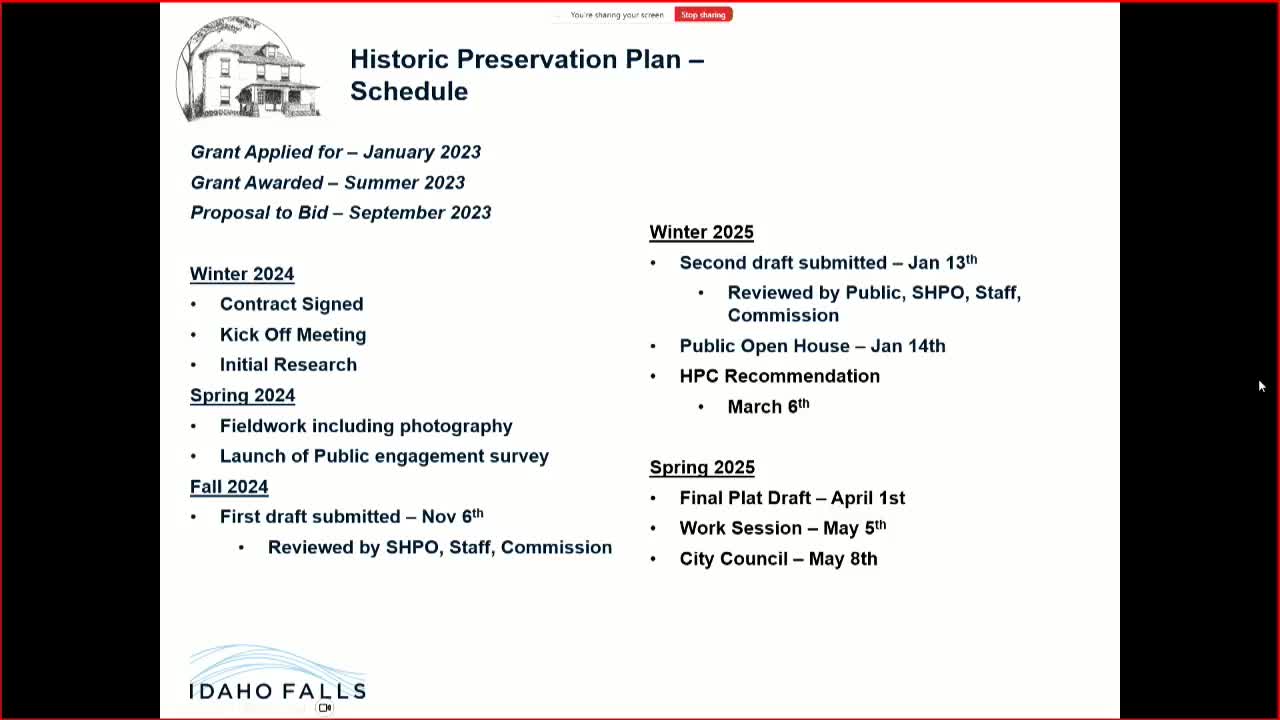
Caitlin Long reported that the consultant contract was executed in winter 2024, that the first draft was produced in fall 2024, and that a final draft was completed in April 2025. She told the council the CLG grant awarded to the city was reported as $15,000, the total plan cost was $25,000, and staff time and commission hours satisfied the match so the city expects reimbursement of grant-eligible costs. (Amounts reported to council reflect staff statements during the meeting.)
Council members and staff discussed how a city preservation plan can also be used in mitigation when federal projects cause adverse effects. SHPO representatives explained that when a federally funded project cannot avoid an adverse effect, mitigation — such as inventory work, plaques, interpretive signage or other documentation — is used to "balance" the loss and that the preservation plan can supply candidate mitigation tasks that align with community priorities.
Everhart described a recent, large federal example (Naval Reactors prototypes) as a case where mitigation funding supported signage, documentaries and public events in place of artifact preservation.
Councilors also asked how the city can improve early coordination with SHPO to avoid surprises in grant-funded projects. SHPO staff advised consulting early — including when a project is only a concept — and said their office typically turns reviews around quickly if projects are submitted in a timely way.
The Historic Preservation Commission recommended approval of the plan at its March 6 meeting; staff said the plan is intended to guide the commission’s and staff’s work for the next 10 years, to inform grant-seeking, and to provide a more coordinated approach to documentation, designation and public outreach. If adopted, staff said the plan would be available to guide mitigation opportunities tied to federal projects.
A public hearing and council vote on the preservation plan are expected at the council meeting on Thursday.
Ending: The council received the briefing and public‑process summary and posed questions about funding and homeowner impacts. The mayor and staff said council members should expect the preservation plan on the coming Thursday agenda and that additional questions may be asked at that time.