Get Full Government Meeting Transcripts, Videos, & Alerts Forever!
Get email alerts on the Residency Requirements topic
No spam. Unsubscribe anytime.
Lynnwood councilmember proposes clearer residency proof for candidates; discussion tabled for later review
Summary
Council member Ryan Decker introduced draft language on May 5 to tighten proof-of‑residency standards for city office; the council declined to take immediate action and asked for the draft and related state guidance to be circulated and reviewed at a future meeting.
Council member Ryan Decker introduced draft language on May 5 intended to clarify Lynnwood’s municipal code about eligibility to run for and hold city elective office and to specify acceptable proofs of residency. The council did not vote and agreed to schedule a separate review after members and staff have had time to study the proposed amendment.
Decker said the proposed change responds to recurring public questions about whether voter registration alone is adequate proof of residency. He said the draft would align city proof‑of‑residency standards with documents the Washington State Department of Licensing (DOL) accepts for driver‑license address changes and would specify acceptable evidence and consequences if a council member no longer resides in the city.
“You must live and reside in the area you seek to have elected office in,” Decker said during the presentation, arguing the proposed code would reduce ambiguity about who is eligible to vote or serve and would clarify examination procedures and outcomes.
Other council members asked for time to review the draft. Council member Josh Bridal said state law and existing processes (including challenges to voter registration and examiner hearings) already provide mechanisms to test residency and cautioned against duplicating state rules. The meeting record shows the council requested that the city clerk circulate the draft and relevant RCW/MRSC guidance and that a future work session be scheduled so members can digest the language and related state statutes.
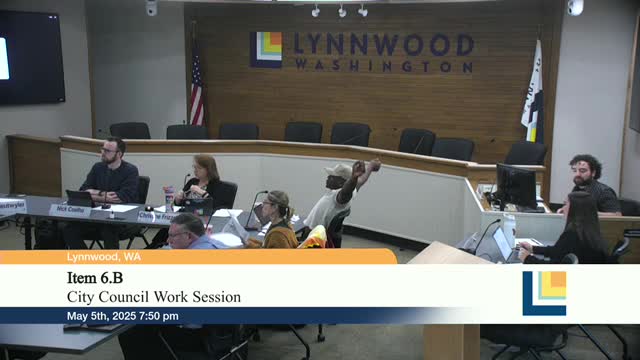
The item became heated at times during public comment; an audience member interrupted the meeting and was escorted out. Council leadership emphasized the need to keep future discussions civil and focused on the draft language rather than on any individual council member’s circumstances.
Because the proposed language was not on the packet in an easily accessible form for all members, council leadership agreed to table the item and schedule it as a later agenda item after staff circulates the draft ordinance and supporting state guidance. The council asked staff to show the existing municipal code, the proposed amendment, and pertinent state RCWs and MRSC guidance for the next discussion.