Get Full Government Meeting Transcripts, Videos, & Alerts Forever!
Get email alerts on the Public Safety topic
No spam. Unsubscribe anytime.
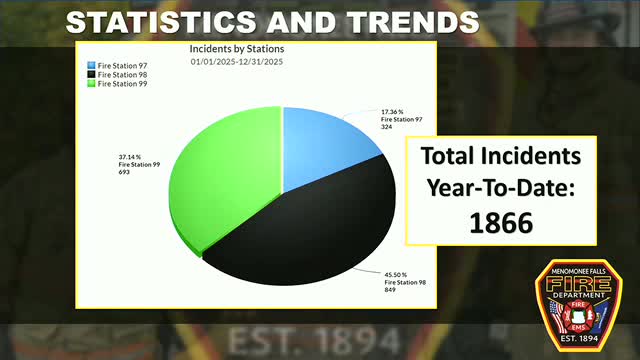
Menomonee Falls fire chief reports 1,866 incidents year-to-date, highlights training and vehicle cost work group
Summary
Fire Chief Joel Palmermarker presented the department's first-quarter report, saying emergency medical responses remain the largest call type, introducing a new medical director, announcing three new lieutenants and describing work on vehicle procurement and Medicare reimbursement for non-transports.
Fire Chief Joel Palmermarker told the Village of Menomonee Falls Board of Trustees that the fire department has responded to 1,866 incidents year to date and continues to see emergency medical services as its primary call type.
Palmermarker said the department now pulls several of its graphs directly from its records management system, which has helped produce incident and station-level trends. He said responses are roughly consistent across the three stations and that station 97 is the least busy but provides backup support for stations 98 and 99.
The chief described a staffed "peak ambulance" that runs roughly 7 a.m. to 7 p.m. to reduce reliance on mutual aid and noted typical peak call times are late morning to early afternoon. He said the department has been monitoring wildfire risk daily because of dry brush and would issue a burn ban if conditions warranted.
Palmermarker introduced Dr. Thomas Engel as the new medical director (Dr. Engel began in January) and said Engel has been active in continuous quality improvement, attending station training and ride-alongs. He outlined the department's three-tier training structure: individual (self-study), company (crew-level) and division (departmentwide).
On equipment and operations, the chief said the department placed three new circular saws on frontline vehicles this year and has increased driver training for water tenders because of rollover risk under heavy water loads. He said the department recently completed a promotional process and swore in three lieutenants, restoring a lieutenant on each station and shift.
Palmermarker discussed external initiatives: legislative outreach on Medicare reimbursement for non-transports (to secure reimbursement when crews provide on-scene care without transport), participation in an Emergency Vehicle Supply and Demand committee to examine vehicle costs and procurement, and work with the Government Finance Officers Association on financial training for fire chiefs.
Trustees asked for additional staff and staffing-status information; Palmermarker said career staffing is stable while part-time staffing "ebbs and flows," noting some recent departures and an active part-time hiring process. He told trustees the department provides the same core training and certifications to part-time and full-time members but that frequency of work affects experience levels.
Asked about the department's response to nonemergent animal rescues, Palmermarker said the department will respond when callers are concerned but will prioritize life-safety emergencies first.
The presentation concluded with trustees thanking the chief and requesting that future reports include staffing metrics (authorized vs. filled positions, retirements, training status) and maps that show cross streets for each station's coverage areas.