Get Full Government Meeting Transcripts, Videos, & Alerts Forever!
Get email alerts on the Firefighter Health topic
No spam. Unsubscribe anytime.
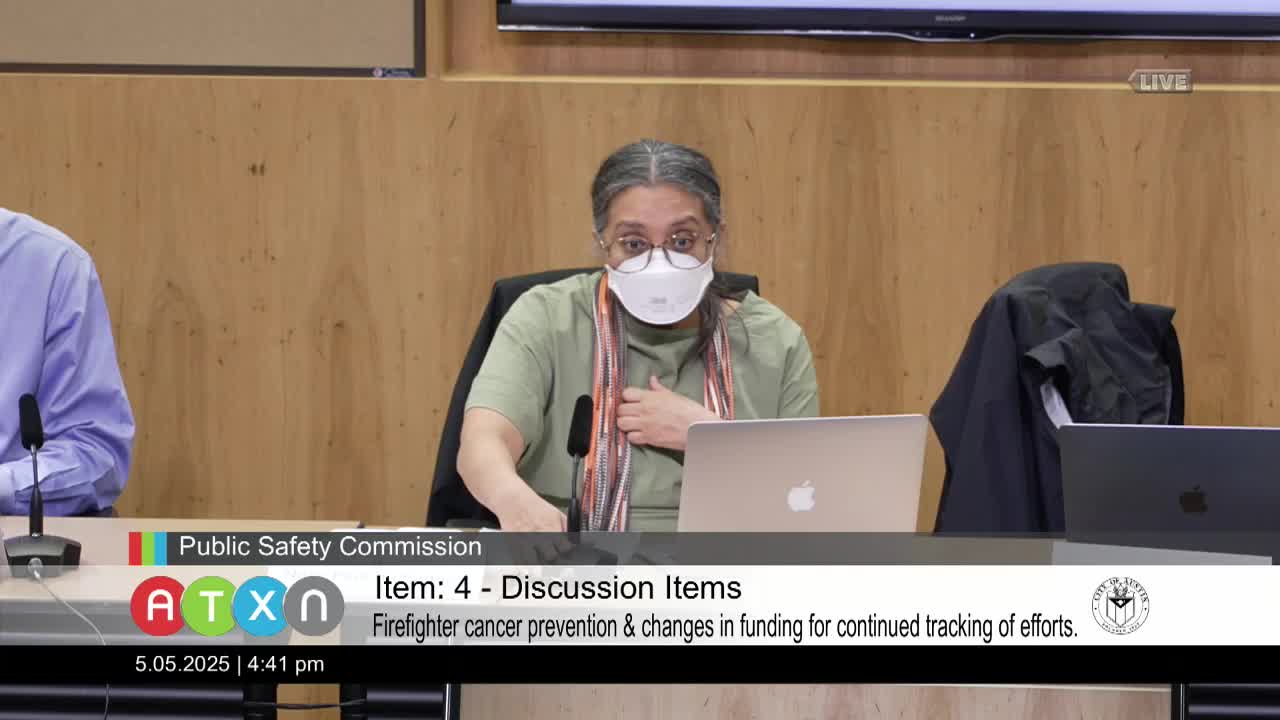
Wellness center outlines PFAS testing, turnout and 'clean cab' steps to reduce firefighter cancer risk
Summary
Clinic administrator Heather Edespan and Austin Fire Department staff described screenings, limited PFAS testing, turnout replacement challenges, and station procedures such as loaner gear, extractors and on‑scene wipes aimed at reducing firefighters' exposure to carcinogens.
Heather Edespan, clinic administrator for the Public Safety Wellness Center, told the Public Safety Commission that the center provides oversight of annual exams and targeted screenings intended to detect early signs of disease among first responders.
Edespan said the Wellness Center performs baseline tests that can prompt referral for further evaluation — spirometry, urinalysis, prostate specific antigen (PSA) checks, thyroid tests and blood work — and that clinicians discuss age‑ and history‑appropriate screening such as mammography or colonoscopy during annual exams. “Though they’re not cancer screenings in and of themselves, they do help identify abnormalities that will then allow our physician to refer our first responders out for additional screening or testing as needed,” Edespan said.
Edespan said Central Austin Dermatology Group provides monthly skin‑cancer screenings at the Wellness Center, and that the center extended services to other city departments with sun‑exposed work. She reported that grant funds paid for PFAS (per‑ and polyfluoroalkyl substances) blood testing for about 78 firefighters and that the results provide a baseline that members can take to their primary‑care providers.
Rob Byers, chief of staff for the fire department, briefed commissioners on operational steps to reduce exposure. He described a multi‑year effort to replace firefighting foam at Austin‑Bergstrom International Airport with non‑PFAS alternatives and said the airport apparatus and foam replacement program aims to eliminate PFOS‑containing foam and equipment by the end of the year. Byers cautioned that replacement of PFAS‑containing products (including some turnout materials that sit between layers of garment fabric) must be done carefully to avoid introducing new safety issues.
To limit contamination, Byers described a “clean cab” policy and a loaner‑gear program: crews bag and swap contaminated turnouts at major incidents, use loaner gear so crews can continue working, and launder the contaminated gear in industrial extractors before return. He described on‑scene wipes, a protocol to shower within an hour after return from a major incident, and diesel exhaust‑capture systems (Plymovent) that pull vehicle exhaust out of apparatus bays.
Commissioners asked about hereditary testing and tracking of presumptive occupational cancers. Edespan said medical history is reviewed during annual exams and that members can be referred for additional testing if indicated; she said the Wellness Center has helped refer members when they request tests that are not yet broadly recommended. On workers’ compensation tracking for presumptive cancers, department staff said such data may be held by the workers’ comp unit and offered to follow up.
Commissioner Nguyen asked about environmental testing and coordination with Watershed for runoff associated with firefighting foam. Byers said the airport and multiple city agencies have participated in a multi‑agency effort; a department representative added that a grant application requesting soil testing was denied earlier, and that further environmental testing has funding limits.
On funding, Edespan and Byers said the Wellness Center’s regular operations are budgeted through the fire department with contributions from police and EMS for shared services. The Fire Foundation and occasional grants have funded equipment and special tests. Byers said the center has had difficulty hiring a second physician, which limits capacity, and that grant funding used for PFAS testing imposed limits on the number of tests performed.
Commissioners recommended broader education on family history and hereditary testing and asked staff to follow up on workers’‑compensation tracking and environmental testing options.