Get Full Government Meeting Transcripts, Videos, & Alerts Forever!
Get email alerts on the Cultural Funding Acme topic
No spam. Unsubscribe anytime.
City’s new ACME office outlines community-driven overhaul of cultural funding, targets Council approval in July
Summary
Office of Arts, Culture, Music and Entertainment (ACME) staff briefed the Austin Music Commission on a review of city cultural funding programs, a community engagement timeline and Live Music Fund statistics. Staff said they will present final guidelines to City Council in July and aim to distribute funds in January 2026.
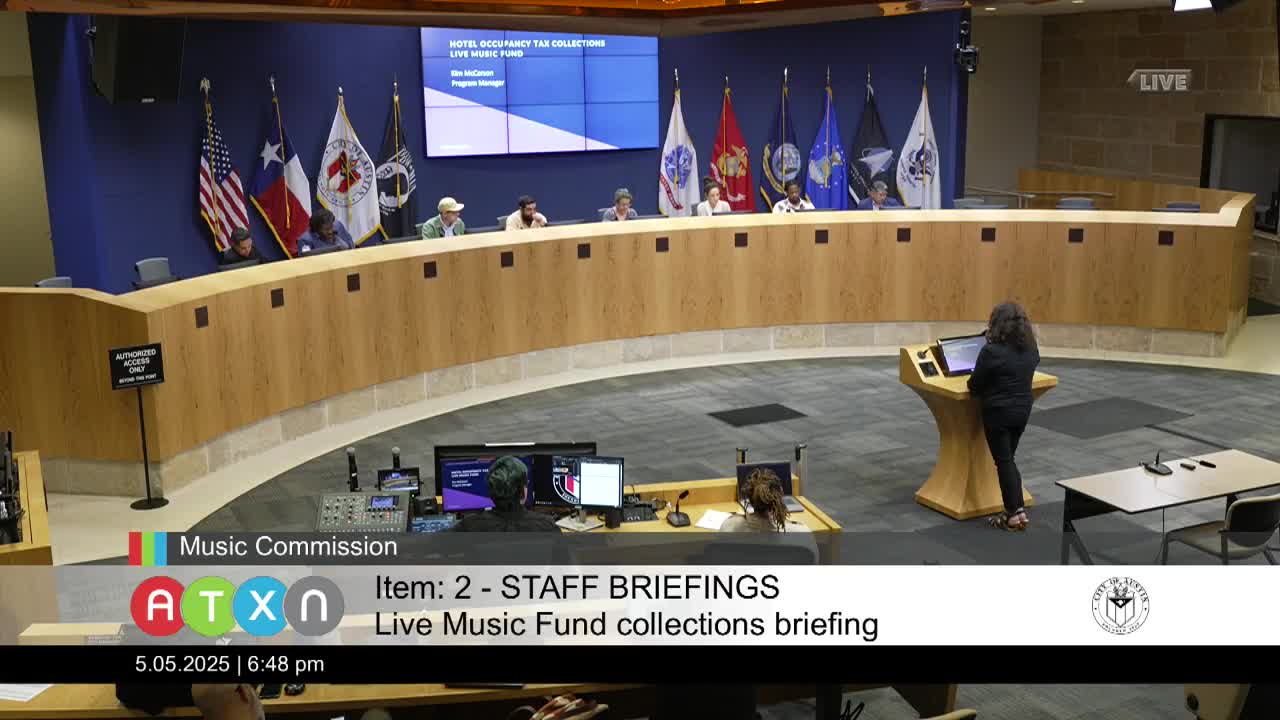
Austin Music Commission staff on May 5 outlined a community-driven review of city cultural funding programs and presented year-to-date Live Music Fund and hotel occupancy tax collection figures.
The Office of Arts, Culture, Music and Entertainment, known as ACME, is evaluating the funding ecosystem that includes the Live Music Fund, Elevate, Nexus, Thrive, the Creative Space Assistance Program and the heritage preservation grant. Erica Chamblee, music and entertainment division manager, and Morgan Messick, ACME assistant director, told the commission the review is intended to make funding more equitable and easier to navigate for artists and organizations.
“This is a community-focused approach,” Chamblee said, noting ACME staff plan to revise program language in response to community feedback and recent Texas legislative changes. Messick said the department has compiled five years of public feedback and will use an AI tool to surface common themes for the working groups and focus groups that will help shape revised guidelines.
ACME presented an abbreviated timeline for the guideline update: staff are collecting input through May, will analyze and draft revisions in June, and plan to present a request for Council action (RCA) in July. The department’s target is a public rollout of final application materials in August and distribution of funds in January 2026, with contract administration handled in partnership with the Long Center.
Messick described the engagement program as a mix of surveys, focus groups and one-on-one meetings with invited stakeholders and said invitations are already rolling out. She also said ACME will provide a “meeting in a box” option for organizations unable to participate in scheduled sessions.
On program delivery, Erica Shamley, music and entertainment division manager, reported on the Live Music Fund’s fiscal-year 2024 grantee status: almost all award agreements have been executed, 70 second payments have been issued to date out of 136 total awardees, and 18 grantees have completed final reporting. Kim McCarson’s office provided a separate briefing on FY25 hotel occupancy tax collections; Chamblee noted reporting is staggered and March activity often appears in subsequent-month filings.
Commissioners raised questions about conflict-of-interest rules applying to working-group participants who may apply for grants and about aligning different grant programs so applicants face fewer barriers. Messick said legal counsel had been consulted regarding conflicts and that staff would follow up with specifics by email.
ACME staff said the engagement and revision process will include input from the commission and other city advisory bodies before being taken to Council. Staff will return to the Music Commission with progress updates.
Why it matters: the changes could alter eligibility, scoring and reporting requirements for multiple city funding programs and affect when local arts organizations can apply for and receive public grant dollars.