Get Full Government Meeting Transcripts, Videos, & Alerts Forever!
Get email alerts on the Nuclear Disarmament topic
No spam. Unsubscribe anytime.
United Nations plants two 'Hibaku jumoku' survivor saplings as call for nuclear disarmament
Summary
At a ceremony at UN Headquarters, UN Office for Disarmament Affairs and partners planted two persimmon saplings originating from trees that survived the atomic bombings, and speakers called for renewed global effort on nuclear disarmament and youth engagement.
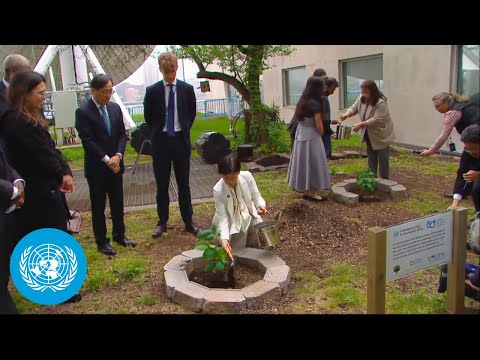
United Nations officials, diplomats and youth representatives planted two Hibaku jumoku — saplings from trees that survived the atomic bombings of Hiroshima and Nagasaki — at UN Headquarters in New York in a ceremony marking the 80th anniversary of both the United Nations and the bombings.
The event, organized by the UN Office for Disarmament Affairs (UNODA) and partner groups including Green Legacy Hiroshima and the San Diego Botanic Garden, featured remarks urging renewed international efforts to prevent nuclear war and to engage younger generations in disarmament work.
Soo Hyun Kim, political affairs officer and youth disarmament lead at UNODA, said the two saplings were brought to the United Nations as “an enduring symbol of peace and resilience for the people and planet.” Kim thanked UN staff volunteers and named colleagues and external experts who helped prepare the plants.
UN High Representative for Disarmament Affairs Izumi Nakamitsu told attendees, “We can make peace and build peace, if we are together,” and said the commemoration should be used to “build momentum” to reverse rising arms and tensions. Nakamitsu thanked the young poets and other youth participants who, she said, will “be looking after those trees, and enjoying the fruit of peace.”
Japan’s Permanent Representative to the United Nations, Ambassador Kazuyuki Yamazaki, said Japan — “as the only country to have suffered atomic bombings during war” — has a responsibility to lead efforts toward “a world without nuclear weapons.” Yamazaki also noted partnerships with UN initiatives, including the Youth Leader Fund for a world without nuclear weapons, and said the tree planting embodied the “spirit of dialogue and collaboration” called for at recent NPT Preparatory Committee meetings.
Harold Agyeman, permanent representative of Ghana to the United Nations and chair of the third NPT Preparatory Committee, said the ceremony was a “solemn occasion” and urged states and the United Nations to do more to prevent the “catastrophic effects of nuclear war.” “May the tree that we plant here today be a symbol of our united resolve and determined aspiration,” Agyeman said.
Junko Shimizu, speaking for Green Legacy Hiroshima, described how seeds were collected under the guidance of master gardener Horiguchi, stored at the Hiroshima Botanical Garden and transferred via the San Diego Botanic Garden to New York. She said Green Legacy Hiroshima sees the work as long-term: “Green Legacy Hiroshima is a 1,000-year initiative,” she said, emphasizing community involvement in preserving and sharing the survivor trees.
The ceremony included readings by youth poets associated with UNODA and a brief planting ritual in which speakers and invited diplomats placed soil around the two saplings. Organizers said the trees planted were persimmons and noted persimmon trees typically have lifespans estimated at 50 to 75 years; speakers expressed hope the saplings would thrive and serve as living reminders of the humanitarian consequences of nuclear weapons.
Speakers repeatedly referenced current disarmament diplomacy, including the NPT Preparatory Committee sessions, and urged sustained multigenerational engagement to advance nuclear risk reduction. Organizers credited voluntary efforts by UN staff and partner institutions for making the planting possible.
No formal decisions or votes were taken at the event; the gathering was ceremonial and intended to raise awareness and symbolically link survivor trees to global disarmament advocacy and youth participation.