Get Full Government Meeting Transcripts, Videos, & Alerts Forever!
Get email alerts on the Budget Reserves topic
No spam. Unsubscribe anytime.
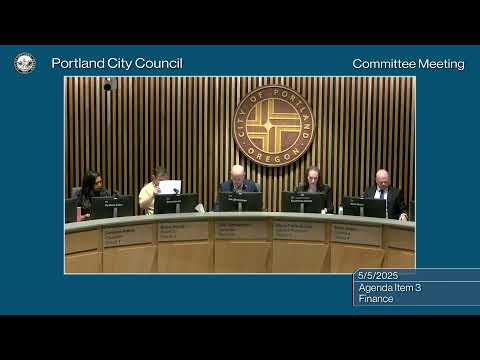
Portland finance committee reviews reserve and contingency policies as budget season begins
Summary
Portland finance staff told the City Council's Finance Committee on May 5 that the city's formal general fund reserve policy (FIN 2.07) sets a target equal to 10% of general fund revenues less beginning fund balance'about $77.6 million in the proposed FY 2025'026 budget'and that policy divides that target equally between a countercyclical reserve and an emergency reserve.
Portland finance staff told the City Council's Finance Committee on May 5 that the city's formal general fund reserve policy (FIN 2.07) sets a target equal to 10% of general fund revenues less beginning fund balance'about $77.6 million in the proposed FY 2025'026 budget'and that policy divides that target equally between a countercyclical reserve and an emergency reserve.
The discussion, led by Jonas Beery, deputy city administrator for budget, finance and chief financial officer, and City Economist Peter Holzman, centered on how reserves and contingency funds differ, when the countercyclical reserve can be used and how a replenishment plan would work if council were to draw on reserves.
Beery said FIN 2.07 identifies the general reserve target and requires that 50% of that target function as a countercyclical reserve and 50% as an emergency reserve. Holzman summarized the forecast as "one more year of very slow growth and then moderate to slow growth after that," and staff told the committee that the countercyclical reserve is usable only if two conditions are met: two consecutive quarters of forecast general fund growth under 3% and one or more sustained economic indicators of decline (for example, sustained housing price declines or multi-year increases in unemployment).
Why it matters: Councilors and staff said the briefing was meant to set expectations before the formal budget season. Committee members raised concerns about whether a 10% reserve target is conservative enough; many local governments aim for roughly 15% to 20% of general fund revenues (about two months of operating expenses). Staff and multiple councilors noted Portland's relatively stable property-tax base as one reason the city has historically set a lower formal target than some peers, but they also flagged other revenue streams'notably business license tax, now about 30% of the revenue mix'as more volatile.
Key details
- Policy target: FIN 2.07 sets the general fund reserve at 10% of general fund revenues less beginning fund balance; staff said that equates to about $77.6 million for the FY 2025'026 proposed budget.
- Reserve structure: Staff explained the 10% target contains two components: a countercyclical reserve (50% of the target) that can be used only under specified economic conditions, and an emergency reserve (the other 50%) that is tied to projections of a negative fund balance.
- Countercyclical draw conditions: Staff described two required triggers to use the countercyclical reserve: (a) two consecutive quarters of forecast general fund growth lower than 3% and (b) one or more repeatable declining economic indicators (examples given included sustained housing price declines and rising unemployment).
- Replenishment: Staff said the policy requires a council-identified plan to replenish any reserves the council draws down; the policy specifies replenishment within the next budget cycle (staff cited a 24-month horizon).
- Contingency vs. policy set-asides: Staff described two common contingency categories: "policy set-aside" contingencies (earmarked for known but variable costs such as public safety overtime) and an "unrestricted contingency" (an undesignated pot staff said has been $3 million in recent practice). Policy set-asides are often set in the proposed budget during the fall process when ending fund balance is clearer.
Councilor reaction and concerns
- Councilor Green asked whether property tax growth had reached a lower bound and how much downside risk exists; staff replied that property tax revenues are still growing but at a slower rate and that the larger near-term risk is from more volatile revenue sources such as business license tax.
- Councilor Perogini pressed for clarity on whether both the countercyclical and emergency reserves are subject to the 24-month replenishment requirement; staff confirmed the policy applies to both.
- Councilor Novick and others questioned how Portland's practices compare with peer jurisdictions and whether contingency and reserve sizing should be reexamined ahead of the budget season.
Other technical points
- Staff said some reserves are statutory or bond-related, some derive from policy (FIN 2.07) and others are management reserves tied to particular program risks (for example, permit activity or development-related revenue swings).
- Staff noted the city maintains other program-specific reserves (permit reserve, health benefits reserve) and that those reserves are typically restricted to their intended purpose.
- Staff said contingency use is a common way to signal an intent to fund an emerging priority during the budget process; councilors noted that adding to contingency without changing reserve policy can reduce the reserves added at year-end.
Where this goes next
Staff closed by saying they will return with additional detail and an inventory of reserves and policy set-asides for further discussion during the budget season. Several councilors said they intend to examine policy set-asides first before supporting draws on the general reserve.
Ending: The committee did not take a formal vote on reserve policy changes at the May 5 meeting; staff said they will provide further briefings and more detailed budget materials at upcoming Finance Committee sessions.