Get Full Government Meeting Transcripts, Videos, & Alerts Forever!
Get email alerts on the Education—Taxonomy topic
No spam. Unsubscribe anytime.
Connecticut hearing on homeschooling spotlights data gaps, child-safety concerns and split views on regulation
Summary
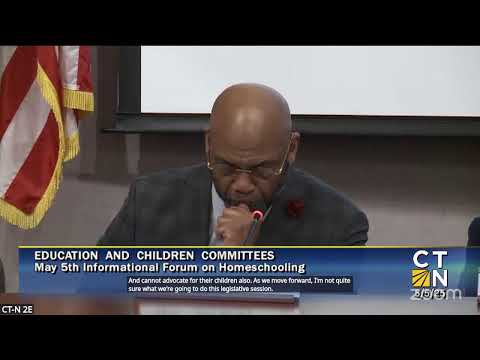
A joint informational hearing convened Connecticut education and child-welfare officials, the child advocate and homeschool advocates to review data on students who leave public school, explain agency limits and debate whether the state should require verification or oversight of homeschooling.
Connecticut education and child-welfare officials, the state child advocate and homeschool advocates met in a joint informational hearing to review how children who leave public school for private schooling or homeschooling are counted and protected, and to wrestle with whether the state should adopt new checks on families that educate at home.
The hearing opened with a broad review of enrollment and exit data from the State Department of Education and descriptions of legal limits on the Department of Children and Families (DCF). Commissioner Charlene Russell Tucker, Commissioner of the Connecticut State Department of Education, said the department’s records show most students who leave public school do so because they graduate or move out of state, and that only a small share of annual exits — roughly 1,800 students per year in recent years — were recorded as exits to homeschooling. "We have data on students who exit the public school system for homeschooling purposes," Russell Tucker said, adding that the department’s running registration system can show transfers but that snapshot counts change throughout the year.
The Office of the Child Advocate and DCF described the safety risk the state faces when children leave the public school system and disappear from routine public oversight. Christina Guillot, acting child advocate, told the committees that Connecticut is an outlier in New England because parents can indicate they will provide "equivalent instruction elsewhere" and then have no further contact with state education officials. Guillot said her office’s 2025 report found thousands of children withdrawn to private school or homeschooling between 2021 and 2024 and that a meaningful share of elementary-age children withdrawn to homeschool had histories of chronic absenteeism or school referrals. "So long as we have no regulation, that will continue to happen," Guillot said, urging changes that preserve parents’ rights while ensuring children are seen.
Jody Hill Lilly, Commissioner of the Department of Children and Families, described DCF’s statutory authority and operational limits. She said mandated reporters must notify DCF when they have reasonable cause to suspect abuse, but DCF must meet a higher legal threshold to remove a child and cannot compel cooperation without police or court involvement. Hill Lilly urged lawmakers to balance family autonomy with child safety and said DCF is open to working with other agencies and the legislature on changes.
Department staff presented detailed data and process information. Ajit Gopalakrishnan, chief performance officer for the Department of Education, summarized department analysis showing that over a three-year period (July 1, 2021–June 30, 2024) the department recorded 10,636 students withdrawn to private school and 5,109 withdrawn to be homeschooled (these counts capture only students who had previously been enrolled in public school and later left). Gopalakrishnan emphasized that these are moving data (the department takes official enrollment snapshots on Oct. 1 and at the end of the school year) and that the underlying registration system changes daily. He said districts provide the exit documentation that the department uses to unregister students and that the department follows up on many incomplete transfers.
Representatives of school administrators and advocacy groups urged different responses. Grama Benowitz, executive director of the Connecticut Association of Public School Superintendents, told lawmakers superintendents do not want to control homeschooling but want enforceable registration and a lightweight annual academic check so districts know withdrawn students are receiving instruction. "We don't want to judge whether or not you are educating. We just want to know that you are educating your children," Benowitz said, asking lawmakers to consider some form of annual evaluation and a simple health form at entry points (consistent with existing school practice at kindergarten, grade 6 and grade 9).
Homeschool organizations and legal advocates pushed back. Deborah Stevenson, an attorney who said she represents Connecticut homeschool interests, disputed linking the Waterbury child-abuse case to homeschooling and argued the state already has duties and statutory authorities (she cited duties of parents in Conn. Gen. Stat. § 10‑184). Diane Connors of the Connecticut Homeschool Network and other homeschool speakers told the committees that many homeschool families include mandated reporters and that additional mandatory reporting or intrusive checks could retraumatize families who left public school because of prior harms.
A homeschool‑alumnus speaker, Beau Treba of the Coalition for Responsible Home Education, gave personal testimony about abuse he said occurred while he was withdrawn from public school, urged checks to detect children hidden from mandated reporters, and pointed lawmakers to a national database of public cases compiled by his group. Treba said the goal is to develop safeguards that protect children while preserving legitimate homeschooling.
Lawmakers and agency leaders repeatedly emphasized that the hearing was an informational, listening session, not a vote on legislation. Agency leaders said they are exchanging policy options and looking at regulatory and statutory models used in neighboring states. Commissioner Russell Tucker and others said they have had preliminary conversations about possible legislative language but deferred to the Legislature’s policy process. Guillot and DCF officials said they would provide additional materials and urged that any changes be implemented with clear guidance and training for districts and DCF staff.
Next steps identified at the hearing included additional follow-up questions from legislators, further data sharing from the Department of Education, continued review by the Office of the Child Advocate (which said it is conducting ongoing investigations), and conversation among agency leaders and lawmakers about model statutory language. No formal actions or votes were taken at the informational hearing.
The hearing highlighted two consistent themes: (1) officials and advocates want to protect children who might be hidden from mandated reporters after being withdrawn from school, and (2) homeschool advocates and many parents fear one-size-fits-all regulation that would erode parental rights or force families back into a system they left for reasons of safety or pedagogy. Lawmakers signaled they will continue to gather input, review models used in other states and weigh options that aim to maintain parental choice while providing targeted, feasible oversight to reduce the chance that children fall out of public visibility.