Get Full Government Meeting Transcripts, Videos, & Alerts Forever!
Get email alerts on the Cannabis Policy topic
No spam. Unsubscribe anytime.
Minn. House passes omnibus cannabis policy bill 82-50 after amendments
Summary
The Minnesota House passed an omnibus cannabis policy bill on third reading after adopting multiple amendments, including changes to hemp product rules, testing variances and social equity ownership thresholds. The final vote was 82 ayes and 50 nays.
The Minnesota House passed an omnibus cannabis policy bill on third reading, voting 82 to 50 to approve Senate File 2370 as amended.
Representative Stevenson (Anoka), the bill author, described the measure on the floor as “the omnibus cannabis policy bill,” saying it makes technical adjustments to the state’s cannabis program and licensing regime and “creates a new license for low dose hemp” wholesalers.
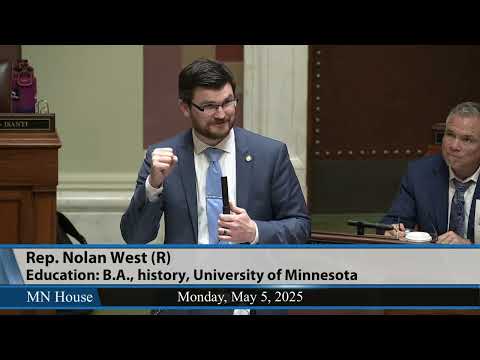
The bill incorporates language from House File 1615 and was taken up with a series of floor amendments. Representative West moved the principal amendment (A1), which sponsors said would allow some medical cannabis licensees broader distribution rights, permit certain hemp manufacturers to produce products for sale outside Minnesota if labeled “not for sale in Minnesota,” and adjust social equity ownership thresholds. Representative Robbins offered and successfully moved an amendment to that amendment intended to limit certain kinds of joint alcohol–cannabis advertising; Robbins summarized that change as, “This amendment just builds on work we did last session to limit advertising of cannabis in different ways.” Both the amendment to the amendment and the underlying A1 amendment were adopted by the House.
Several policy details were highlighted in debate. West said the bill includes a testing variance intended to let laboratories participate while they complete accreditation processes and that the measure “increases the non intoxicating cannabinoid limits for hemp products.” He also referenced state rollout timing, saying “the department announced June 5. Finally gonna have the lottery.” Stevenson and West said those and other adjustments aim to smooth rollout and clarify preapproval and preliminary approval language tied to local zoning and department processes.
Representative Robbins described a separate, withdrawn proposal she had prepared that would have required low‑potency hemp edibles and beverages to be securely stored behind a counter or in locked cabinets; she withdrew it to give retailers and industry “the chance to fix this” but warned she may reintroduce the measure if retail practices do not improve.
Representative Duran (Beltrami) spoke in opposition on third reading, arguing that marijuana remains a Schedule I drug and stating, “there is no therapeutic value to the drug whatsoever.” Duran urged caution about expanding or improving medical cannabis policy while that federal scheduling remains in place.
There was no roll-call vote printed in the transcript for the floor amendments; adoption was announced by voice. The final passage vote on third reading was recorded at 82 ayes and 50 nays, and the clerk announced that “the bill as amended is passed.”
The House will send its version and adopted amendments to conference with the Senate for resolution of outstanding differences. Sponsors indicated additional technical and policy work is expected in conference committee.