Get Full Government Meeting Transcripts, Videos, & Alerts Forever!
Get email alerts on the Subdivision Process Highway Occupancy Permit topic
No spam. Unsubscribe anytime.
Perry County planning commission debates requiring PennDOT HOP recording for county-reviewed subdivisions
Summary
Members of the Perry County Planning Commission discussed proposed language requiring applicants to record PennDOT highway occupancy permits (HOPs) in the county courthouse for subdivisions the county reviews, and debated conditional approvals, implementation mechanics and municipal responsibilities.
Perry County planning staff and commission members debated whether subdivision approvals under the county’s subdivision and land development ordinance should require applicants to record PennDOT highway occupancy permits (HOPs) in the county deed office.
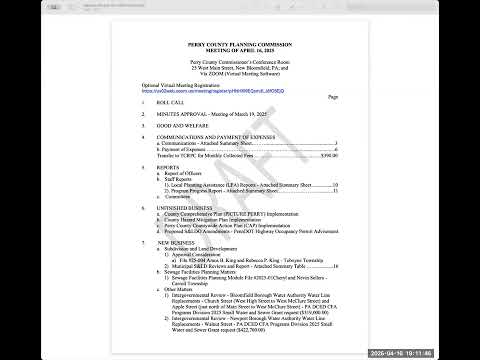
The commission heard a sustained discussion during the meeting’s unfinished business about inserting a note into the county SALDO that would require, for plats the county reviews, that applicants record the HOP in the county register or recorder’s office and provide the HOP number to county staff before final recording. County staff said the note is intended to ensure municipalities and the county have a permanent record of PennDOT approvals tied to parcel PINs. Staff also reported there is a $50 administrative step in the county process tied to obtaining a copy of an approved HOP for file purposes.
Commission members pressed staff on implementation details. Several members raised a circularity problem: PennDOT historically has issued an HOP to a property owner, but in many cases a deed or plan cannot be formally recorded until municipal or county recording requirements are met. Commissioners asked whether PennDOT will issue HOPs to a landowner who retains title after subdivision or whether the permit is issued only to a recorded owner. Staff said PennDOT’s policy on that point has changed in recent years and differs by district, and recommended getting direct input from PennDOT district staff before finalizing the note.
The commission discussed alternatives to a hard recording requirement. Staff outlined a practical approach staff has used in prior years: condition final plat approval on receipt of the HOP number, allow conditional approval to stand while the applicant obtains the HOP, and then require the applicant to re-record the plat with the HOP number once PennDOT issues it. Commissioners debated whether a conditional-then-rerecording approach is workable in practice and whether it disadvantages developers by delaying lot sales.
Members also discussed the county’s role relative to seven municipalities that still rely on county land development review. Staff said the proposed language should apply only where the county retains land development review authority; once a municipality adopts its own land development ordinance and takes over review, the county would no longer expect a recorded HOP for that parcel. The commission asked staff to craft wording that (1) applies to parcels under county purview, (2) notifies the affected municipality when an HOP is recorded, and (3) clarifies enforcement and timing expectations.
Staff recommended seeking guidance from PennDOT district staff on whether the district will issue HOPs to owners who have not yet recorded a subdivision or whether PennDOT’s current practice will require any change to county procedure. The commission agreed to table the SALDO language change and asked staff to solicit input from PennDOT and the county solicitor before taking further action.
The commission did not adopt final language or a formal amendment at the meeting; members reached consensus only to pursue clarification from PennDOT and the solicitor and to return with revised wording.