Get Full Government Meeting Transcripts, Videos, & Alerts Forever!
Get email alerts on the Short Term Rentals topic
No spam. Unsubscribe anytime.
West Fargo commission sends short-term rental ordinance back for March-version rewrite after split vote
Summary
The West Fargo City Commission on a split vote directed staff to return for another first reading the March 2025 version of a proposed short‑term rental ordinance with added language on repeat violations and mailed neighbor notice.
The West Fargo City Commission on a split vote directed staff to return for another first reading the March 2025 version of a proposed short‑term rental (STR) ordinance, after a public hearing and more than an hour of questions from commissioners.
The commission’s action, passed 3–2, instructed staff to bring back the March 2025 draft with two clarifications the commission asked to keep: (1) a 12‑month rolling window for counting repeat violations and (2) a requirement that city staff mail a notice to property owners within 150 feet after a license is issued. The motion did not adopt the current Planning & Zoning Commission version; an earlier motion to approve that version on first reading failed for lack of a second.
The proposed ordinance would require annual city licensing for any short‑term rental of a residential dwelling and set minimum operational standards. Aaron Nelson, the city’s director of planning and zoning, told the commission the licensing application would require verification of ownership, proof of liability insurance, confirmation of compliance with state and local lodging and sales taxes, designation of a local contact who can respond within two hours, an on‑site safety inspection and notification of neighboring property owners. Standard city nuisance, noise, snow‑removal and property‑maintenance rules would apply, and violations would be treated as infractions with escalating fines on a rolling 12‑month basis and possible suspension or revocation of the license; denials and revocations would be appealable to the City Commission.
Nelson said the Planning & Zoning Commission recommended approval of the current (April) draft by a 6–1 vote after removing an earlier primary‑residence requirement; that earlier requirement would have limited STRs to dwellings occupied as the owner’s primary residence for more than half the year. Nelson told the commission staff still intends to set licensing fees by resolution and recommended a delayed effective date of at least four months after final adoption so staff can establish internal processes.
Public commenters urged opposite outcomes. Tyler Erickson, a West Fargo resident who addressed the commission during the public hearing, supported the March 2025 draft that included the primary‑residence limitation. Erickson argued that limiting STRs to owners’ primary residences helps preserve the residential character of neighborhoods, prevents “incompatible commercial use of a residential property” and aligns STR regulation with how the city treats other accessory, incidental home uses such as home daycares and home occupations. Another resident, who identified himself as living at 2421 Cloud Drive East, opposed the March version on the grounds that converting residential neighborhoods to commercial use would harm local residents.
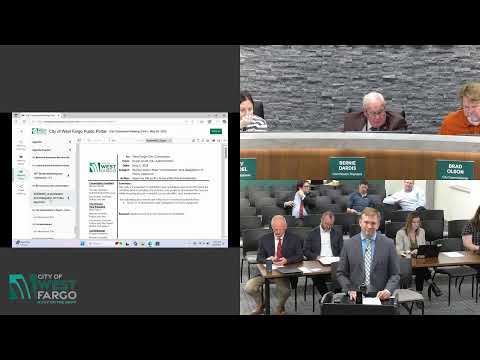
Commissioners debated enforcement and scope. Commissioner Zundel asked how neighbor notification would work; Nelson said staff would mail notices to property owners within a 150‑foot radius after a license is issued and would use media outreach if the commission adopts the ordinance to notify the public about the licensing timeline. Commissioner Olson raised enforcement questions about operators who do not obtain a license; Nelson said the ordinance contemplates a 30‑day compliance period after discovery and notice, after which staff would treat continued operation without a license as a violation subject to the staged fines. The dollar amounts discussed on screen during the meeting were $250 for a first offense, $500 for a second and $1,000 for a third, measured using the rolling 12‑month window. Nelson deferred legal recourse beyond fines to the city attorney for specifics.
Commissioners also discussed grandfathering options for existing operators, noise monitoring as a potential license condition and the practical difficulty of identifying unlicensed operators until they are reported or otherwise discovered. Nelson said staff can identify applicants who voluntarily apply for a license; otherwise discovery depends on complaints or investigation.
Action: The commission voted to direct staff to return the March 2025 version of the STR ordinance for first reading with two additions (12‑month rolling violation window and mailed neighbor notification within 150 feet). The motion passed 3–2. The commission did not adopt the Planning & Zoning‑recommended version on first reading; an earlier motion to approve that version failed for lack of a second.
Why it matters: The commission’s choice between the March and April drafts determines whether STRs may be operated year‑round as commercial investments in residential zones or are limited to owners’ primary residences. The decision affects neighborhood character, enforcement needs and which properties will be eligible for city licensing and related tax collection.
What’s next: Staff will return the March 2025 draft, amended to include the rolling violation window and neighbor‑notification language, for another first reading and public hearing before the commission takes final action.