Get Full Government Meeting Transcripts, Videos, & Alerts Forever!
Get email alerts on the Airport Infrastructure topic
No spam. Unsubscribe anytime.
Redmond Airport outlines $180 million terminal expansion, steady passenger growth and staffing challenges
Summary
Redmond Airport Director Zach Bash briefed BDAB on passenger growth, a new $180 million terminal project, funding sources including a Connect Oregon grant and airport revenue bonds, and air-service recruitment priorities.
Zach Bash, director of the Redmond Airport, told the advisory board that the airport will start construction on a terminal expansion within weeks and that the project totals about $180 million, funded through airport revenue bonds, federal grants and roughly $40 million in airport cash.
“The Redmond Municipal Airport is completely self-sustaining,” Bash said, noting the airport does not draw city general-fund dollars for operations and that most revenue comes from commercial traffic, parking, concessions and contractual fees.
Project and service overview
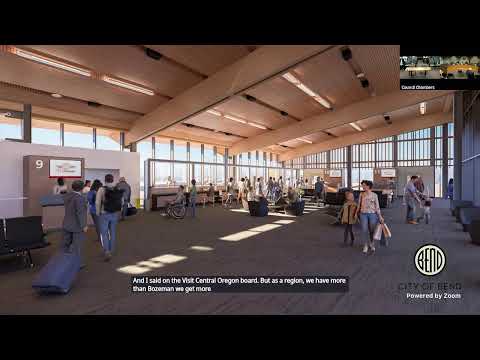
Bash said construction will add a new concourse with seven jet bridges, new concessions and roughly 850 additional waiting-area seats (the airport currently offers about 250). He said the expansion will create about 383 full-time-equivalent construction jobs during the build and estimated a $65 million short-term economic boost from construction activity; once complete, Bash estimated about 207 ongoing jobs and roughly $39 million in annual economic output tied to expanded operations.
Funding and timeline
Bash said the airport will rely on an airport revenue bond (not a general-obligation tax bond), about $10 million from a Connect Oregon grant, and a substantial airport cash contribution amassed over several years. He said construction should finish in 2027 with phased occupancy and that communications about the project will begin this month.
Air service and capacity
The airport reported continuing passenger growth: Bash said Redmond is the third-largest commercial airport in Oregon, has added seven destinations in the last decade and posted roughly 65% passenger growth over 10 years. The facility currently offers about 13 nonstop destinations on five airlines, and Bash said summer seat capacity would increase by about 60,000 seats compared with the prior year and the airport expected to be busier than any previous summer.
Bash also discussed air-traffic-control staffing and irregular operations. The on-site tower is short-staffed: he said the tower is staffed by five controllers currently but is staffed for 11 controllers under FAA planning. The airport has paid retention stipends to controllers to maintain operations, Bash said, and he described coordination with FAA facilities and with a regional Central Oregon air-service recruitment team to attract new routes.
Bash invited board members to schedule tours of airport operations, noting that day-to-day service quality depends on carriers, ground handlers and irregular-operation conditions that the airport does not directly control.