Get Full Government Meeting Transcripts, Videos, & Alerts Forever!
Get email alerts on the Personnel Maintenance topic
No spam. Unsubscribe anytime.
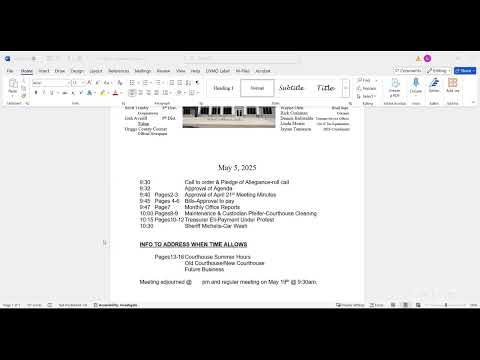
Griggs County discussion to merge courthouse maintenance and housekeeping jobs fails after heated debate
Summary
County commissioners discussed updating the courthouse cleaning schedule and combining maintenance and custodial roles into one full‑time position, citing security and budget considerations. Commissioners debated hours, pay and equipment needs but a motion to merge the two part‑time roles into a single full‑time post failed.
Griggs County commissioners discussed a plan to update the courthouse cleaning schedule and combine the county’s maintenance and housekeeping positions into a single full‑time job, but a motion to implement the change failed after debate.
Supporters said the merged role would centralize building care — daily cleaning, carpet shampooing, window washing, snow removal and light maintenance — and could reduce outside contract costs. Opponents raised concerns about employee impacts, pay equity, liability, on‑site security and whether the county already pays for equivalent hours.
Commission discussion and staff presentations described the proposed job as a 37.5– to 40‑hour week covering both maintenance and custodial duties, with responsibilities that would include mowing, snow removal, minor repairs, managing maintenance contracts, and routine cleaning. Commissioners and staff said the position would likely require equipment purchases (window‑cleaning tools, a carpet shampooer and possibly ladders or scaffolding) and training to operate county equipment such as the Bobcat/Kubota for snow removal.
County staff reported that the two existing positions were structured as 20 hours for maintenance and 20 hours for housekeeping. Participants discussed converting those combined hours into a single 40‑hour position with benefits. During the debate commissioners and staff cited historical wages: in prior pay records cited during discussion Deb’s part‑time housekeeping wage was listed by staff as roughly $22.22–$22.26 per hour and Brian’s maintenance wage as about $21.06 per hour; participants also referenced a combined budget line near $50,555 as a possible salary target for a single full‑time post. Commissioners stressed they would not increase the county’s overall payroll burden if the duties and pay were kept within the existing budgeted amounts, but several said more precise figures were needed before approving the change.
Several staff concerns surfaced in the meeting. Speakers said the current arrangement sometimes left maintenance tasks undone between breakdowns and that having a single, on‑site person could enable preventive work (painting, patching, scheduled carpet cleaning) rather than only reactive repairs. Others said combining duties could reduce opportunities for existing employees and could lead to reduced take‑home pay for current staff if not handled carefully. Commissioners also raised timekeeping and payroll compliance questions: witnesses described that, historically, some maintenance work had been paid by flat rate while other work used time slips; commissioners said hourly timesheets would be required for any merged hourly position and for audit and workforce‑safety records.
The motion to merge the two positions into one full‑time courthouse maintenance/custodial position was made and seconded, discussed at length, and ultimately failed. Commissioners asked staff to return with a more detailed job description, budgeting analysis, and clearer documentation of existing wages and benefits before any future vote.
The discussion also produced an immediate non‑binding administrative decision: commissioners said the updated cleaning schedule itself (daily/weekly/monthly/quarterly tasks and a twice‑annual carpet shampoo) should be finalized and brought forward for approval regardless of whether the positions were merged.
The commission did not adopt a new personnel structure at the meeting and directed staff to prepare more detailed cost estimates, a precise job description, and options that protect current employees’ pay and benefits.